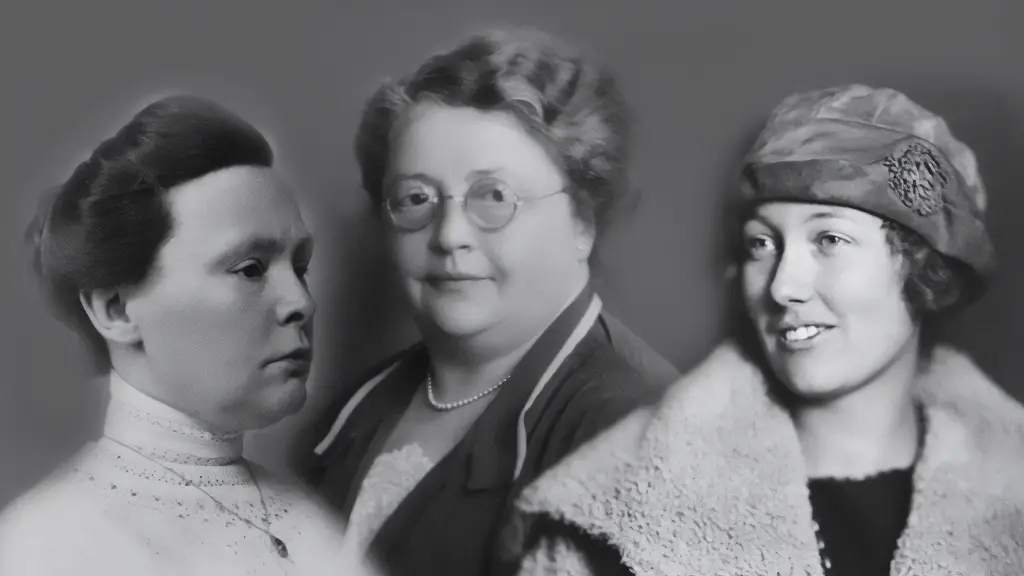
Ninety years ago, three women decided that the history of women's movements should not be lost. Feminists Rosa Manus (1881-1942), Johanna Naber (1859-1941) and Willemijn Posthumus-van der Goot (1897-1989) founded the International Archive for the Women's Movement (IAV) on 3 December 1935. Who were they and how did the establishment of today's Atria, knowledge institute for gender equality and women's history, come about?
Ninety years ago, three women decided that the history of women's movements should not be lost. Feminists Rosa Manus (1881-1942), Johanna Naber (1859-1941) and Willemijn Posthumus-van der Goot (1897-1989) founded the International Archive for the Women's Movement (IAV) on 3 December 1935. Who were they and how did the establishment of today's Atria, knowledge institute for gender equality and women's history, come about?
Previous history
By 1935, the so-called 'first feminist wave' was over and many women who had been active in the women's movements around 1900 were elderly or deceased. The three founders of today's Atria felt that the history of women's movements should be preserved and scholarly research into the position of women in society should be promoted. In addition, young feminists in the 1930s needed well-documented knowledge of the past. For example, to be able to defend themselves against the government, which since the 1920s regularly tried to ban (married) women from gainful employment.
Foundation
After a year of hard work to get the collection up and running, IAV officially saw the light on 19 December 1936 at its opening at Keizersgracht 264, in Amsterdam. IAV initially collected mainly material by and about the white women's movement. Over the years, increasing attention came to include archives of black, migrant and refugee women.
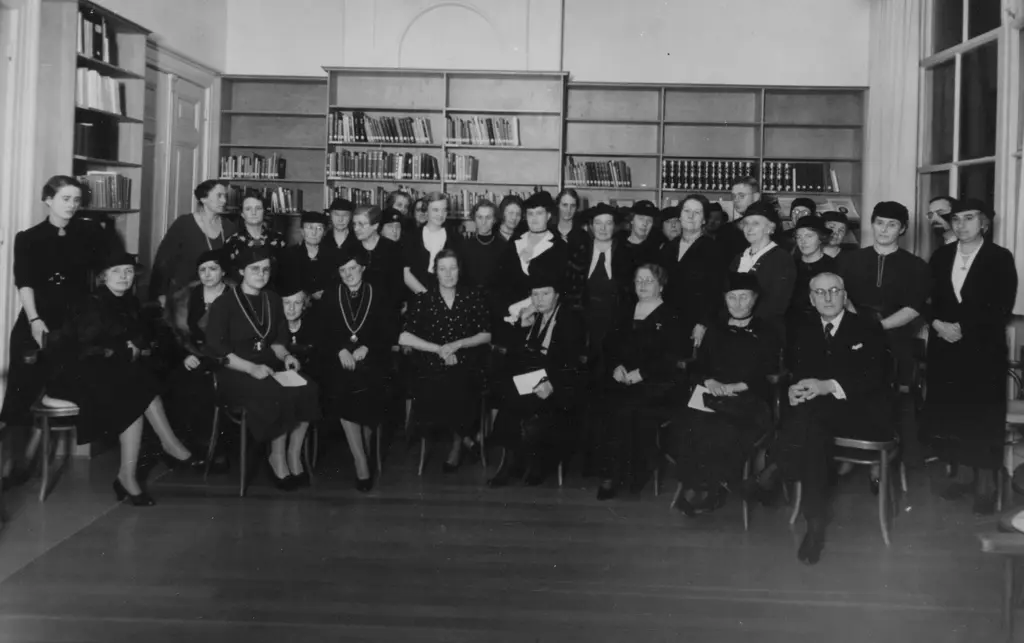
From left to right seated: A. Adama van Scheltema, Mrs Ketelaar van Gogh, three female students Amsterdam-Utrecht, Dr W.H. Posthumus-van der Goot (secretary IAV), Johanna W.A. Naber (founder IAV), Rosa Manus (president IAV), Mathilde Cohen Tervaert-Israels, Prof. N.W. Posthumus (director International Institute of Social History). Staande v.l.n.r.: mej. MacDonald, mevr. Potgieser-Rolandus, mevr. Manus-van Erkom, mevr. van Steenderen-van Houtum, mr. Corry Tendeloo, mej. M. C. Bouwmeester, mej. Jackson, mej. Corrie van der Griendt (adjunct secretaris IAV), mej. B. Ferf (bibliothecaris), mevr. Slingenberg, Ms Vening Meinesz, Mr Frida Katz, Ms Annie Schippers, Ms Douwes Dekker-Jolles, Ms B. Rijkens-Culp (treasurer), Mr Bas Bakker, Ms E.H. Piepers, Ms A.M. Boissevain-van Lennep, Mr Boissevain, Ms Clara Meijers.
Rosa Manus
Starting the collection were three hundred books by founder Rosa Manus herself. Manus came from a liberal Jewish family and, like Aletta Jacobs, played a crucial role in (inter)national women's and peace movements. She served on numerous boards, including the Vereeniging voor Vrouwenkiesrecht and later the International Women's League for Peace and Freedom. A year after the founding of the IAV, she donated the archive - declared a UNESCO heritage site in 2017 - of Aletta Jacobs (1854-1929), the first female doctor in the Netherlands and famous fighter for women's suffrage.
Willemijn Posthumus-van der Goot
Posthumus-van der Goot was the first female economist in the Netherlands. To back up her opinions with facts, she needed good and versatile information on women. She therefore collaborated with Manus and Naber in 1935 to establish the IAV. Posthumus played a crucial role in the relaunch of the IAV after World War II, becoming its president because Rosa Manus (former president) had died in a concentration camp. Posthumus co-authored and edited the book Van moeder op dochter: het aandeel van de vrouw in een veranderende wereld (1948). This contained the history of the Dutch women's movements, from the French era to 1948.
Johanna Naber
Naber was the first to describe the Dutch history of the women's movements. From 1917 to 1922, she was president of the National Women's Council and from there also involved in the International Women's Council. In 1921, she was elected to the Amsterdam city council for the Vrijheidsbond, a liberal party. Through her own historical research, Johanna Naber knew the importance of preserving and making available historical material such as letters and diaries. This must have been the basis for her to proceed, together with Rosa Manus and Willemijn Posthumus-van der Goot, to found the IAV.
The founders of today's Atria were acutely aware of the fragility of previous achievements, such as the introduction of women's suffrage. At a time of economic crisis and rising fascism in Europe, achievements were in danger of being reversed. The purpose of establishing the IAV, to collect and preserve women's heritage and to stimulate scientific research on the position of women, has lost none of its urgency in 2026. As the current collection and knowledge institute Atria, we support policymakers, researchers and other stakeholders to connect historical insights with current issues of women's rights and gender equality.