International Women's Day is celebrated every year on 8 March. How did International Women's Day come about? Which women played a role in it? Curious about how International Women's Day is celebrated in the Netherlands? Every year, Atria produces an overview of events across the country, which is posted online in mid-February.
International Women's Day is celebrated every year on 8 March. How did International Women's Day come about? Which women played a role in it? Curious about how International Women's Day is celebrated in the Netherlands? Every year, Atria produces an overview of events across the country, which is posted online in mid-February.
How did International Women's Day come about?
The origins of International Women's Day are closely linked to the rise of the socialist labour movement in the 19th century. Among other things, this movement demanded universal suffrage. One of the pioneers in the fight for universal suffrage for women was Aletta Jacobs.
The following events marked the beginning of International Women's Day:
1907: First International Socialist Women's Conference - in Stuttgart
German socialist Clara Zetkin had previously written in the women's magazine Die Gleichheit that socialism would be impossible without women. To exert more influence, she founded an international organisation for women, in addition to the already existing Socialist International.
8 March 1908: Demonstration in New York by thousands of women, mostly textile workers
They demonstrated for more pay, shorter working hours, better working conditions and abolition of child labour. In short, the women demanded 'bread and roses'. They were not only concerned with survival, but also the quality of life.
1910: Socialist International - Copenhagen
More than 100 delegates from 16 countries attended. Universal suffrage, as well as the threat of war, social security for women and children, and the high cost of living were on the agenda. Here, Clara Zetkin proposed a new means of struggle: the International Women's Day for universal women's suffrage. The date on which this day was to take place would be set annually.
March 1911: The first International Women's Day
Women's Day was first celebrated internationally in several countries, including Germany, Denmark, Austria, Switzerland and the United States. Not in the Netherlands; the women's organisations here were still too small to organise it.
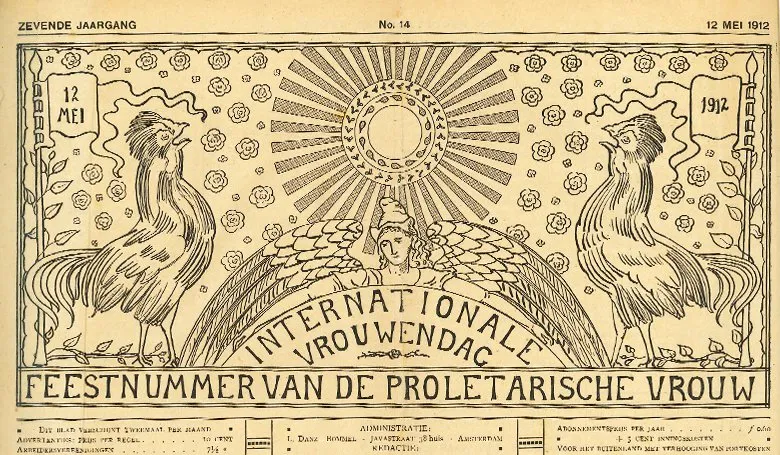
12 May 1912: The first International Women's Day in the Netherlands
The first Dutch Women's Day was organised by the Social Democratic Women's Clubs. Their magazine De Proletarische Vrouw came out with a special celebration issue. The day was dedicated to universal women's suffrage.
1914 - 1918: Women's Day during World War I
World War I broke out in 1914. The international labour movement fell apart, but the international women's organisation continued to exist. An annual Women's Day was also held during the war, with adapted slogans such as 'For Peace' and 'War on War'.
8 March 1917: Women's strike in St Petersburg
Women workers went on strike in Saint Petersburg. As a decade earlier in the United States, it was mainly about poor working conditions. More and more women took part in the strike. They also went on strike against the war and the food shortage. Eventually, it came to a general work strike. This day would later be counted as the beginning of the Russian Revolution.
In 1921, the International Women's Secretariat proposed 8 March as a fixed date to commemorate the events in St Petersburg.
8 March: International Women's Day
1922: First International Women's Day on 8 March
From 1922, mainly communist women celebrated International Women's Day on 8 March. Other women associated the date with the 1908 New York strike. Yet much suggests that the real origin of the March 8 date lies in Russia. Incidentally, Belgium and South Africa still celebrate Women's Day on a different date, namely 11 November and 9 August.
1940s and 1950s: organisation by the Dutch Women's Movement (NVB)
After World War II, there was little interest in International Women's Day in the Netherlands. Only communist women's organisations like the NVB organised themselves on this holiday.
Turbulent 1970s: 'second feminist wave'
In Europe and the United States, interest in International Women's Day revived. Culminating in 1975, when the United Nations had declared the International Year of Women. Three years later, the United Nations recognised 8 March as the official International Women's Day.
International Women's Day Now
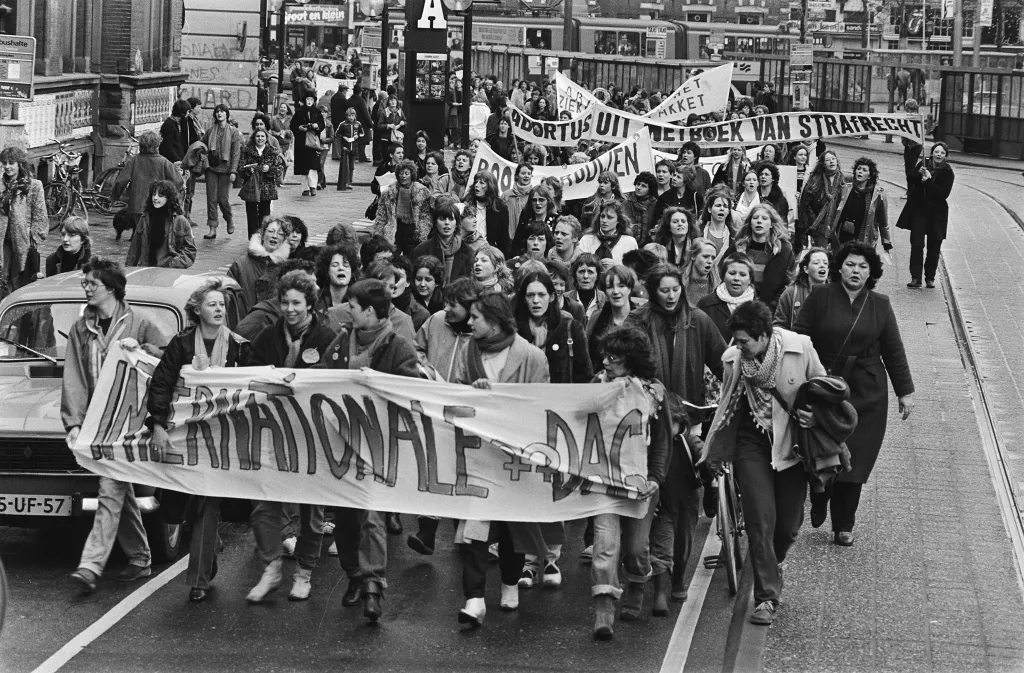
In the Netherlands today, 8 March is celebrated in many different ways and by a wide variety of (women's) organisations. There are lectures, symposia, festivals, workshops, trainings, debates, tours and demonstrations in which everyone can participate. The aim is to draw attention to important themes such as equal rights of all women and non-binary persons, inclusiveness, a safe working environment, the role of men within gender equality. In recent years, many cultural institutions also organise all kinds of events where female pioneers from history are put in the spotlight.
Did you know?
The celebration of International Women's Day varies by country. With the outlier being Russia. There, it is an official day off for men and women reminiscent of Dutch Mother's Day. It is meant as a tribute to all women. For example, schoolboys give a gift to their teacher and a gift to the girls in their class.
Some of the pioneers who played a role in the birth of International Women's Day
Clara Zetkin (1857-1933)
Clara Zetkin was a German feminist and revolutionary. While training as a teacher with the feminist Augusta Schmidt, she came across socialist ideas. She joined the Social Democratic Party in 1881. From the beginning, she championed women's issues. She saw it as part of the class struggle. Zetkin initiated a socialist women's movement, gave lectures and edited the socialist women's magazine Die Gleichheit from 1892 to 1916.
As one of the few social democrats, she opposed World War One. Her growing dissatisfaction led to a break with the socialists. In 1916, together with Rosa Luxemburg and Karl Liebknecht, she formed the revolutionary Spartakusbund, which became the Kommunistische Partei Deutschland after the revolution in Russia. Zetkin was also president of the International Women's Secretariat. From 1920 to 1932, she was a member of the Reichstag for the Communists.
Aleksandra Kollontaj (1872-1952)
Aleksandra Kollontaj was a Russian revolutionary and politician. She came from an aristocratic liberal general family, but broke with her milieu and became a Marxist. Kollontaj was always committed to the women's struggle within socialism. In Lenin's government, she was the only woman; she was People's Commissar of Social Affairs. There she was able to champion maternity leave, divorce and the legalisation of abortion. She also propagated companion love without marriage, sexual freedom and a common, socialist education for children. Her views were considered too radical by her (male) party colleagues. In 1923, she was therefore sent away as envoy to Norway and later to Mexico. Later in life, she became ambassador to Sweden.
Aletta Jacobs (1854 -1929)
Aletta Jacobs spoke about an International Women's Day back in 1901. This was at a Peace Demonstration of a number of associations, on 18 May 1901. Here, she commemorated the International Peace Conference that had opened two years earlier in The Hague on 18 May. And she suggested that 18 May should henceforth be regarded and celebrated as an 'international women's day'. More information about Aletta Jacobs.