Anyone who hears the name Aletta Jacobs thinks of the first female doctor and women's suffrage. Her name appears on schools, streets and awards. But the core of her struggle lies in boxes and letters, carefully preserved at Atria, Institute on Gender Equality and Women's History. There lies the story of a woman who spent her life, in the Netherlands and abroad, fighting for women's rights and against the double standards of her time.
Anyone who hears the name Aletta Jacobs thinks of the first female doctor and women's suffrage. Her name appears on schools, streets and awards. But the core of her struggle lies in boxes and letters, carefully preserved at Atria, Institute on Gender Equality and Women's History. There lies the story of a woman who spent her life, in the Netherlands and abroad, fighting for women's rights and against the double standards of her time.
During World War II, the Germans looted much of Aletta Jacobs' archive. Part of it ended up in Moscow and did not return to the Netherlands until sixtiy years later, in 2003. Since 2017, the archive has been part of the UNESCO Memory of the World register; a recognition that this is not one human life, but many. But who was Aletta Jacobs? And what did she mean to the Netherlands and the world?
A girl with an impossible dream
Aletta Henriëtte Jacobs was born on February 9 1854 in Sappemeer, Groningen, to a progressive Jewish family where learning was not a male privilege. Her father, general practitioner Abraham Jacobs, and mother Anna de Jongh raised their daughters and sons in the same way. But Aletta's ambition was exceptional: like her father, she wanted to become a doctor.
In nineteenth-century Holland, that was as revolutionary as it was impossible. Universities were the domain of men. So Jacobs was sent to the young women's school, where she lasted less than two weeks. Every day she became quieter and more listless.
"After all, I'm not allowed to become anything because I'm a girl!"
She had to and would find another way.
With her father's support, she studied Greek and Latin, graduated as an apprentice pharmacist at sixteen and then wrote a letter that would make history: a request to liberal minister Thorbecke for admission to university. A groundbreaking and, at the time, controversial move, as universities were then completely closed to women. The letter led to a decision that made headlines; on 20 April 1871, Aletta Jacobs became one of the first women - alongside Anna Maria van Schurman - to be officially allowed to study at a Dutch university.
The criticism was merciless. Newspapers mocked her ambition and one of her brothers even declared her dead out of shame. Learned girls, according to prevailing views, would turn into 'man-wives' and neglect their 'natural' role in the home and family. Yet Jacobs persevered; her perseverance overcame every moment of discouragement. In 1878, she passed the medical exam and in 1879, she was promoted to doctor of medicine; the first woman in the Netherlands to do so. And all this at twenty-five. She had, her proud father said in a poem, "ascended the highest step as a woman."
The doctor of the pessary: struggle against hypocrisy and taboos
Jacobs established herself as a general practitioner in Amsterdam, on the Herengracht. Again, people tried to push her back to the margins, but Jacobs did not allow herself to be intimidated easily. Once, the husband of a cured patient complained about the bill, because it was as high as that of a male doctor. Wise, she replied, "When Mrs Your spouse was indeed seriously ill, did you seek inferior and therefore cheap help for her? I suspect that you were primarily concerned with good help."
She treated the wealthy as well as the poorest. For fourteen years and as many as twice a week, she held free consulting hours in the Jordaan (district in Amsterdam) for women who had no money for care. What she saw there touched her deeply: "Women who gave birth to nothing but languishing or lifeless children, as well as those for whom each new birth meant a new struggle with death."
In 1882, she therefore introduced the pessary as a contraceptive, just developed by German doctor Mensinga. Whereas the pessary had previously been used to support prolapsed uteruses, Jacobs gave it a new, revolutionary function. She called it "a means of random motherhood," offering women direct control over their own fertility for the first time in history. Very groundbreaking, as contraception was taboo and socially forbidden at the time. For a long time, the pessary remained the most reliable contraceptive in the Netherlands. No less than until the 1960s, when the contraceptive pill was on the rise.
In the meantime, it received fierce criticism and was accused of immorality. It was considered indecent for a woman to talk about her own body. Hypocrisy did not escape Jacobs either. Preachers who publicly warned against contraception silently sent their wives to her consulting room. And doctors who publicly reviled her came to her for advice in secret.
Her influence reached far beyond the Netherlands. In her archive at Atria are dozens of letters from women from America and Canada, written in 1920. They asked Jacobs for help, advice and information. She was also seen as an authority on women's health at the London (1922) and New York (1925) international congresses on birth control. With her book De vrouw, haar bouw en haar inwendige organen (The Woman, Her Construction and Her Internal Organs) (1899), she made knowledge about the female body accessible. It was intended not only to educate women, but also to show the medical profession that the female body was not 'too weak' for labour.
It also fought against the double sexual morality of the time. The prevailing view was that prostitution was 'necessary' for male health. Jacobs abhorred that idea. She argued that men did not get sick from abstinence, but from hypocrisy. When a professor claimed that prostitution was a biological necessity, she replied sharply, "If that is really your opinion, you are morally obliged to make your daughters available for this purpose."
Love, loss and the long road to women's suffrage
In her personal life, Jacobs found friendship and love with Carel Victor Gerritsen; a feminist and politician. They initially lived together without marrying - a scandalous act at the time. Nevertheless, they later married in 1892 for practical reasons, as they wanted a child. However, their infant son died at birth, in 1893, which Jacobs and Gerritsen experienced as a trauma. To cope with the loss, Jacobs temporarily withdrew and ceased her activist work.
The fight for women's suffrage gave her new direction. In 1883, her request to be placed on the Amsterdam electoral list was rejected; politics was now the domain of men. The constitutional reform of 1887 explicitly confirmed this idea by formally excluding women from the right to vote. Jacobs' determination grew, however. Sometime after the death of Jacobs's son, she began to advocate more and more for women's suffrage. So much so, in 1894, that she founded the Vereeniging voor Vrouwenkiesrecht together with feminist and politician Wilhelmina Drucker, among others. She became president of the Amsterdam branch and the face of the women's suffrage movement.
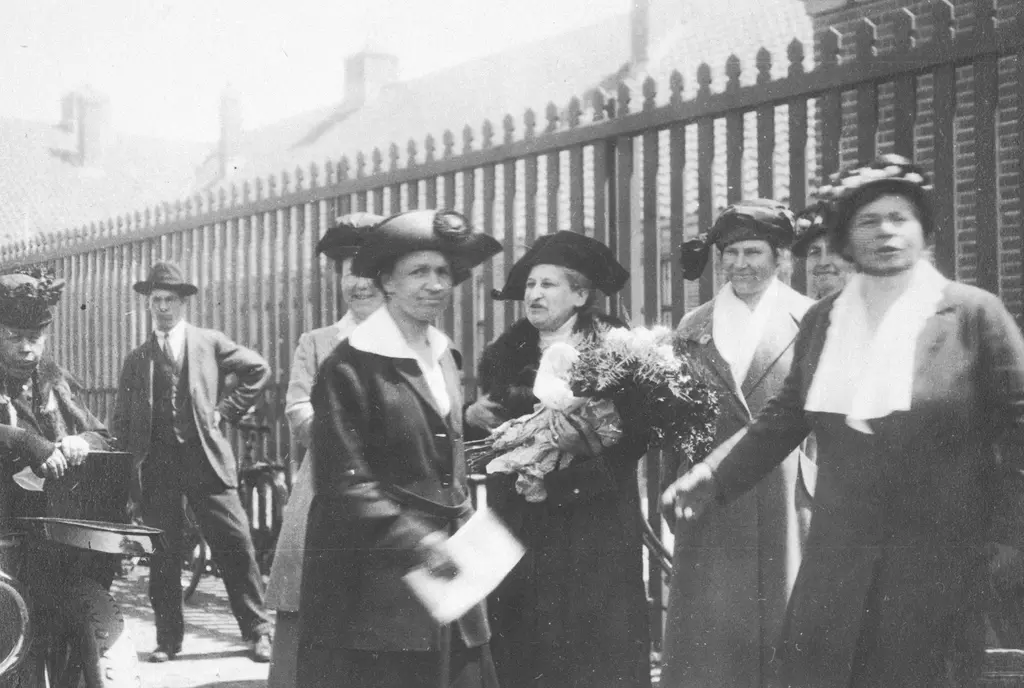
For years, she toured the country, giving lectures and organising demonstrations. After decades of struggle, the turning point came: partly thanks to Jacobs, women in the Netherlands were given the right to stand for election in 1917, and two years later also the right to vote. On 5 July 1922, Jacobs cast her first vote. "Laden with flowers that grateful women had offered me at the entrance to the polling station," she wrote, "I was able to throw my first ballot paper in the bus."
Around the world: the limits of Jacobs' gaze
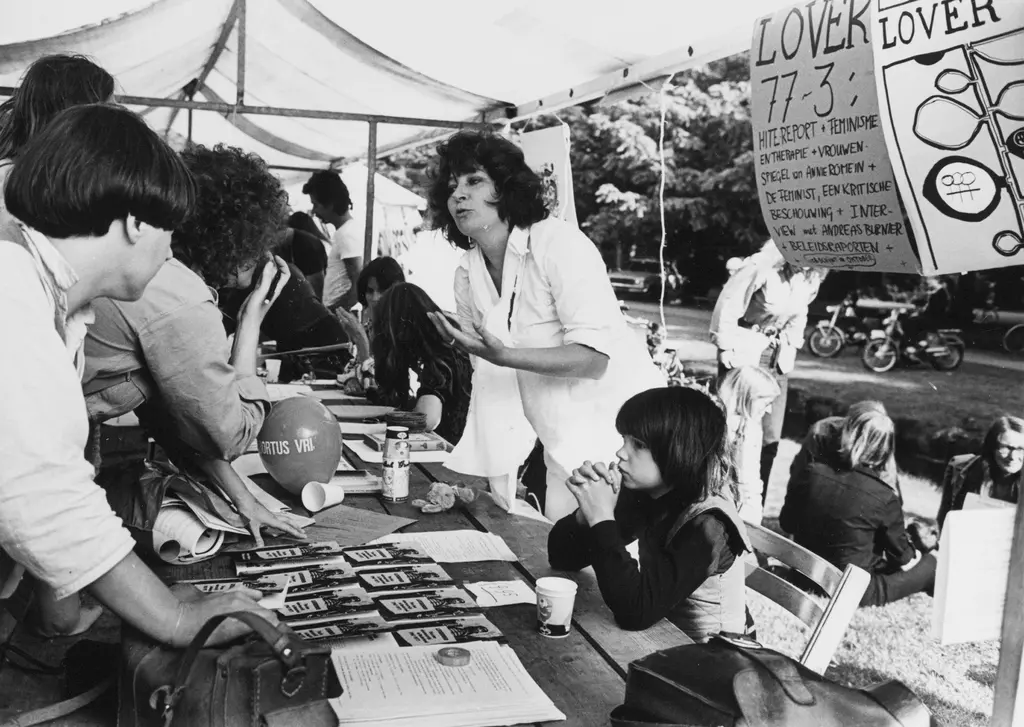
Jacobs also worked with the International Women Suffrage Alliance. In 1911 and 1912, she travelled with US president Carrie Chapman Catt to South Africa and the Dutch East Indies, among others, to promote women's suffrage. Jacobs recorded her impressions in letters, published in 1913 as Reisbrieven uit Afrika en Azië (Travel Letters from Africa and Asia). Ena Jansen, who wrote a piece on this for Lover magazine, found that this echoes Jacobs' fascination with other cultures, but also something that falters: her colonial outlook.
Jacobs' letters show how she was both a committed feminist and pioneer of women's rights, and someone who simultaneously perpetuated oppressive ideas and systems. In South Africa, for instance, she frequently noted observations about "race" and "racial purity." Jacobs described people of mixed descent as "social problems" who needed "special treatment" before they could be "assimilated into society".
In the small Karoo village of De Aar in South Africa, she met South African writer and thinker Olive Schreiner, who was fiercely committed to equal rights for all, regardless of race or gender. Jacobs' notes show that she did not adopt Schreiner's views on broader political rights for indigenous peoples. Her main focus was on voting rights for white, South African women. So while Jacobs did advocate for women's suffrage, her struggle focused only on a limited group.
In the Dutch East Indies, it is notable that Jacobs spoke of "our natives" and took the colonial structure for granted. She spoke in favour of Dutch tutelage: the Javanese and Malaysians had to learn to consider themselves "first and foremost Dutchmen." Self-determination was not an issue for her. Thus, at one suffrage meeting, Jacobs interpreted the presence of Javanese women as a sign of solidarity with women and women's suffrage in the Netherlands, not as an expression of their own desire for independence.
True to the end
Jacobs remained true to her convictions until the end of her life. When she died in 1929 at the age of 75, she opted - again against the spirit of the times - for cremation. Today, her legacy lives on. The Aletta Jacob Prize, awarded biennially by the University of Groningen, honours women who are pioneers in the field of gender equality.
The recognition of her archive as a UNESCO World Heritage Site - along with the work of only four other women - also highlights its value to world history. As Jacobs herself wrote, just before her death in 1928:
"We have completed our task and we can leave the world in the belief that we are leaving it in better condition than we found it."
Although Aletta Jacobs' feminist vision also sometimes perpetuated oppressive ideas, her legacy remains inspiring on many levels. She is proof that progress begins with one person refusing to acquiesce to inequality.