Atria's collection features an unusual garment. The trousers printed '10 years of LOVER' were used to promote the magazine.
Atria's collection features an unusual garment. The trousers printed '10 years of LOVER' were used to promote the magazine.
Ten years of LOVER
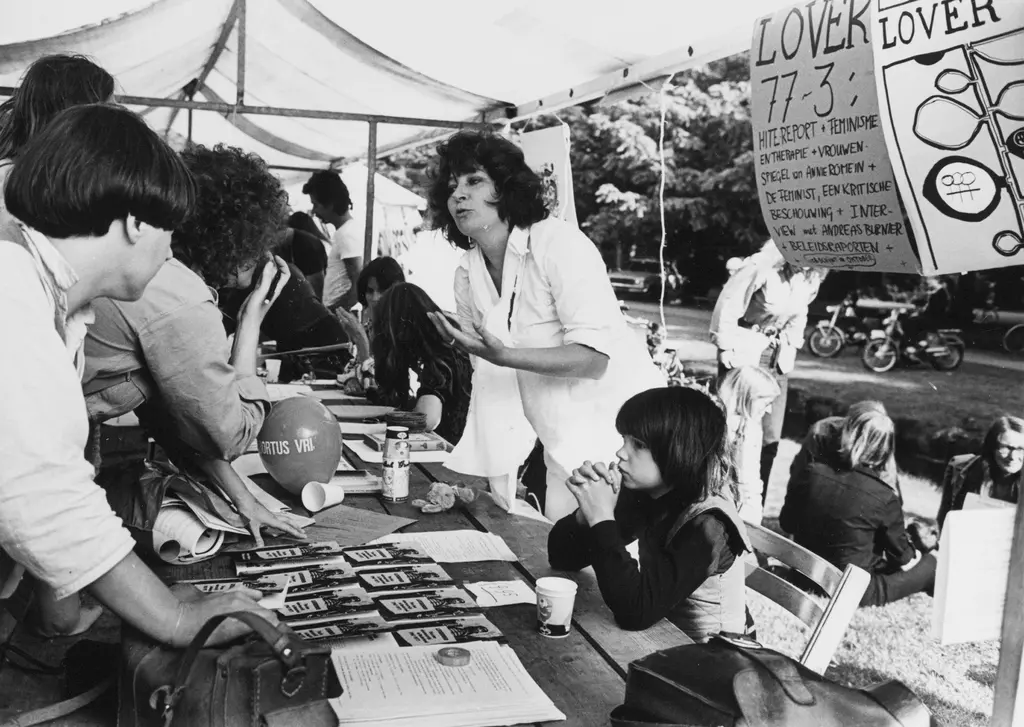
'10 years of LOVER' is printed in big blue letters on these white trousers. The trousers were probably used in the shop window of Athenaeum News Centre to promote LOVER in 1984. LOVER was published quarterly since 1974. The name LOVER (pronounced Lóóver) is an abbreviation of the word LiteratuurOVERzicht (Bibliography). The magazine aims to bring together all published national and international literature of the women's movements in an orderly manner and make it findable.
In 1974, LOVER first appeared as a supplement to the MVM Newsletter. After being published twice as a supplement, it launched as an independent journal in the same year. With a few exceptions, the editorial team consists of volunteers and mostly all women.
Journals, alerts and texts
From the beginning, the choice was made to divide the magazine into three clear sections. The colophon of one of the first LOVERs shows what those sections meant:
Texts: reviews of important publications, literature reviews, "Side Science"
Notices: classified mentions of new publications
Magazine reviews: table of contents of national and international magazines important for the women's movement and listing of relevant articles from Dutch opinion magazines
With the large increase in feminist literature, a magazine like LOVER was very welcome. This was reflected in subscription numbers, which grew rapidly in the early years.
LOVER ten years
LOVER' s tenth anniversary was celebrated with a photo exhibition Ten Years of LOVER at Keizersgracht 10, the building in Amsterdam where LOVER had been based since 1981 together with the IAV, IDC, COC (Van Leeuwen Library) and SVBK. In honour of the anniversary, a 'double-thick' anniversary issue was published, for which Robertine Romeny wrote an extensive piece entitled Passionately, thoroughly. Ten years of texts policy. In it, she describes LOVER 's desire to highlight various currents of feminism. Yet no single current prevailed.
"All currents were taken seriously. On the contrary, we wanted to get rid of norms and patterns, so a normative feminism was reprehensible."
That principle does not seem to have changed in the ten years of LOVER's existence. However, the editors do note that there are many more publications to write about.
"If there was a thesis, we were so happy that above a jubilant review the headline was "about an excellent thesis" (74/3), whereas now you drown in theses."
LOVER then and now
LOVER 's tenth anniversary is followed by many anniversaries. Besides its function as an 'overview' of publications on women and feminist topics, LOVER also paved a way for inexperienced authors and researchers. They could gain experience in publishing their texts in LOVER. At the time of the 10th anniversary, the supply of publications and titles was apparently very large. In that respect, not much changed after 1984, but the demand for a paper literature review became less and less. In terms of content, the magazine therefore changed over time, focusing more on current debates and feminist scholarship. Despite this, LOVER has currently been around for more than 40 years. Since 2011, LOVER has gone fully digital.
Find out more about LOVER
Besides these special trousers, Atria has other LOVER collection items in its archive and library. All journals can be consulted in Atria's library. Using the paper issues of LOVER between 1974 and 2011, the magazine's development can be followed closely. In addition, the LOVER archive is also available at Atria. In it, developments of LOVER as an organisation can be traced.
Tip for researchers
If you are looking for information on individuals and organisations, also search our object collection. Atria not only has books, magazines and archives, but also many objects that have played an important role in feminist propaganda. For example, buttons and banners.