In the 1960s and 1970s, Dutch companies were eager for workers from Morocco and Turkey, among others. However, many guest workers face discrimination in society. In 1975, a group of Turkish women decided to unite in Hollanda Türkiye Kadinlar Birligi (HTKB), the first national Turkish women's association in the Netherlands, to stand up for their interests. What is their story?
In the 1960s and 1970s, Dutch companies were eager for workers from Morocco and Turkey, among others. However, many guest workers face discrimination in society. In 1975, a group of Turkish women decided to unite in Hollanda Türkiye Kadinlar Birligi (HTKB), the first national Turkish women's association in the Netherlands, to stand up for their interests. What is their story?
New workers from Spain, former Yugoslavia, Morocco and Turkey, among others, were initially welcomed with much gratitude from the 1960s onwards. Until 1980, the policy of the Dutch government focused on the idea that migrants present would one day return. In the 1970s, family reunification was therefore made very difficult. The woman's residence permit expired if her husband returned to his homeland or divorced his wife within three years of the certificate being issued. In that case, the woman would be obliged to leave the Netherlands. Thanks to this government policy, migrant women became completely dependent on their husbands. They could not apply for an independent residence permit themselves until they could prove that they had lived in the Netherlands for three consecutive years. Only if the women already held a work permit were they entitled to a residence permit without further ado.
HTKB
One of the founders of the Turkish Women's Association Hollanda Türkiye Kadinlar Birligi (HTKB) was Maviye Karaman: at the time, together with her husband, the face of the progressive Turkish labour movement HTIB in the Netherlands. Although that association was then open to women's membership, Karaman believed a separate women's organisation should be set up for them. So it happened. From then on, the HTKB not only campaigned for gender equality, but also for class equality and against racism. Their goal: to show solidarity with the democratic movement and population in Turkey and to make Turkish women aware of their position.
On strike
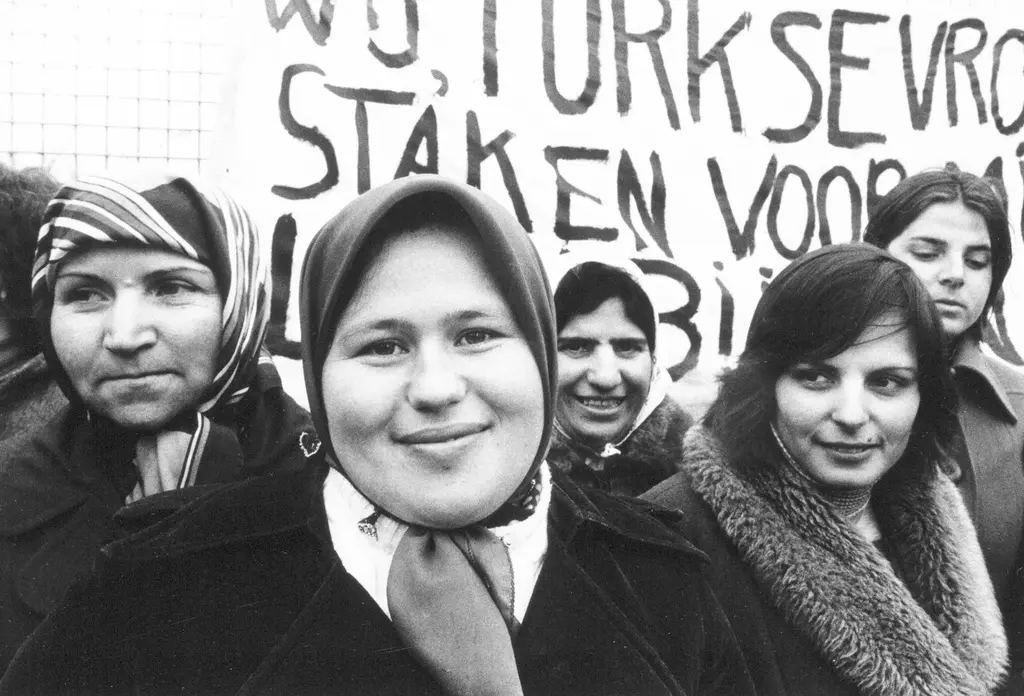
Together we are stronger, Turkish women note. In 1978, Bertien van Manen records the first strike of Turkish women in the Netherlands at a chicken slaughterhouse in Almelo. The women revolted because of poor working conditions. They get physical complaints because they have to remove the red-hot chicken meat from bones with their hands, work 80 hours a week and are underpaid. All the women register with the union during the strike. The picture reminds us of an underexposed history: not only men but also the first generation of Turkish women in the Netherlands worked hard for a living.
Mutual respect
From the outset, the HTKB networked extensively with other feminist groups. However, cooperation with Dutch women's organisations was difficult. Turkish women, for example, did not feel supported in their fight for independent residence permits for foreign women. This was seen as a problem for foreign organisations 'That is unequal,' HTKB chair Maviye Karaman argued in 1986. After all, many migrants had now settled permanently in the Netherlands. Maviye Karaman in 1986 (De Waarheid, 30 May): 'We should also make joint programmes under equal conditions. Mutual respect is a prerequisite and fighting prejudice against migrants and fighting for equal rights should be seen by Dutch organisations not only as their problem but also their duty'.
Colour in the women's movement
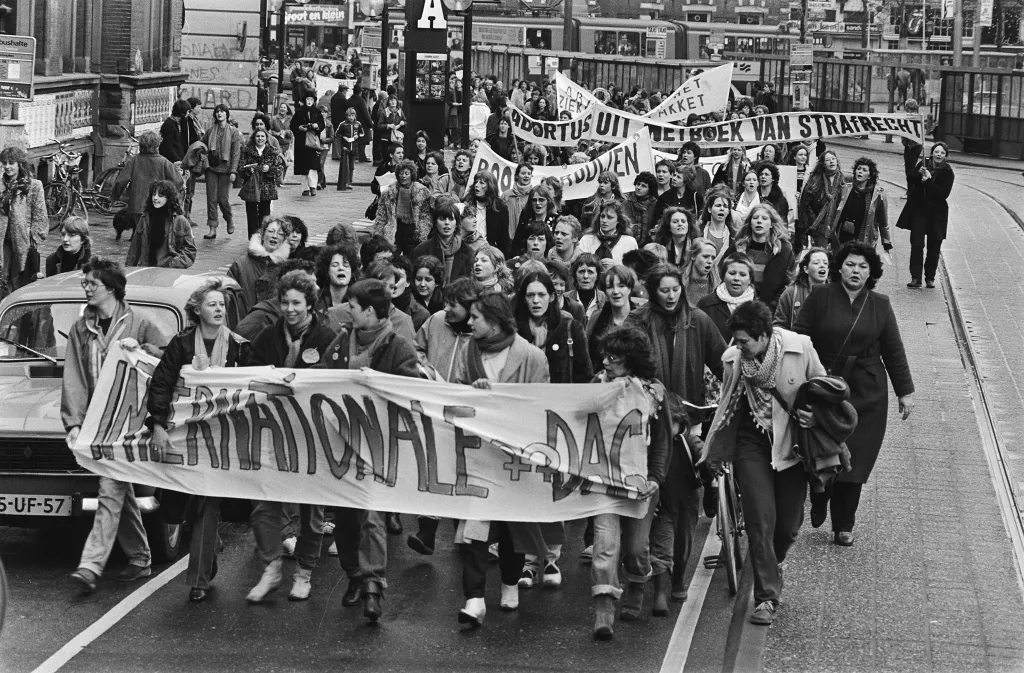
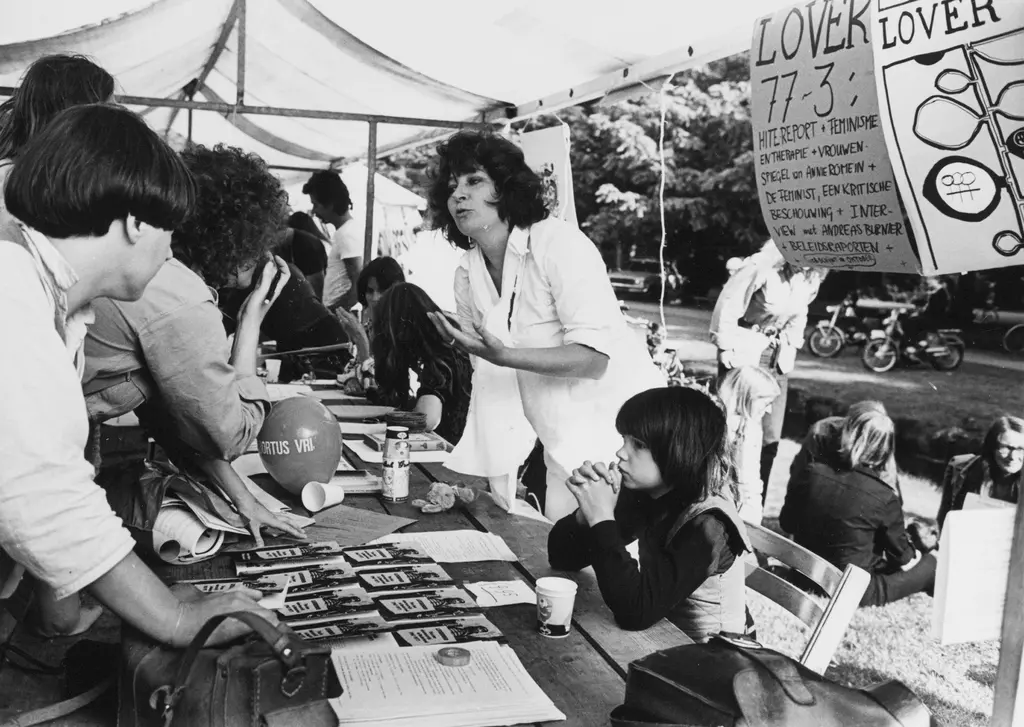
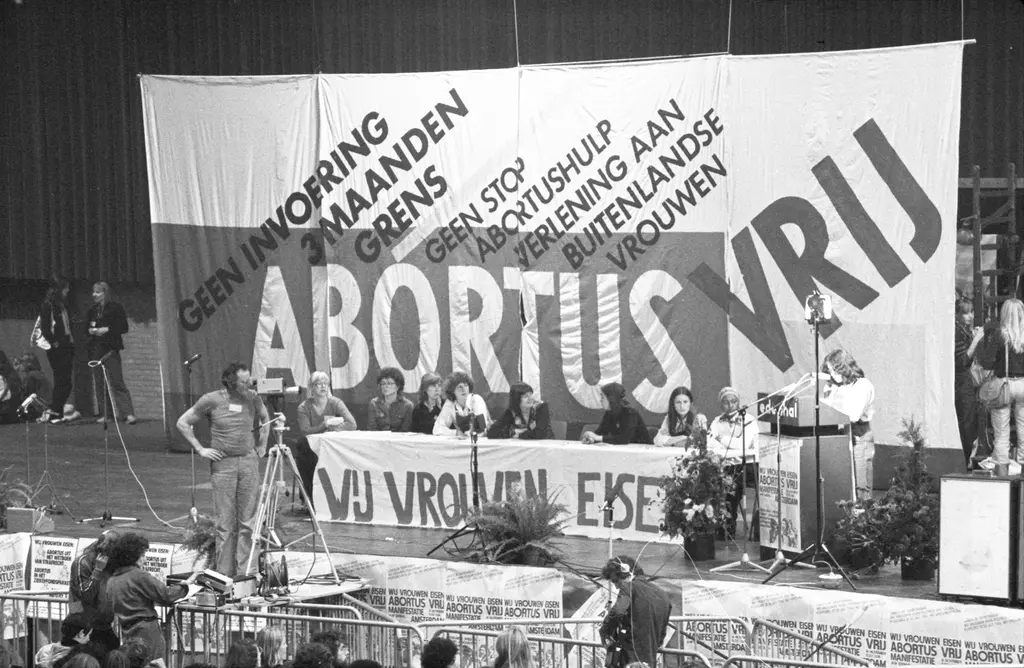
Women of colour face both racism and sexism in the Netherlands in the 1970s and 1980s. Within the mainstream women's movement, they hardly have a voice. Black women and women of colour therefore set up new groups under the umbrella Black, Migrant and Refugee Women's Movement to claim their place in society. Women, such as the Turkish women of the HTKB, organised numerous activities.
They set up centres, printed their own newspapers and newsletters and published reports on Black Women's Radio. They were at the forefront of the social debate on feminism, gender and ethnicity in the Netherlands. Thus HTKB president Maviye Karaman said in 1986:
"A common struggle is possible only on equal terms. Conversely, we expect true solidarity, free from any kind of prejudice, from women's organisations of political parties, trade unions and women's organisations in the struggles we are to wage in all spheres of life."
Neighbourhood house meetings HTKB
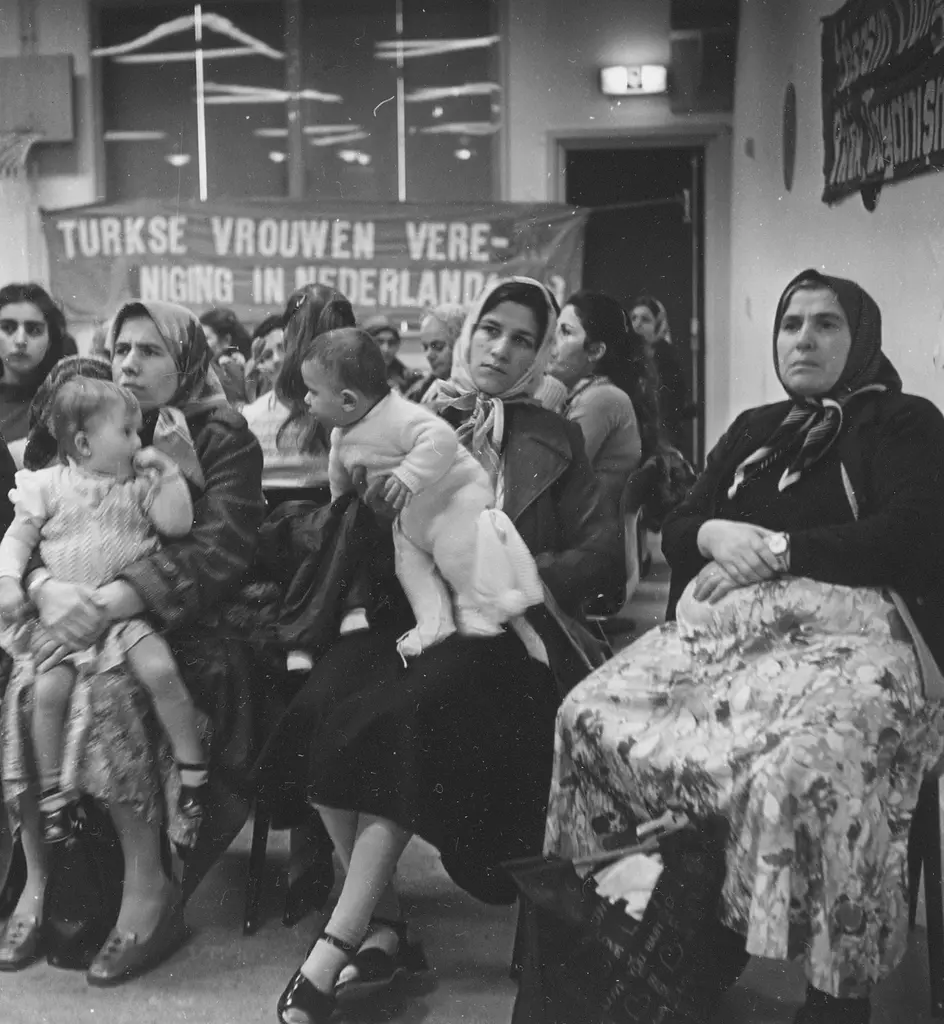
During HTKB meetings, the women discussed their common problems. This gradually created a systematic picture of the inequalities these women faced. Therefore, the association also took up advocacy and tried to influence the policies of municipalities or central government towards 'their' women. This photo shows a meeting of the HTKB at community centre Oosterhonk in Oosterpark in Amsterdam.
In solidarity
The Turkish Women's Association also publishes a bilingual newspaper: the Kadinlarin Birligi (Turkish Women's Newspaper). The newspaper covers a variety of topics, including discrimination in the Dutch labour market, gender equality and racism, and solidarity with politically persecuted women in Turkey. HTKB also supports the democratic movement in Turkey; the association regularly speaks out against the fascist Turkish regime. Improving the economic and political situation in Turkey is of great importance to them. Women who came to the Netherlands as political refugees in the 1980s are regularly hosted by HTKB.
Tireless fight
In 1995, the HTKB continues as an Amsterdam and therefore local association. Many actions follow, often together with several other ZMV women's movements. For years, for instance, they would fight together for an independent right of residence and right to assistance for foreign women based in the Netherlands. Thanks to the efforts and lobbying of these organisations, women who face violence in their marriage have a much better chance of being able to leave this marriage without being immediately deported from the country.
Organisations like the HTKB are still desperately needed. The government recently tried to re-impose restrictions on the right to family reunification. The right to independent residence is still not guaranteed. Standing up for rights together helps, the history of the Turkish women's movement shows. The words of the HTKB, and later ATKB, resonate. As Karaman stated in 1986: 'A common struggle is only possible on equal terms'.