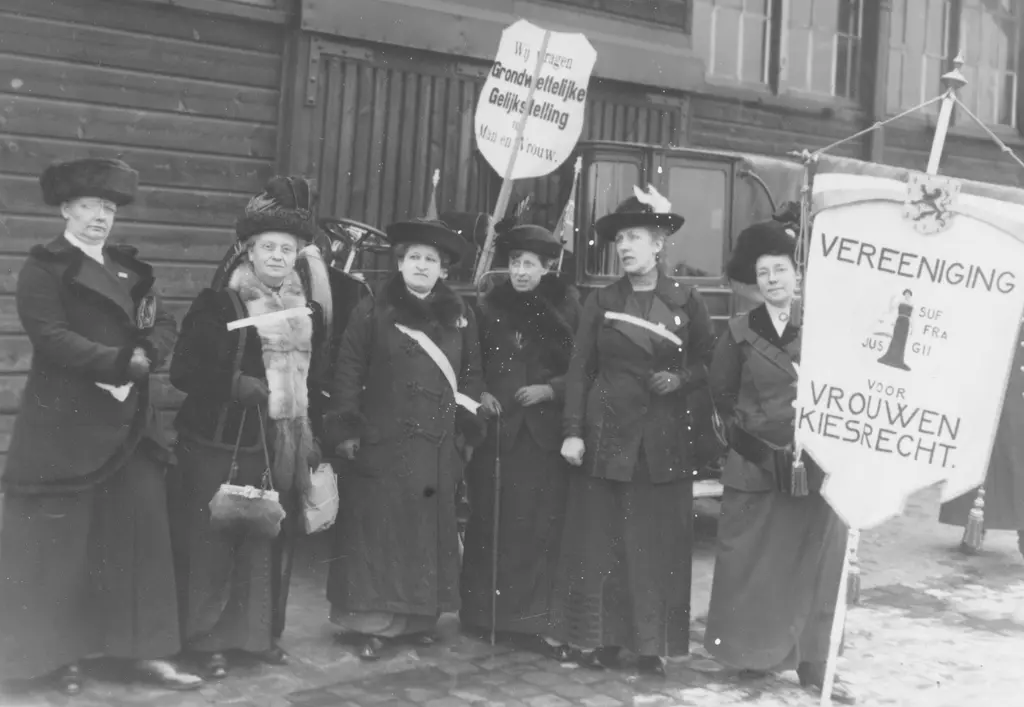
It seems so normal that every Dutch citizen from the age of 18 can vote in elections to the House of Representatives, Provincial Councils, Municipal Councils and the European Parliament. It was only in 1917 that the right of women to stand for election was introduced in the Netherlands. Women could then be elected to political office, but were not allowed to vote themselves. In 1919, women were given the coveted right to vote, allowing them to vote themselves.
It seems so normal that every Dutch citizen from the age of 18 can vote in elections to the House of Representatives, Provincial Councils, Municipal Councils and the European Parliament. It was only in 1917 that the right of women to stand for election was introduced in the Netherlands. Women could then be elected to political office, but were not allowed to vote themselves. In 1919, women were given the coveted right to vote, allowing them to vote themselves.
Fight for women's suffrage
For decades, a true battle for women's suffrage was fought by women of various political movements. From 1889, organisations for women's suffrage emerged. These organisations held demonstrations and speeches, organised protest meetings and exhibitions, issued a monthly magazine and published articles. Activities to make it clear to the general public that women with the right to vote would have an indispensable input in solving everything that was wrong in society. Women's suffrage was not an end in itself, but the first step towards women's equality in all sections of society.
Electoral law and the constitution
The constitution on suffrage anno 1882 referred to 'Dutchmen'. Women were therefore not excluded from the right to vote according to the letter of the law. When Aletta Jacobs wanted to be the first woman to be put on the electoral roll in Amsterdam in 1883, she was refused. Suddenly, 'the spirit of the law' was said to be more important. In fact, only men could vote if they met certain requirements. To be sure, the new constitution of 1887 only referred to male residents of the Netherlands, which meant women did not have the right to vote according to the spirit and letter of the law.
Suffrage struggle and the women's suffrage movement
In the period after 1870, feminist consciousness also developed among 'well-to-do' middle-class women in the Netherlands, influenced by international women's suffrage movements in England and the United States, the later named ´first feminist wave´ (ca. 1850-1920). This women's movement denounced the disadvantaged position of women in society. The aim was women's access to all forms of education, the right to work in the public service on the same terms as men and the same right to manage and spend the common property. Last but not least, women's suffrage.
Which women's organisations were concerned with women's suffrage?
Vrije Vrouwen Vereeniging (VVV) (1889-1903)
On 2 October 1889, the Vrije Vrouwen Vereeniging (VVV - Association of Free Women) was founded, the first Dutch women's organisation. The 'free', according to Wilhelmina Drucker, one of the founders, referred to "wanting to remain oneself, not wanting to join any party, not wanting to subscribe to any dogmatic banner" (Source: Wilhelmina Drucker (1898), De vrije vrouwen vereeniging, haar streeven en haar werken). The aim of the association was: "to promote the social interest of women and their spiritual and political development".
Four years later, in 1893, the VVV organised its first public meeting specifically on the subject of women's suffrage. From socialist circles, feminists asked for support for a constitutional amendment to establish universal male suffrage. This would then also demand women's right to vote. The cooperation soon foundered, because leading socialists of the time - such as Henri Polak and Frank van der Goes - thought the women's demands were much too far-reaching.
Vereeniging voor Vrouwenkiesrecht (1894-1919)
On 5 February 1894, a number of women of different religious and political orientations founded the Vereeniging voor Vrouwenkiesrecht (Association for Women's Suffrage) in Amsterdam. At first, the Vereeniging had great difficulty recruiting new members. Nearby, husbands, relatives and friends often put pressure on women not to join the Vereeniging. Men were also allowed to become members, but not sit on the board. The Vereeniging published the monthly magazine of the Vereeniging voor Vrouwenkiezenrecht.
Gradually, understanding for the struggle for women's suffrage grew. In 1900, the Vereeniging had 1,089 members, spread across fifteen chapters in the country. Due to the great success and attention paid to the congress of the World Confederation for Women's Suffrage in Amsterdam in 1908, membership began to increase substantially. For the executive committee, it was important for the Vereeniging to maintain a neutral position. Departments were not allowed to have too close ties with a particular political party, as this would damage unity. This position did regularly cause loss of members and, in 1907, a split in the Vereeniging.
Nederlandsche Bond voor Vrouwenkiesrecht (1907-1920)
A number of members who had left the Vereeniging voor Vrouwenkiesrecht founded the Nederlandsche Bond voor Vrouwenkiesrecht (Dutch Association for Women’s Suffrage) on 25 February 1907. This Bond's aim was to 'educate women to obtain the right to vote', as opposed to obtaining the right to vote, which was the aim of the Vereeniging voor Vrouwenkiesrecht. The Union believed women should first be able to make independent judgements, only then could they participate in political life. Neutrality and impartiality were thus better guaranteed.
By also allowing men in board positions, the Union also thought it would gain wider public support for women's suffrage. The Union had branches throughout the country. Members of the Bond were generally of 'better stock' and more distinguished than the members of the Vereeniging voor Vrouwenkiesrecht. For example, they condemned holding demonstrations as 'militant'.
Which women, among others, were active in the women's suffrage movement?
Aletta Jacobs (1854-1929)
She was a suffrage fighter from the very beginning. Jacobs stirred up the suffrage issue when, in 1883, she wanted to be the first woman on the electoral roll in Amsterdam. According to the letter of the constitution on suffrage, she was allowed to register. Women were allowed to elect and could be elected, as the law referred to 'Dutchmen'. The Amsterdam city council interpreted the text differently and refused. Jacobs appealed to the Supreme Court, but she was ruled against.
In 1893, she joined the Free Women's Association when they also started working for women's suffrage. From 1903-1919, she was president of the Vereeniging voor Vrouwenkiesrecht. She also played an important role in the international women's suffrage movement.
Wilhelmina Drucker (1847-1925)
She was a radical feminist, co-founder of the Free Women's Association (VVV) in 1889.
Rosa Manus (1881-1942)
She was a member of the Association for Women's Suffrage. In this capacity, she co-initiated the exhibition De Vrouw 1813-1913. She was also very involved internationally in the work for the World League for Women's Suffrage and the International Women's League for Peace and Freedom.
Annette Versluys-Poelman (1853-1914)
She was co-founder and first president (1894-1902) of the Vereeniging voor Vrouwenkiesrecht. Under her inspiring leadership, the association became an independent movement that gained influence in numerous cultural and political circles.
Esther Welmoet Wijnaendts Francken-Dyserinck (1876-1956) and Lizzy van Dorp (1872-1945)
On 25 February 1907, they founded the Nederlandsche Bond voor Vrouwenkiesrecht (VVK). Dissatisfied with its political course, they had left the Vereeniging voor Vrouwenkiesrecht. They felt that members with more moderate views had little or no opportunity to join this association.
Clara Meijer-Wichmann (1885-1922)
She was involved in founding the Utrecht branch of the Nederlandsche Bond voor Vrouwenkiesrecht in 1907. She was active as a board member until she left the Union in 1911.
Dates of demonstrations, public meetings and exhibitions
1898: National Exhibition of Women's Labour
Conceived by several women's organisations working together for the first time. The aim of the exhibition was to put paid labour for women on the agenda and improve contact between the existing women's organisations. Due to the great success of the exhibition with 90,000 visitors, the Vereeniging voor Vrouwenkiesrecht realised that in unity lies strength. With this in mind, the association called on its members to visit the exhibition in its Monthly Bulletin: "Shows (...), members of the Vereeniging voor Vrouwenkiesrecht, to understand what solidarity means. Now give proof of unity, and of interest in the efforts of your sisters, which will give respect for the power that emanates from you."
1908: Congress of the World Confederation for Women's Suffrage in Amsterdam
On 15 June 1908, the fourth International Congress of the World Confederation for Women's Suffrage was held in Amsterdam. Due to the great attention paid to this congress at home and abroad, more and more women realised that women's suffrage was needed.
1910: Celebration of women's suffrage day
Women's Suffrage Day was celebrated for the first time on 15 June 1910, exactly two years after the International Congress of the World Confederation for Women's Suffrage in Amsterdam.
1913: Protest meeting Vereeniging voor Vrouwenkiesrecht
On 4 May 1913, the Vereeniging voor Vrouwenkiesrecht, led by Aletta Jacobs, held a protest meeting in The Hague. The women were agitating against the suffrage paragraph in the government proposals for Minister Van Heemskerk's 1913 constitutional review.
1913: 'The Woman 1813-1913' exhibition
To mark the centenary of the independent nation of the Netherlands, some members of the Vereeniging voor Vrouwenkiesrecht wanted to organise a political exhibition on the suffrage struggle. The Monthly Magazine of the Vereeniging, July 1912, reported, "Then, after a hundred years, let the Netherlands elevate its women to citizenesses!" The exhibition ended up being less political in character than originally intended. The organising committee wanted to broaden the scope of the exhibition and compare the position of women anno 1813 with that of 1913. All kinds of directions within the women's movement that advocated the improvement of the position of women helped organise the exhibition.
The 'suffrage hall', a separate room dedicated to women's suffrage, did get a strategic place at the exhibition. During Queen Wilhelmina's tour of the exhibition, she was not allowed to see this room by the minister. The queen had to be led around it because - the government reasoned - women's suffrage was not yet legally recognised.
The exhibition was in Amsterdam, lasted from May to September and was a great success. Nearly 300,000 visitors came, including internationally prominent feminists Carrie Chapman Catt and Anna Howard Shaw.
1914: People's petition meeting
The Vereeniging voor Vrouwenkiesrecht held a meeting on the People's Petition for constitutional equality between men and women. The meeting at the Paleis van Volksvlijt in Amsterdam, led by Aletta Jacobs, was preceded by a demonstrative procession. In 1915, the People's Petition was presented to the government.
14 June 1914: 'National meeting'
The Vereeniging voor Vrouwenkiesrecht organised a 'National Meeting' in The Hague, with various speakers and musical performances.
18 June 1916: Large demonstration with 18,000 demonstrators
Organised by the Association for Women's Suffrage. The slogan was: 'No constitutional amendment without women's suffrage'. At the front of the procession were horseback riders and a gentleman on horseback. Behind them were groups of women representing countries where women's suffrage already (partially) existed. These were followed by 'the Dutch virgin' on horseback, surrounded by twelve young girls dressed in green representing the eleven provinces and the Dutch East Indies. Finally, the main board, departments and others, such as the Social Democratic Women's Clubs, followed.
Read more
1918: Aletta Jacobs stood for election
for the Liberal Democratic League in the elections. She received only 1919 preferential votes.
Key dates in a row around the introduction of suffrage
16 November 1916: Bill for universal male suffrage and passive female suffrage passed in the House of Representatives
12 December 1917: The new constitution is proclaimed.
1918: Suze Groeneweg elected as the first woman to the Lower House, for the Social Democratic Labour Party (SDAP)
9 May 1919: Bill by Liberal MP Hendrik Pieter Marchant. Amendment to the Electoral Act for active women's suffrage passed in the House of Representatives. Removed the word 'male' from the Electoral Act.
10 July 1919: Bill by liberal Member of Parliament Hendrik Pieter Marchant to amend the Electoral Act for active women's suffrage passed in the Senate.
1922: Women allowed to vote nationwide for the first time. Seven women were elected to the House of Representatives.
Political input and voting behaviour after women's suffrage was introduced
After women's suffrage became a reality, there were some unsuccessful attempts to establish a women's party. Quite soon, feminists chose the strategy of integrating their political input and feminist demands into the political parties of the time. Thus, women's groups emerged at various parties. In the 1919 municipal elections, nearly hundred women were elected as members of a municipal council. That was 1% of the number of elected members.
After the 1922 elections, it turned out that women's voting behaviour did not differ that much from men's: political proportions remained about the same. However, the Nederlandsche Vereeniging van Staatsburgeressen, the successor of the Vereeniging voor Vrouwenkiesrecht, had called on voters to vote for feminist candidates. In the end, seven women entered the Lower House. Suze Groeneweg, a member of the Social Democratic Labour Party (SDAP) who had been in the Lower House since 1918, was re-elected.
Further elected were:
Johanna Westerman (Freedom Union)
Betsy Bakker Nort (Liberal Democrats)
Elisabeth C. van Dorp (Liberal Party)
S. Bronsveld-Vitringa (Roman Catholic Electoral Society)
Frida C.F. Mackay-Katz (Christian Historical Union)
A.E.J. De Vries-Bruins (SDAP)
Apart from Frida Mackay-Katz, all the women had been active suffrage fighters.
After 1922
The upward trend continued until after the 1929 elections with eight women MPs elected. Then the number dropped drastically to four, after both the 1933 and 1937 elections. This was mainly due to the political climate in the late 1920s. The Dutch government tried to shift the blame for the economic crisis and unemployment onto women with their demands for paid work and economic independence.
The Vereeniging voor Vrouwenkiesrecht and the Nederlandsche Bond voor Vrouwenkiesrecht did not cease to exist, as indicated earlier. Although the goal had been achieved, there remained plenty of battles to fight in areas such as economic independence, education and marriage laws. The position of women was still far from equal to that of men.
The Vereeniging voor Vrouwenkiesrecht changed its name to the Nederlandsche Vereeniging van Staatsburgeressen and in March 1920 the Nederlandsche Bond voor Vrouwenkiesrecht merged with the Vereeniging tot Verbetering van den Maatschappelijken en den Rechtstoestand der Vrouw in Nederland to form the Nederlandsche Unie voor Vrouwenbelangen.
In the former Dutch East Indies (now Indonesia), the Volksraad only agreed to active women's suffrage in 1941 for the colonial upper class and the Indonesian elite. For Suriname and the Netherlands Antilles, it even took until 1948 before women were given the right to vote there.
Still today, the Dutch Association for Women's Interests, Women's Labour and Equal Citizenship, the result of an amalgamation of several women's associations from the first half of the 20th century, runs the M/V-50/50 Vote for a Woman campaign at every election.