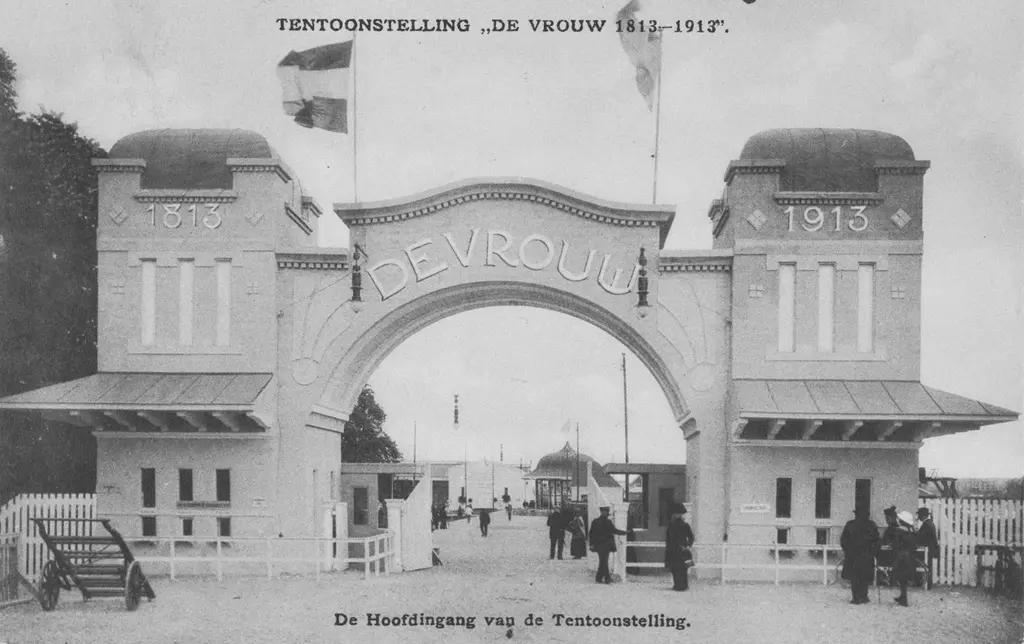
Pamphlets, congresses, debates and demonstrations are well-known feminist means of action. That Dutch feminists also organised exhibitions towards the end of the 19th century and early 20th century is less well known. Read more about the exhibition De Vrouw 1813 - 1913, which was visited by some 300,000 women and men, here.
Pamphlets, congresses, debates and demonstrations are well-known feminist means of action. That Dutch feminists also organised exhibitions towards the end of the 19th century and early 20th century is less well known. Read more about the exhibition De Vrouw 1813 - 1913, which was visited by some 300,000 women and men, here.
The Woman 1813 - 1913
In the run-up to the centenary of the Dutch monarchy in 1913, commemorations and festivities were staged throughout the Netherlands. The women's movement seized the opportunity to highlight their fight for women's suffrage through a major exhibition. Within a year, the exhibition De Vrouw 1813 - 1913 (The Woman 1813 - 1913 ) arose at the Meerhuizen estate on the Amsteldijk in Amsterdam .
From 2 May to 1 October 1913, the progress of the position of Dutch women was made visible to a wide audience on the exhibition grounds and in the large halls. The exhibition was thus in the tradition of the world exhibitions organised since the second half of the 19th century. Dutch women showed what they had achieved since the Netherlands became independent in 1813. They did this with a thoughtful mix of knowledge and entertainment, such as statistics, historical exhibitions and party nights.
Why did feminists choose an exhibition?
According to Mia Boissevain (president daily of the exhibition), congresses and magazines only reached audiences already won over to the women's cause. An exhibition also attracted people who were not yet aware of the women's issue. Not entirely coincidentally, there was also a tea corner in the suffrage hall. Because ultimately, the aim was to convince people of the importance of women's suffrage.
The first major exhibition of the women's movement, the National Exhibition of Women's Labour (1898) attracted over 90,000 visitors. Since then, several women's organisations and associations had been formed. The organisers of The Woman 1813 - 1913 hoped their exhibition would have the same effect.
Initiators Mia Boissevain and Rosa Manus
Mia Boissevain (1878-1959) was born into a well-to-do Amsterdam family. Before unfolding her exhibition plans with Rosa Manus in 1912, she traded Amsterdam for Zurich, where she obtained a PhD in zoology. In 1905, Boissevain returned to the Netherlands. And from then on, she played an active role in the Vereeniging voor Vrouwenkiesrecht. Together with Rosa Manus, she founded its Propaganda Committee. Not surprisingly, together they took the initiative to make propaganda for the women's cause in the commemorative year 1913. Their joint efforts eventually led to the exhibition De Vrouw 1813 - 1913 in Amsterdam.
Money
The plans naturally cost money. The government supported the initiative with a contribution of 8,000 guilders. Money also came in through the sale of publications. For 75 cents, visitors could buy a catalogue. The lease of shop spaces in the gallery, donations from donors who cared about the Dutch women's movement and public admission fees raised the required 150,000 guilders.
What was there to see and do?
Although visitors came for the sections on women's suffrage, education, statistics, colonies, social work, hygiene and nursing, cottage industry and the grand historical section, these serious themes of the women's movement went hand in hand with entertainment. Just as contemporary museums cannot do without a café or restaurant, The Woman 1813 - 1913 also offered food and drink options. From 2 May to 1 October, the exhibition was open every day from 10am to 10.30pm.
Visual arts
Besides focusing on women in art history around 1813, the Fine Arts section also included space for the art of women of their own time. Artistically, the Visual Arts Committee showed the various art forms practised by Dutch women on the front of the catalogue.
Literature and drama
In its section, the Subcommittee on Literature and Drama wanted to give an overview of the work of modern Dutch women writers and actors. Books and portraits of them adorned the walls and visitors could attend a series of readings and stage performances. The well-known Dutch writer Carry van Bruggen (1881-1932) was the president of the subcommittee.
Lectures on topical issues
Each week, the conference hall hosted lectures on a current topic in the women's movement. A total of 51 lectures were held in the five months that De Vrouw 1813 - 1913 lasted. Some well-known international feminists visiting the exhibition informed the audience that the women's movement extended far beyond the Dutch borders. American Carrie Chapman Catt, president of the International League for Women's Suffrage, made an ardent plea for women's suffrage in the Congress Hall.
Exhibition magazine
Those who did not want to miss anything from the exhibition could subscribe to the exhibition magazine The Woman: official organ of the exhibition The Woman 1813 - 1913. A total of 16 issues of this appeared.
Queen's visit
Queen Wilhelmina must have been very impressed with her visit in May 1913, because on 16 August 1913, she again delighted the board with her arrival. This picture shows the queen together with Rosa Manus during her second visit, on her way to the Indian House.
Women's suffrage
The feminists of The Woman 1813 - 1913 looked to the past for the future. Armed with the knowledge gathered, exhibited and published for the exhibition, the fight for women's citizenship could continue after the exhibition ended. The main goal was achieved with the introduction of women's suffrage in 1919.