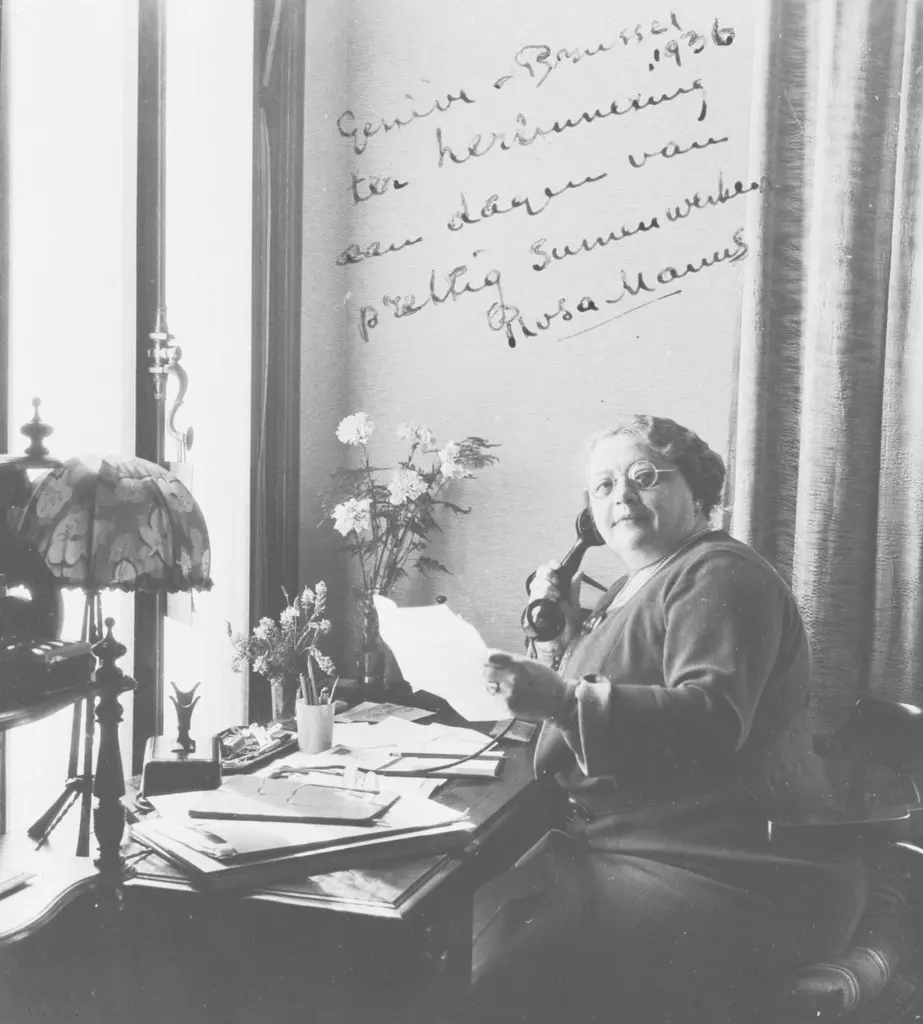
Rosa Manus (1881-1942) was a Jewish very active and internationally oriented feminist and activist. In 1935, she co-founded the International Archive for the Women's Movement (IAV), now Atria. Manus was involved in organising many congresses and events of the Vereeniging voor Vrouwenkiesrecht and the International Woman Suffrage Alliance (since 1926 International Alliance of Women).
Rosa Manus (1881-1942) was a Jewish very active and internationally oriented feminist and activist. In 1935, she co-founded the International Archive for the Women's Movement (IAV), now Atria. Manus was involved in organising many congresses and events of the Vereeniging voor Vrouwenkiesrecht and the International Woman Suffrage Alliance (since 1926 International Alliance of Women).
A brief life overview of Rosa Manus
1881
20 August 1881: Born in Amsterdam as Rosette Susanna Manus, daughter of tobacco merchant Henry Philip Manus and Soete Vita Israel.
1908
15-20 June 1908: Participation in the third international congress of the International Woman Suffrage Alliance. This was the beginning of her involvement in many congresses and events of the World Woman Suffrage Alliance and the Dutch Association for Women's Suffrage.
1910
Appointed 'special organiser' of the World Confederation for Women's Suffrage.
1913
Organisation of the exhibition De Vrouw 1813-1913 together with Mia Boissevain on the occasion of 100 years of the Kingdom of the Netherlands. Shown was the situation of women around 1813 and developments until 1913.
1914: First World War breaks out
1915
Organisation of much of the International Congress of Women - proclaimed by Aletta Jacobs - in The Hague, with women from countries at war with each other in World War I and women from neutral countries.
1915
Secretary of the International Committee of Women for Lasting Peace (Women's International League for Peace and Freedom (WILPF), founded on 28 April 1915.)
Women's suffrage and disarmament
1922/1923
World tour of just under a year with Carrie Chapman Catt, the president of the World Confederation for Women's Suffrage, with South America as the main destination.
1924
Organising the celebration of Aletta Jacobs' 70th birthday.
1926
Vice-president of the World Confederation for Women's Suffrage until 1940.
1932
6 February 1932: Secretary of the International Disarmament Committee of the International Women's Organisations. Rosa Manus handed over more than nine million signatures from 59 countries to the president of the League of Nations at the disarmament conference in Geneva. More signatures arrived after the presentation of the petition, bringing the total to more than 10 million.
1933
Chairman of the Neutral Women's Committee for Refugees which helped refugees from Germany after Hitler's rise to power.
1935
Trip to Egypt with Margery Corbett Ashby (Chapman Catt's successor as president of the World Federation), Germaine Malaterre-Sellier and Christine Bakker-van Bosse. She then travelled on to Palestine with Corbett Ashby, while the other two travelled to Lebanon and Syria. The aim was to persuade women to attend the 1936 congress in Istanbul, the World Federation's first international congress in a non-Western country.
1935: Founding IAV
Founding, together with Johanna Naber and Willemijn Posthumus-van der Goot of the International Archive for the Women's Movement (IAV), later called IIAV, and since 2012 Atria, knowledge institute for gender equality and women's history. Rosa Manus donated the Aletta Jacobs library bequeathed to her to the IAV.
1936
Organisation of the pacifist congress 'Rassemblement Universel pour la Paix' in Brussels, which brought together peace organisations from as many countries as possible in a protest against war and fascism.
22 August 1936
Appointment as an officer in the Order of Orange-Nassau by royal decree. As Rosa Manus was in Brussels to organise the above-mentioned congress, she did not hear of the appointment by telephone until 29 August 1936, according to Elly Winkel's diary.
1 September 1936
Interrogation by the Belgian police for her alleged communism.
1940: World War II breaks out
1940
Donation of Rosa Manus' personal archive to the International Archive for the Women's Movement. The IAV was closed by the Nazis on 2 July 1940 and emptied on 12 July 1940.
1941
16 August 1941: Arrested for "pacifist and international tendencies" after several interrogations. She spent three weeks in prison (the 'Oranjehotel') in Scheveningen.
September 1941: Sent to Düsseldorf. There she was detained in the Polizeipräsidium, where the Gestapo had its own interrogation facilities.
2 October 1941: Transported to Ravensbrück concentration camp, arriving on or about 25 October 1941.
Rosa Manus died
1942
March 1942: Rosa Manus was most probably gassed in Bernburg because she was Jewish.(research by Myriam Everard)
23 July 1942: Notification from Ravensbrück to the family that Rosa Manus had died on 29 May 1942.
1943
28 April 1943: The Red Cross gave 28 April 1943 as the date of death after the war. The latter date was long held up as the most likely date, as the obituaries sent by the Nazis had often proved incorrect. Research by Myriam Everard shows that 28 April 1943 was also incorrect and it was probably March 1942.