Until the 1950s, a woman was legally deemed to lack legal capacity when she got married. This meant that she had to be obedient to her husband. Hím had the decisive voice in bringing up the children. He had control over the community property. From the first manifestations of a 'feminist wave' in the 19th century, marriage laws were under attack. But the struggle continued for decades. Regardless of her social status or commitment to women's rights: when a woman married, she could not circumvent harsh realities.
Until the 1950s, a woman was legally deemed to lack legal capacity when she got married. This meant that she had to be obedient to her husband. Hím had the decisive voice in bringing up the children. He had control over the community property. From the first manifestations of a 'feminist wave' in the 19th century, marriage laws were under attack. But the struggle continued for decades. Regardless of her social status or commitment to women's rights: when a woman married, she could not circumvent harsh realities.
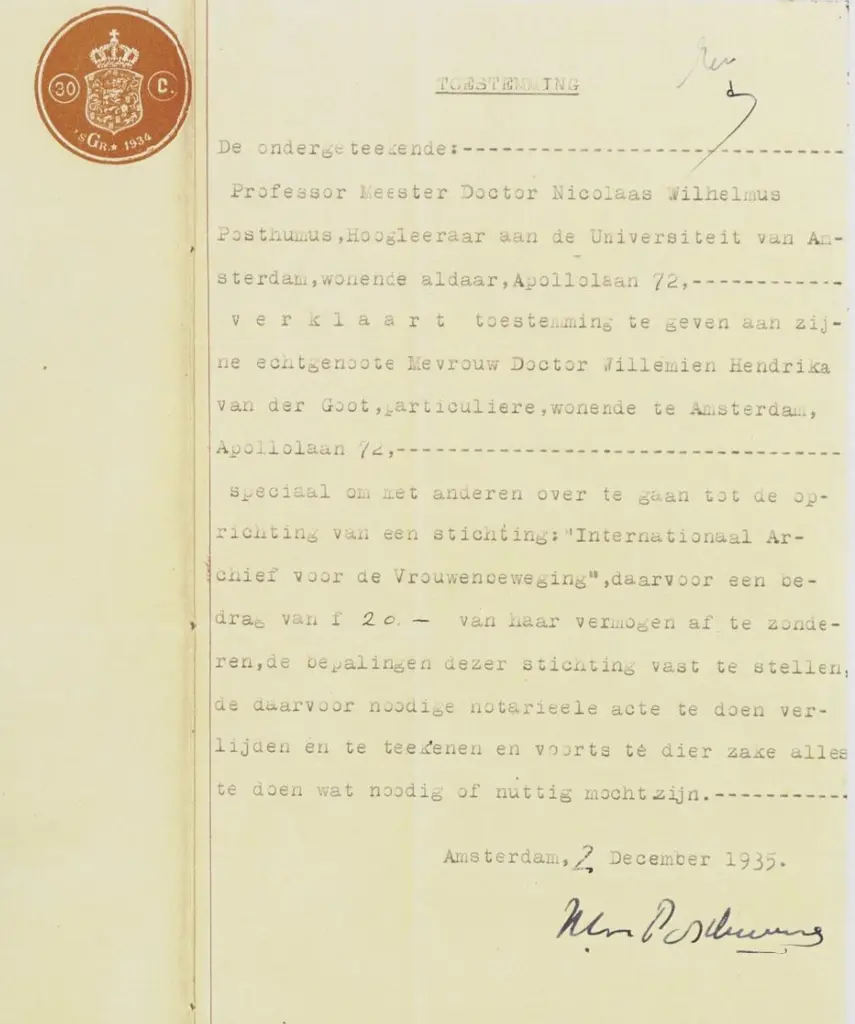
"Professor Master Doctor Nicolaas Wilhelmus Posthumus [...] declares to give permission to his spouse Mrs Doctor Willemien Hendrika van der Goot [...] specially to proceed with others to establish a foundation: 'International Archive for the Women's Movement'."
Nor had the founding of the IAV (Atria's predecessor) taken place without the consent of a man. The oldest two founders, Johanna Naber (1859-1941) and Rosa Manus (1881-1942) were unmarried. They were able to propagate their feminist activities uninhibitedly. The youngest Willemijn Posthumus-van der Goot (1897-1989) was married to Nicolaas Posthumus. She could not incur large expenses, take out insurance without his permission. And certainly no foundation either.
In times of the Middle Ages and the Republic, men had had sole dominion within the family for centuries. The Enlightenment and French Revolution could not change this. So a long struggle awaited the first feminists.
Personae miserabiles
The marriage law in force in the Netherlands for over a century owes much to the Civil Code of 1838. This was inspired by the French Code Civil (1804), and distinguished between two types of persons: legally capable and incapacitated (personae miserabiles). This second group included minors, persons under guardianship and married women.
Even before Napoleon seized power in France (1799), a draft code was created during the French Revolution. In it, marriage law was based entirely on the principles of liberty and equality. But this draft never became law. 'Liberty, equality and fraternity,' according to Napoleon, was only a right for brothers. So he quickly restored the supremacy of the man (marital power), paternal power and the legal incapacity of the married woman.
Two captains on one ship...
Male marital power was justified from 'the unity of marriage'. By law, it was impossible to have two people with equal control in a family, like two captains on a ship. In case of disagreement over finances or the children, one of the two had to give a casting vote. Second, the stronger sex, had to protect the weaker sex. Women, 'because of weak physique and generally less vigorous mental development,' were obliged to seek help from men. Moreover, the stronger sex had to be protected from the erotic attraction of women.
"Nature has given women so much, that the law has very wisely given them little."
The 'bridal basket'
Criticism of marriage law was put into words by several feminists and liberals around the 1970s. Geesje Feddes (1831-1882), in the brochure Gelijk recht voor Allen! wrote that women had been made stateless by the legislature.
"[I]n the midst of his free men, all equal before the law, there is a caste of pariahs [referring to the daughters, husbands and mothers of men, ed.], to whom the law grants fewer rights, and, in the case of equal burdens, fewer pleasures."
Codien Zwaardemaker-Visscher wrote the book In den Bruidskorf in the same period, in which she described marriage in the year 1875 as a form of 'slavery'. And Elise Haighton did not hesitate to make this comparison either, finding the legal fate of the married woman abhorrent. 'She is a slave,' she stated in her lecture De vrouw in Nederland (1882).
So is the queen capable of acting?
In the decades that followed, an uneasy dilemma arose - for male administrators. On the death of King William III (1890), his second wife Emma became the queen of the Netherlands. Thereafter, daughter Wilhelmina would succeed her. So the Netherlands had to put up with a female monarch for decades, making marriage law a fraught issue. Could an incapacitated woman rule the country? For feminists, this was a favourable view. If a woman held the country's highest office, she could no longer be seen as personae miserabiles.
To perform her function, the queen had to become the head of marriage. But this idea met with much resistance among policymakers. After all, it would not guarantee a good and harmonious married life and would be offensive to her future husband. To the displeasure of feminists, an exception was made for Queen Wilhelmina at her wedding in 1901. The special marriage commitment developed for her ensured that husband Hendrik retained his marital power, but always had to comply with his wife's will. In practice, this did not change anything about other women's incapacity to act. The government decided to keep the issue quiet for now. Even heir to the throne Juliana was still legally represented by her husband after her marriage.
After women's suffrage
Many years passed during which the situation remained unchanged. Feminists of the 'first feminist wave' hoped that the acquisition of women's suffrage would give room for a change in marriage law. Lawyer Betsy Bakker-Nort (1874-1946) entered the Lower House in 1922 and worked tirelessly for modern marriage laws.
"Each of the spouses is in charge of what he possesses when the marriage is contracted and what he acquires during the marriage, both that which belongs to him in property and that which falls on his side in the community of fruits and income."
Parliamentary resistance was still in full force. It was finally Corry Tendeloo (1897-1956) who - only in the 1950s - was able to change the position of married women. With a motion, she managed to abolish the law that prohibited married women from working for the government.
Then, in 1956, it was Justice Minister Julius van Oven (1881-1963) who succeeded in turning the work of Tendeloo, Bakker-Nort and the many before them into the abolition of legal incapacity. With the Lex-Van Oven, women became fully legally competent and husband and wife gained equal control over the community property.
Creation of the IAV
That a man's signature was needed to establish the International Archive for the Women's Movement also confirmed its importance. The contrast was stark: the women's movement had already achieved much in 1935, but gender equality was far from complete. While women could vote and study, marriage remained characterised by oppression and dependency. That this remained so for many years underlined the importance of the documentation of the women's movements, in which, among other things, all the contradictions of marriage law became clear.