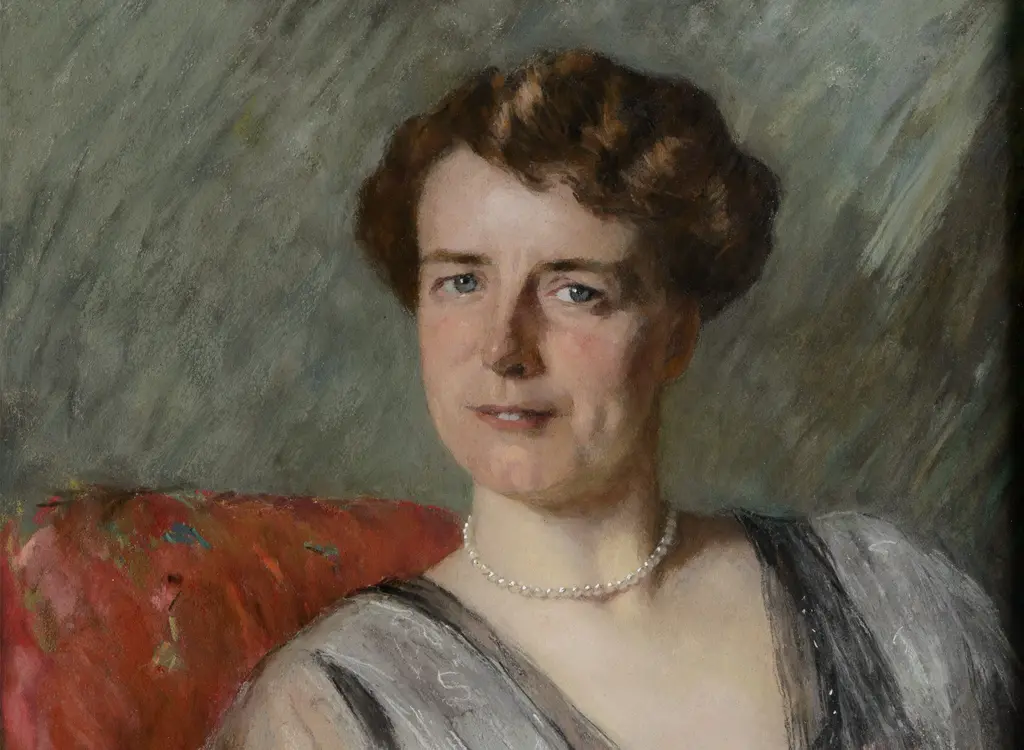
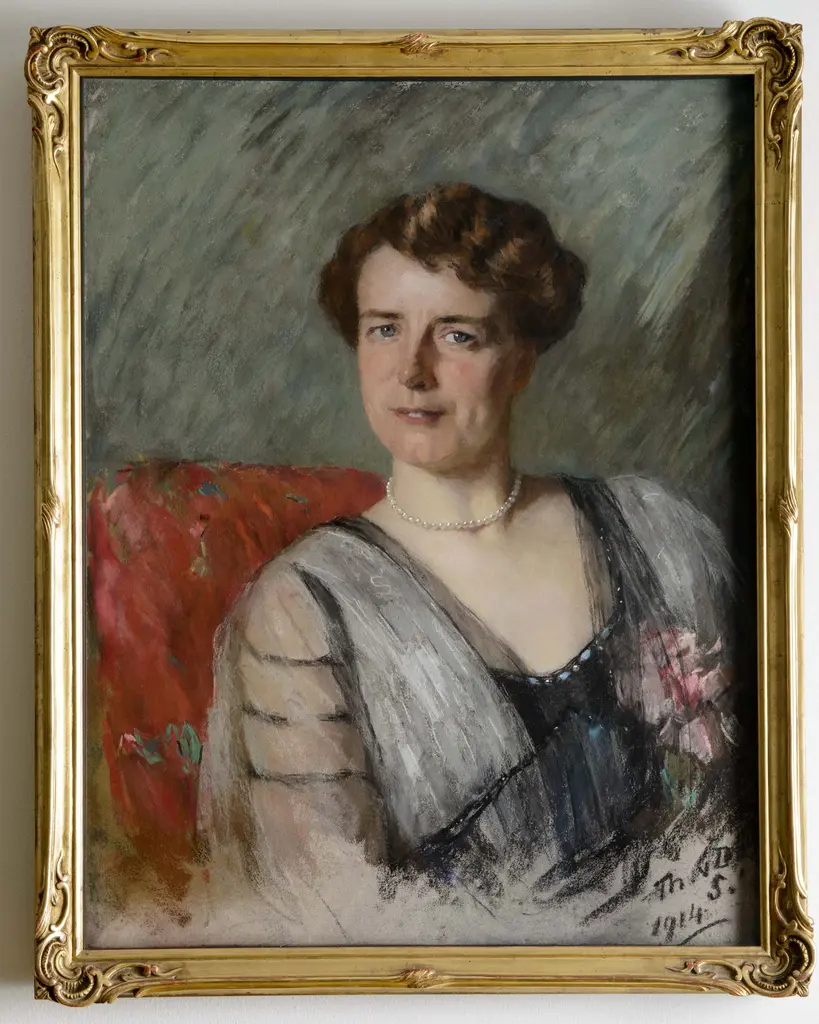
The feminist and journalist Welmoet Wijnaendts Francken-Dyserinck has been called the counterpart of Aletta Jacobs. Indeed, she was one of those who seceded from the Vereeniging voor Vrouwenkiesrecht in 1907 and founded the Nederlandsche Bond voor Vrouwenkiesrecht.
The feminist and journalist Welmoet Wijnaendts Francken-Dyserinck has been called the counterpart of Aletta Jacobs. Indeed, she was one of those who seceded from the Vereeniging voor Vrouwenkiesrecht in 1907 and founded the Nederlandsche Bond voor Vrouwenkiesrecht.
Like Jacobs, she did much more than fight for women's suffrage. Draft dogs, the introduction of summer time, conscription for women, there is no subject she did not have an opinion on, publish about, speak about, found an association about.
Esther Welmoet Dyserinck, was born in 1876 in Den Helder. She was a flamboyant and multifaceted person. During her lifetime, she wrote many hundreds of articles, brochures and lectures on numerous subjects. Someone once wrote to her 'You had to be invented, if you didn't exist!'
Archive full of files
The paper record of her activities can be found in her archive. During her lifetime, she formed many files by subject. She used that material for writing articles, brochures and letters to the editor, and for giving courses and speaking engagements. Welmoet Wijnaendts Francken-Dyserinck had a special 'document cabinet' in her house for this purpose. She left her entire archive, including the cupboard, to the International Archive for the Women's Movement (IAV) (now Atria). Thus, on 15 April 1936, she wrote to the board of the IAV:
"I have already taken measures, as soon as the creation was known to me, to transfer my entire archive Women's Movement to your foundation after my death."
Unfortunately, what happened to the cupboard we do not know. Her archive is fortunately still there. To get some idea of the enormous wealth of fascinating subjects in this archive of over four and a half linear metres, here are some examples.
Women's suffrage
Welmoet Wijnaendts Francken-Dyserinck joined the Vereeniging voor Vrouwenkiesrecht, probably in 1899. In the The Hague section, she made it to president. She wrote the brochure Pro en Contra. Concerning Questions of Public Interest in 1906.
Dissatisfied with the radical course of the Vereeniging voor Vrouwenkiesrecht, Welmoet founded the Nederlandsche Bond voor Vrouwenkiesrecht together with Lizzy van Dorp and others. The Bond pursued a more moderate liberal course and men sat on the board. In 1954, Wijnaendts Francken-Dyserinck published De strijd voor het vrouwenkiezenrecht heralded. She sent it to many acquaintances, including the first female secretary of state in the Netherlands, Anna de Waal, appointed in 1953.
Political
Wijnaendts Francken-Dyserinck was a member of the Vrijzinnig Democratische Bond, the Economic Union, the Liberal State Party 'De Vrijheidsbond', the Nederlandsche Unie and the Party for Law, Freedom and Prosperity, respectively. For the longest time, she was active in the Vrijheidsbond, which she co-founded, a merger of some seven parties. Welmoet was closely involved in this merger process from the Economic Union. It is thanks to her efforts that even a month before the Freedom Union was officially founded, there was already a Women's Group, called the 'Women's Group from the Freedom Union' and founded on 19 March 1921. Wijnaendts Francken-Dyserinck was its first president.
In 1922, 1925 and 1929, Wijnaendts Francken-Dyserinck was a candidate in the elections for the Lower House, but she was never elected.
Scouting
Wijnaendts Francken-Dyserinck attached great importance to the physical development of women and girls. This is evidenced by, among other things, her role in the Nederlandsch Padvindsters Gilde, founded in 1916, of which she was vice-president from 1922 to 1936. At her suggestion, the World Association of Girl Guides and Girl Scouts (WAGGGS), now called World Scouting, was founded at the 8th World Conference in Hungary in 1928. She herself was installed as a Girl Scout in 1926.
Soroptimism
Wijnaendts Francken-Dyserinck was the founder of the First Dutch Soroptimist Club 's-Gravenhage, on 27 November 1927, and thus the founder of soroptimism in the Netherlands. The name soroptimist is derived from the Latin words soror (sister) and optimus (best). As with Rotary, the core of soroptimism lies in the word serve: serving in one's own profession or business, among oneself and serving society and mankind in general. Soroptimist clubs are made up of women over the age of 25 who do responsible work that provides all or part of their livelihood.
Travels
Until the outbreak of World War I in 1914, she and her husband C.J. Wijnaendts Francken undertook several trips abroad. Between 1898 and 1902, the two stayed in Germany, Switzerland and France, among other places, where they attended lectures at the universities of Jena, Zurich, Paris and Berlin. In 1911 they travelled through Africa (she was there at the same time as Aletta Jacobs) and from December 1912 to the early spring of 1913 they made a trip to the West Indies. Publications appeared as a result of these two trips: in 1912 From the Sun Country. Afrikaans Travel Letters and in 1913 Three Months in the West. Travel Letters. In 1931, she travelled again to the Balkans as a guest of the Chamber of Commerce of Yugoslavia.
Pioneers
Welmoet Wijnaendts Francken-Dyserinck had a keen interest in the history of the women's movement. She gave lectures on 'forerunners of the women's movement' and courses at folk high schools. Her great examples were Mina Kruseman and A.M.M. Storm-van der Chijs, both of whom had laid the foundation for the later women's movement with their pleas for gender equality in the 19th century.
Stamps
In 1948, Wijnaendts Francken-Dyserinck made an attempt to have a commemorative stamp published as a contributor to the Exhibition De Nederlandse Vrouw 1898-1948. This attempt failed. In 1955, she submitted a second request, this time for a series of heroines from the 19th and early 20th centuries. She had four women in mind who she felt were stamp-worthy:
Alexandrine Tinne (Africa Traveller)
Mienette Storm-van der Chijs (advocate of girls' education)
Marianne van Hogendorp (a Reveil woman known for her charitable activities)
Mina Kruseman (actress, writer and feminist)
Despite intensive lobbying, an issue again failed to materialise.
Personal Memories
A large number of pieces provided Welmoet Wijnaendts Francken-Dyserinck with the letters P.H., Personal Memories. They are notes, letters, photographs, travel reports, clippings and publications by her on numerous subjects. Presumably she later classified these pieces, provided with comments, in this way. An example is a sheet with an adhesive seal of the National Society to Combat Usury. She has written next to it "One of the associations I helped found and whose statutes I designed".
Other topics
Other topics of which we have files from her archive are: animal protection, women's service, marriage, women's labour, family duty, sexual issue, prostitution and trafficking, fatherhood, New Feminism ('Famke'), reform clothing ('Fashion and Dressing'), Press Committee of the International Women's Council, plastic surgery, summer time, 'Loose Articles', 'Own Work'.