In the Archives of Resistance series, we dive into the often invisible but important realm of everyday health activism. In this interview, researchers Hanna Blom and Dominique van Dongen talk about their search in Atria's archives for stories of everyday health activism around menopause and transgender care. Their experiences show how archives not only preserve the past, but also determine whose stories become visible - and how archival research can be critical, personal and inspiring.
In the Archives of Resistance series, we dive into the often invisible but important realm of everyday health activism. In this interview, researchers Hanna Blom and Dominique van Dongen talk about their search in Atria's archives for stories of everyday health activism around menopause and transgender care. Their experiences show how archives not only preserve the past, but also determine whose stories become visible - and how archival research can be critical, personal and inspiring.
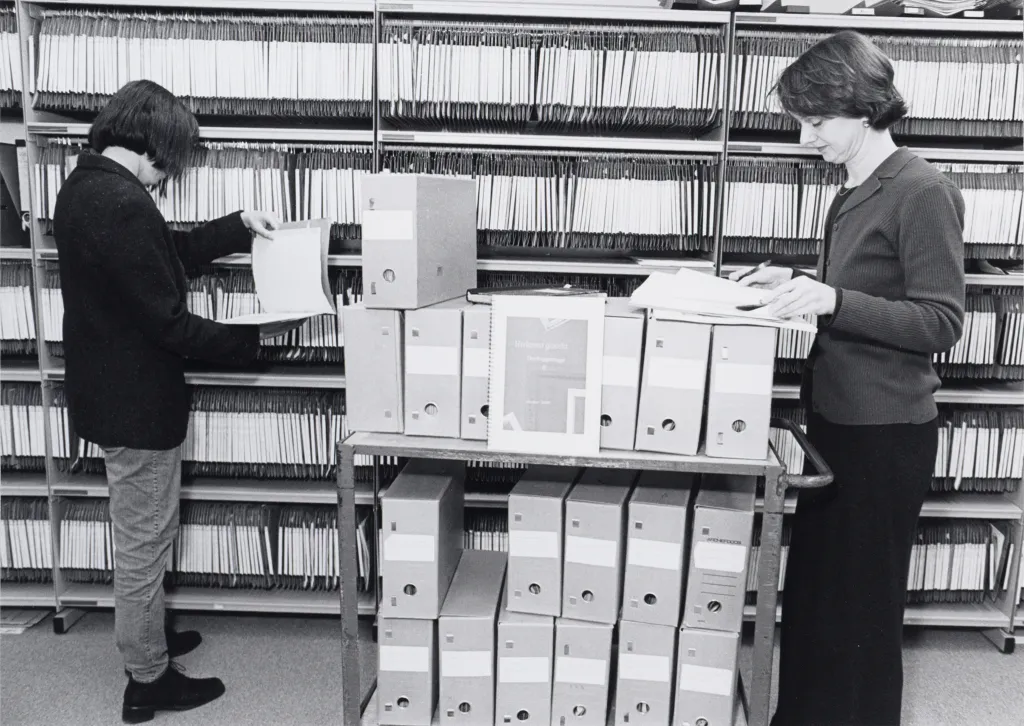
Archive research may conjure up the image of dusty boxes, endless rows of folders and boring, repetitive work. But those who really delve into work in and with archives soon discover a world full of sleuthing, puzzles and sometimes even exciting gossip. Because behind seemingly dry documents lie stories of struggle, change and resistance.
"It's like reading an exciting book"
But take note: archives are not neutral repositories of facts. They are places where history is made and contested. As archival scholar Verne Harris (2002) argues: archives are both expressions and instruments of power relations. Those long rows of folders and exciting stories do not simply show us the past, but influence how we remember, understand and pass on that past.
For feminist and queer research, this realisation presents important opportunities and challenges. Feminist archival scholars such as Michelle Caswell (2016) and Kate Eichhorn (2015) point out that traditional archives often underexpose or exclude the voices of women, people of colour, LGBTQIA+ individuals and other marginalised groups. These histories are preserved, activated and made visible in feminist archives - such as that of Atria.
But according to academic and writer Sara Ahmed (2007), even the arrangement of a feminist archive is not neutral. Its orientation - who enters it, what is categorised, what is named - guides access to knowledge. This requires a certain reflexivity from researchers, or as Gunaratnam (2003) calls it, a "radical attention to your own position." As a researcher, you are never an outsider, but always a co-shaper of the narrative.
This idea of the archive as an active political terrain is therefore also central to the research that history students Hanna Blom and Dominique Van Dongen conducted at Atria. In the interview below, they talk about what it is like to dive into the archive as young researchers. Not just looking for information, but also for connection, context, nuance and - sometimes - justice.
Who are Hanna and Dominique?
With a shared passion for feminist and gender history, Hanna and Dominique joined Atria for their graduate internship. Hanna focuses on global history and social movements during her master's at the University of Bologna. Dominique is delving into the history of feminism, gender, motherhood and women's health during her bachelor at Erasmus University Rotterdam.
"We both have an activist background," Dominique says. "I am fascinated by people who fall outside the dominant image of 'the perfect activist', but do bring about social change." Hanna says: "When I moved to Amsterdam, it was exciting to finally encounter feminism in a very tangible way."
Hanna and Dominique's research focused on two less researched topics: menopause and transgender care. "These topics did not come out of the blue. So much is still unknown about these topics. As a cis woman, I felt a responsibility to use my privilege to make trans stories more visible," Dominique says. Hanna also motivates their choice: "Historically, menopause marked a difficult period when women experienced not only physical symptoms, but also the loss of their female identity - a tough topic that was little talked about. I wanted to explore how women dealt with this and how they organised themselves around this experience."
An archive as puzzle and treasure chest
The first step in their research was getting to know the archive: interviews with collection specialists, literature review and the creation of conceptual frameworks. "We categorised four forms of everyday activism," says Dominique:
"Bringing together, such as discussion groups and meetings
Informing, for example through flyers and brochures
Speaking out, for example by wearing buttons on your clothes
Activist professional practice, where people use their work for change.
"With those glasses, we dove into the archives," he said.
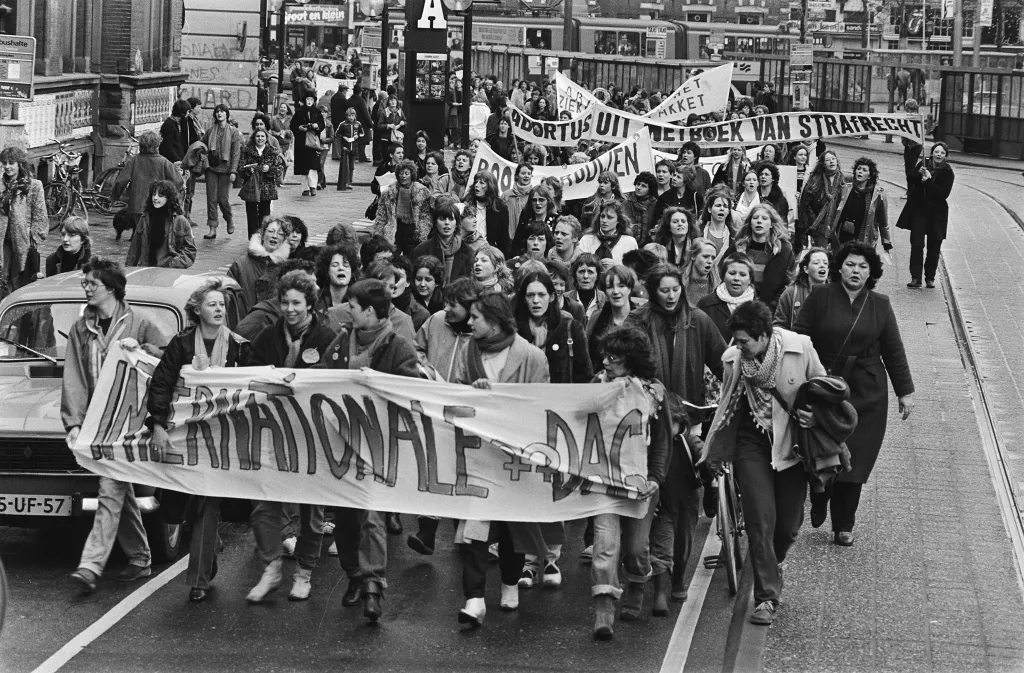
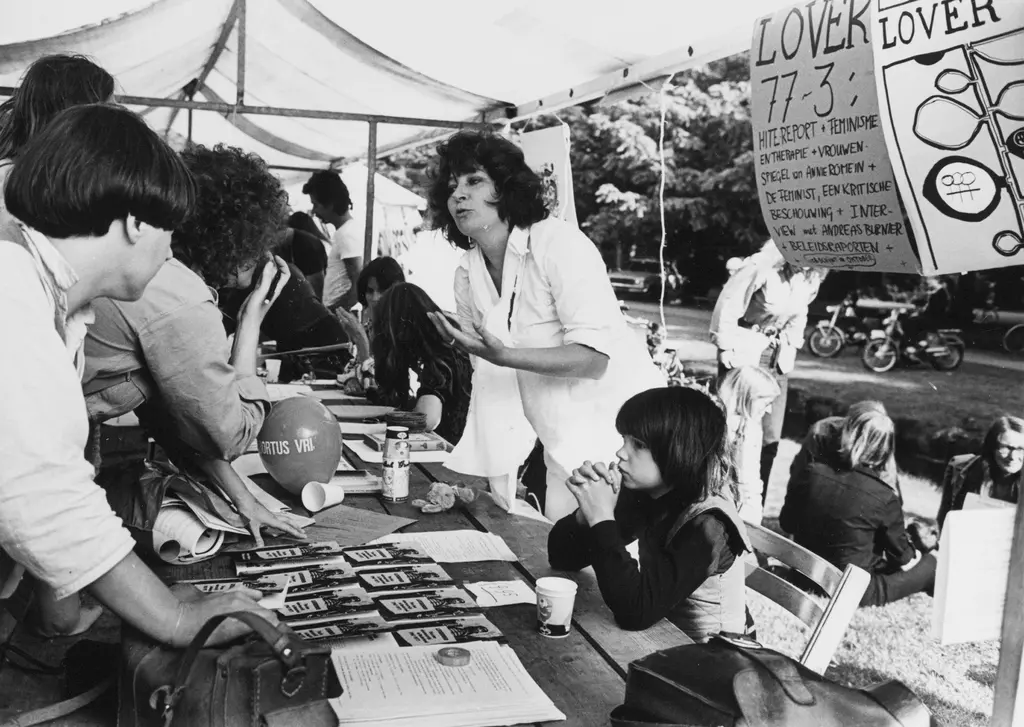
"I started with local women's newspapers from the 1970s and 1980s," Hanna explains. "Atria has hundreds of them, full of poems, drawings and theme nights. Made by women in women's cafes or women's houses, as a means of speaking to the local feminist movement. I looked for articles on health, especially menopause, and so I came across discussion groups and organisations like VIDO (women going through the menopause). Most of my research involved digging through archives of these groups, and so I also found personal stories of women who laid the foundations for the movement."
For Dominique, things started differently: "Transgender activism was excluded from dominant feminism for a long time, until the 1990s approximately. So I really had to network first, collect names and only then could I dive into the archives. I found a lot at IHLIA, an archive in Amsterdam that focuses on LGBTQIA+ stories, and the Transvision archive at Atria. I also found person archives that were very helpful. There are so many people who dedicate their whole lives to the trans community - I really like that."
For both, finding information was not always easy. "Sometimes the specific word 'menopause' wasn't even mentioned in archives. Then I had to look for words like 'the switch,' or really had to read between the lines," says Hanna. For Dominique, the archive was also sometimes a puzzle: "Then you would find a name or a description, and that would lead to something new. There was a kind of snowball effect. That makes it exciting and fun; you want to keep searching."
Moving, fun finds and the responsibility of doing archival research
Working with intimate, personal sources made a deep impression. "Sometimes I felt like an intruder," says Dominique. "But precisely because of this, I wanted to handle these stories with care and respect. Especially the story of a mother of a trans child touched me deeply. She set up a foundation for trans children with her partner and two other parents. In the interview we did with her and her partner, they told how they did everything to give their child a good life. As a young activist and a co-parent, that inspired me so much." Hanna says: "It's hard not to be touched by some of the letters or poems. You notice how personal activism is. I read about women who first led traditional lives - everything determined by their husbands, no money of their own. But their activism totally changed their lives and relationships. That touches me."
"Sometimes it really is like reading an exciting book," Dominique says. "You never know what you're going to find. One time I found a card with a pretty 'juicy gossip', but with no context. There had apparently been a heated confrontation. Then you want to know everything - and that's what makes it so much fun." Hanna adds: "I found a folder with up to 100 letters from women, all written in one week after a TV broadcast about uterine surgeries being performed without good reason. The women recognised themselves in the story - something they had never been able to share in their environment, but so now they do. It is extraordinary, but also funny, to realise that they could never have known that some intern, 50 years later, would read their intimate stories."
Both researchers discovered how vulnerable and political it is who does and does not appear in the archive. "Black women's organisations are little represented," says Hanna. "Partly that says something about the fact that black women's organisations did not always put everything on paper, as many white women's organisations did. But that does not mean there is nothing to archive." Dominique adds: "It is important not to ignore this lack of archiving, but to name it. And also to acknowledge that as a white cis woman, I cannot or should not tell all the stories. I can, however, make space and call for addition and change."
Archival research at Atria
Working with the Atria team was of great value, according to both students. "So many people with knowledge, so much enthusiasm," says Dominique. "You really feel part of a team. Everyone has their own expertise, and you can learn an awful lot from that." The physical environment also played a part. "Gender-neutral toilets, coffee and tea (but not over the archives!), peace and cosiness - it may sound unimportant, but it all contributes to how safe and welcome you feel," says Hanna. "The library itself is great. The first time I stood there I thought: I want to read everything," Dominique adds.
"What makes Atria special is the combination of professionalism and genuine commitment," says Dominique. "You notice that the staff care about what is kept and that they take you seriously as a researcher." Hanna concurs: "There is room for curiosity, discovery and sharp analysis. That's exactly what you need as a researcher.
At the same time, we also need to remain critical of the descriptions in the archive. What is mentioned? What remains vague? Those metadata are not neutral - they are political. It is important to think about that actively." Dominique adds, "Ideally, a feminist institute would pay attention to that which otherwise gets forgotten. Even if it doesn't seem popular or topical at the time. That requires courage and vision. But the fact that Atria is now setting up a project like Archives in Resistance shows that this movement is already there. That makes me hopeful for the future."
An open mind
"I also hope that other activists will be inspired by the project. Not only to look more critically at their own activism, but also to see that activism does not always have to be grand. It is precisely in the small, in the everyday, that there is so much power. I really learned that," Dominique says. Hanna: "I learned that the closer you get, the more complex the stories of political movements are. There are currents within movements, contradictions and views that really don't fit the picture you had beforehand. As a researcher, it is important to be open to that complexity and not reduce history to an easily digestible story."
Interested in archival research?
Hanna and Dominique's story has a clear message: archival research is a living, engaging and transformative practice. Did you get excited after reading this article and would like to do archival research too? Then check out our collection or drop by the library.