In the Archives of Resistance series, we dive into the often invisible but important realm of everyday health activism. In this article, using three sources from the archive, Atria looks at the ways in which the personal story was also used outside the talking shop to build a strong political movement.
In the Archives of Resistance series, we dive into the often invisible but important realm of everyday health activism. In this article, using three sources from the archive, Atria looks at the ways in which the personal story was also used outside the talking shop to build a strong political movement.
Research intern Hanna Blom frequently came across the talking group as a form of resistance in his research into everyday health activism. From the late 1960s, women organised specific discussion groups for women in transition. An important space in which it was realised that the problems they were experiencing were not their own fault, but the collective oppression of women.
The personal is political
In 1970, American feminist Carol Hanisch published her famous article 'The personal is political', a title that became an important motto in the 'second feminist wave'. In it, she defends talking groups against the idea that the personal nature of the topics of discussion meant that the groups were not political, but rather therapeutic. In the talking groups, through the sharing of personal stories, women could see that the problems they were experiencing were not caused by personal failures, but by the collective oppression of women. In this, the talking groups had a therapeutic effect. And it also gave them a space to find the words for the oppression they had only felt until then.
Women in transition
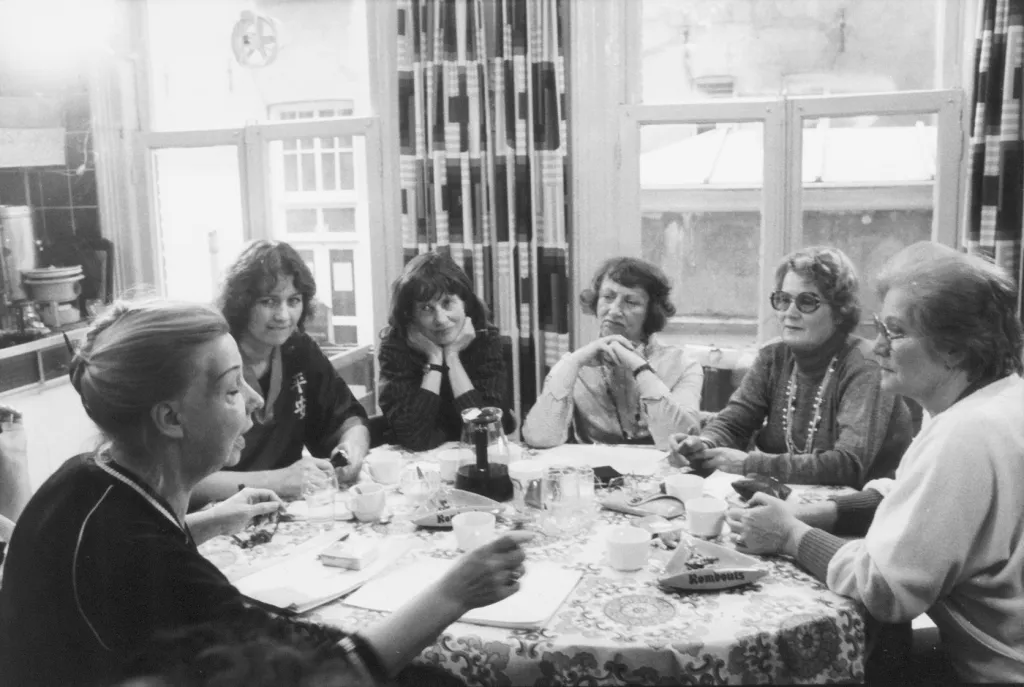
Talking groups also became popular in the Netherlands. During the 'second wave', groups on specific topics began to emerge. In 1974, the first Vrouwen in de Overgang (VIDO) discussion group was in Uithoorn. Until then, menopause was a mysterious phenomenon about which there was much prejudice and shame. There were few clear terms to describe the symptoms and experiences. There was intermittent talk about 'the switch' or 'the change'. But what exactly it meant, and what symptoms fell outside the transition, was unclear.
Women stepped out of their social isolation and started talking openly and honestly with each other about how they felt. It was not only about the physical symptoms of menopause, but also about loneliness. Often, complaints were denied or dismissed by doctors and loved ones.
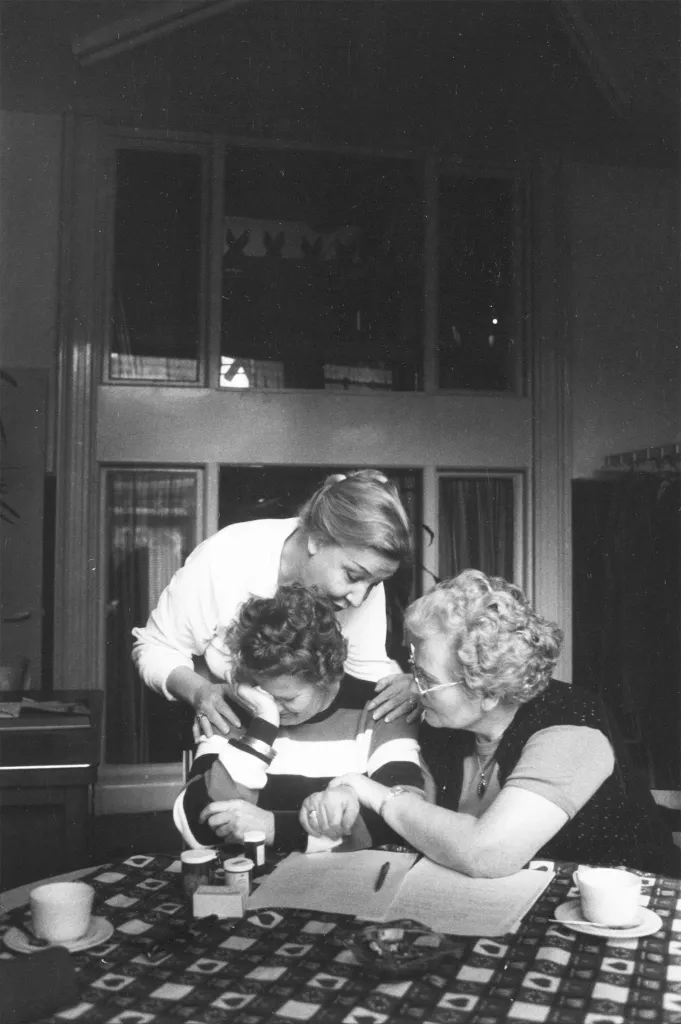
Doctors at the time had little knowledge about, and interest in, gender-specific care. Female patients were quickly labelled hysterical. In addition, it was common for women, without being informed in advance, to receive invasive surgery, with traumatic consequences. An example of this was the uterine surgery popular at the time. Within the discussion groups, women were able to tell their stories. And, just as importantly, see themselves reflected in others' shared experiences. The discussion group was often described as 'a feast of recognition'.
Finding words for the pain
Often the transition occurred simultaneously with the children leaving the parental home. The loneliness, traumatic experiences due to doctor visits and denial of their discomfort caused many women to suffer from psychological symptoms.
So in the discussion groups, the psychosomatic nature of menopause was also discussed at length. One question that emerged, for example, was: is our problem due to the transition itself or the socio-political position of middle-aged women in society, or are the causes intertwined?
Activism in the archive
However, the personal experiences of menopausal women also played an important role outside the discussion groups in the struggle for better care for female patients. Three sources from Atria's archives show how personal stories of menopause were used as a means of resistance.
How I aged 10 years in 'a month - in Vrouwenmantel
Atria's archives contain many local women's newspapers, for example Vrouwenmantel: a 1978 women's newspaper for Helmond and the surrounding area.The theme issue on health contains informative pieces on the use and abuse of tranquillisers, a stencilled interview from the Volkskrant with a feminist general practitioner from Rotterdam, and several personal stories of women who had unpleasant acceptances in medical care.
An anonymous woman talks about how, at the age of 30, as a mother of two, she goes to the hospital for her pill check-up, where her uterus is eventually removed. This causes her to go into early menopause. From her story, it does not sound like she was ever informed about this. The way she formulates the experience reads like a friend hanging on the phone with you. The story flows out. The woman tells how she is reassured time and again, and "not to worry so much". The next day, medical complications occur, requiring her to undergo surgery again. This repeats itself a few times. She feels increasingly alienated from her body, about which she cannot make decisions and receives no clear information.
"My belly has become a thing. It no longer belongs to me. All kinds of strange people slap the covers on and look at a piece of my body. Is that me?"
Surgeries, humiliating experiences in hospital and gloomy thoughts are all named in Women's Mantle. Women who had not yet participated in a support group themselves could still recognise themselves in this story.
Photo report about the course of a uterus operation by Marlies Bosch
Vrouwen zonder baarmoeder (Women Without Wombs) was originally a VIDO working group. It later developed into an independent foundation to provide support to women who had undergone (unnecessary) uterine and/or ovarian surgery. They provided information to women being considered or advised to undergo surgery and advocated for a more careful approach from medical practice. At the time, gynaecologists considered surgery in a wide range of complaints, especially if the patient was over 40 and already had children. Women were often not well informed about the consequences of such an intervention.
Marlies Bosch was one of many women in whom the uterus was removed. As a photographer, she decided to capture this process. From shaving the hair around the vulva to the operation itself, photographically captured by a friend of Bosch. The photographic report Het verloop van een baarmoederoperatie was eventually published as a leaflet with a detailed description of the operation, in simple language. This deviated from the often inaccessible language used by many doctors. Bosch had obtained information from Vrouwen zonder baarmoeder after her doctor's initial advice on the operation. She decided by recording her surgery to contribute to informing other menopausal women.
Black book gynaecological practices
Zwartboek Gynaecologische Praktijken (The Black Book of Gynaecological Practices) is a publication documenting abuses within gynaecology. In 1980, a tribunal (an often temporarily established judicial body in the form of a court) was organised at the Women's House Amsterdam. The self-organised tribunal came about after a male gynaecologist had 'experimented' during the sterilisation of a female patient, but got off too lightly at the Medical Disciplinary Tribunal. The Black Book is full of stories of medical negligence and unacceptable patient-doctor interactions, in which the gynaecologists and GPs involved are also named and shamed. By making these experiences public, other women could find out which gynaecologists to avoid.
"Apart from the anger we felt at all these personal experiences, when we put all these complaints together, we noticed very clearly that these were not random personal experiences of women, but that gynaecologists just work that way."
The book calls for breaking down a system in which women had no say over their bodies.
Conclusion
The shame and stigma women in the 1960s had to overcome to talk about a topic like menopause - at a time when it was only addressed with euphemisms - called for an intimate space, such as a support group, to discuss the pain and oppression for the first time. There came the realisation that personal problems were carried on many shoulders. Women could then organise themselves into a collective movement.
The celebration of recognition in the discussion groups gave women the confidence to share personal stories of transition beyond the intimate sphere of the group. Thus, personal stories could be used to mobilise others in the fight for better care and empowerment for middle-aged women.