By 1967, the abortion debate* had taken off in society. The following years saw many and rapid developments. Thanks to the 'second feminist wave', abortion shifted from a subject for experts to something for women to decide for themselves. At the same time, the first abortion clinics emerged in the Netherlands. Based on the sources below, these topics are further highlighted.
By 1967, the abortion debate* had taken off in society. The following years saw many and rapid developments. Thanks to the 'second feminist wave', abortion shifted from a subject for experts to something for women to decide for themselves. At the same time, the first abortion clinics emerged in the Netherlands. Based on the sources below, these topics are further highlighted.
1967: The abortion teams
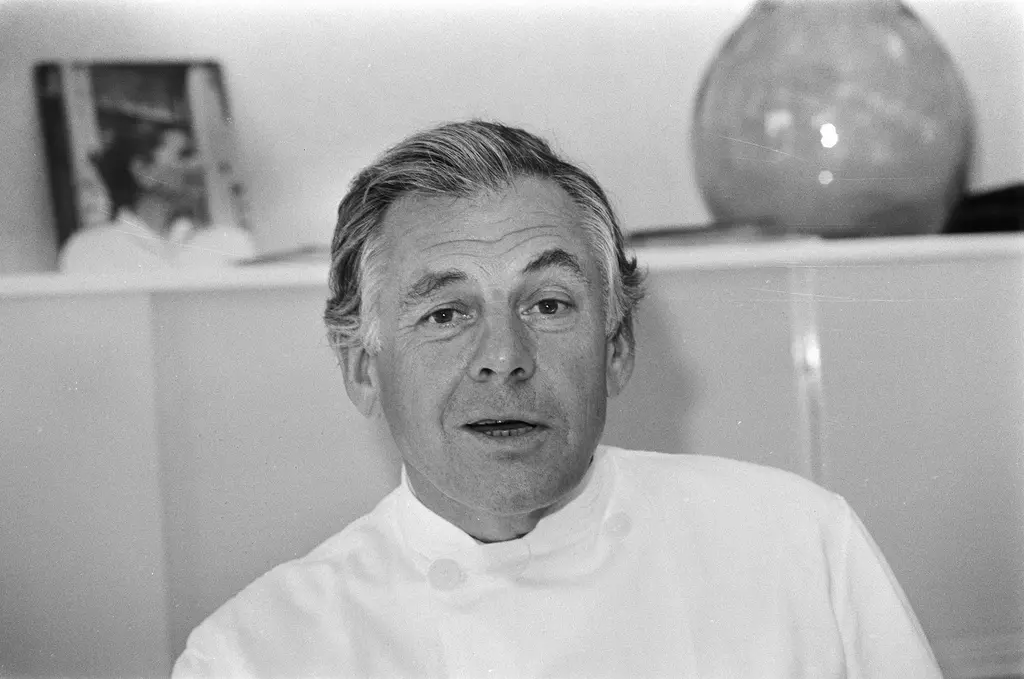
When the influx of abortion requests at the Wilhelmina Gasthuis took off after Kloosterman's TV appearance, they had to come up with a way of working quickly. To this end, the Netherlands' first abortion team was thus established. A gynaecologist, psychiatrist, social worker, psychologist and the referring GP: together, they would use a multidisciplinary approach to objectively determine whether or not a woman was eligible for an abortion. They would talk to the woman at length and then consult among themselves. Kloosterman recalled that sometimes evenings were spent discussing one woman. Abortion teams, also known as abortion committees, soon emerged in other Dutch hospitals as well.
Over time, however, the teams had to conclude that they did not work. There were no universal, objective criteria for allowing abortion. Through their experiences, they recognised that the moment one speaks of the beginning of a human life is subjective. They began to see the woman's feelings and values as the most important criterion. This understanding would form the basis for future abortion counselling. Between 1970 and 1972, the position of abortion teams changed from 'no, unless' to 'yes, unless': abortion requests were from now on always approved in principle. The main function of the teams thus disappeared and they effectively abolished themselves.
1968: Man-Woman-Society
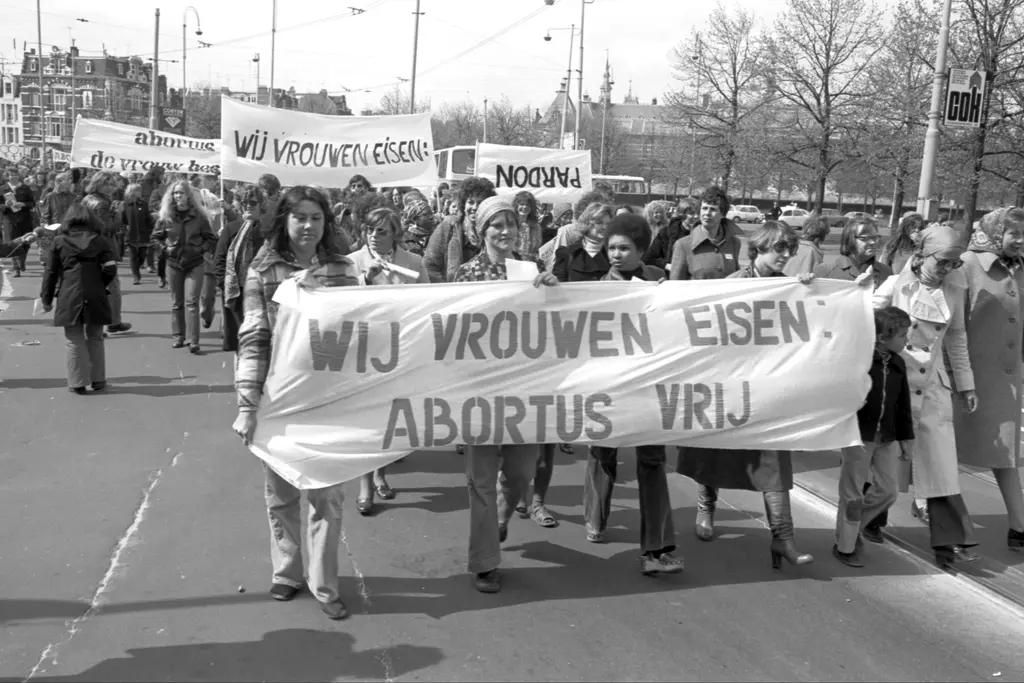
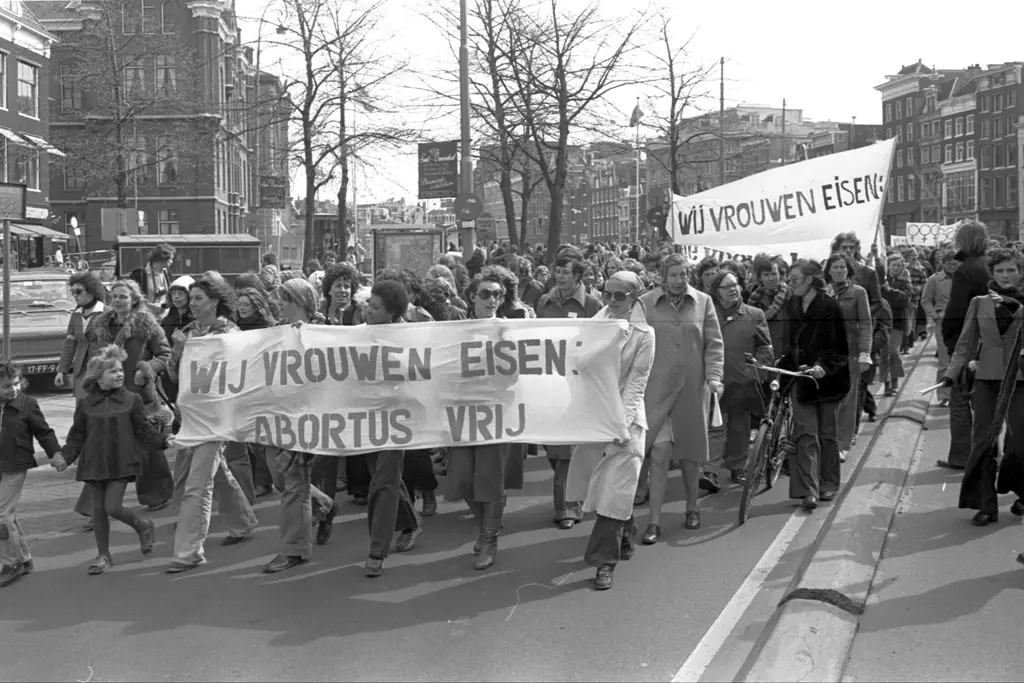
The resurgence of feminism in the Netherlands began in 1967 with Joke Smit's Het onbehagen bij de vrouw . A year later, she founded Man Vrouw Maatschappij (MVM) with Hedy d'Ancona, who later emerged as a politician. Soon the legalisation of abortion became one of their demands. This was a significant change in the abortion debate. Women were now participating in the debate themselves, where until then only experts had spoken. The legalisation demand was also new. Until then, reformers wanted a widening of abortion options, but not for it to disappear from the penal code.
1969: Dolle Mina
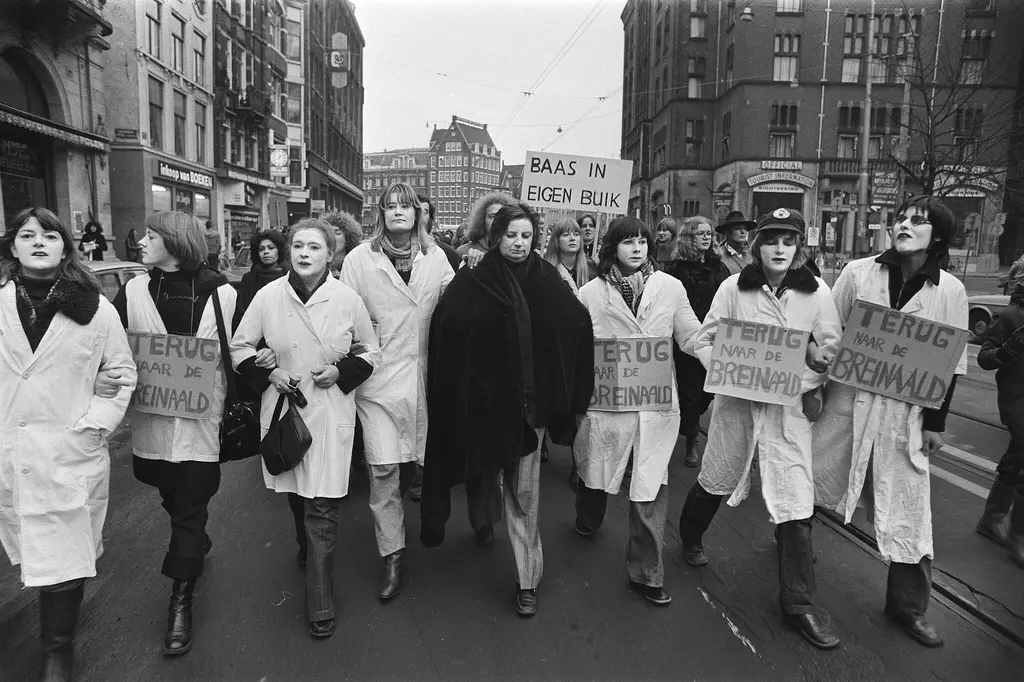
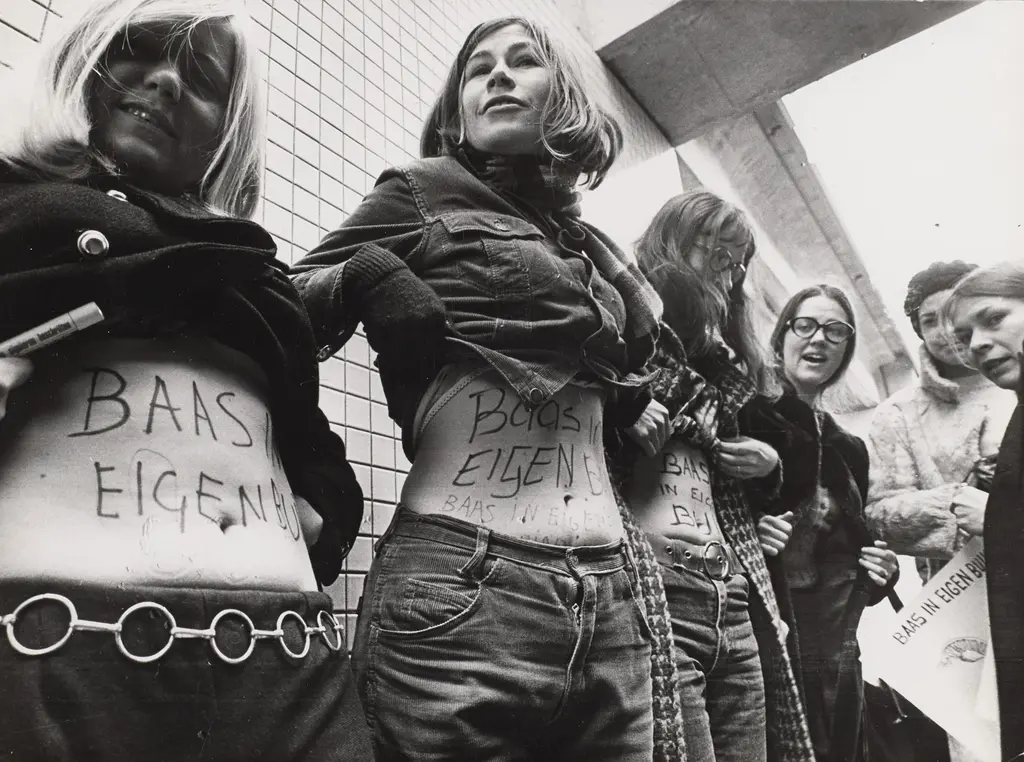
"Boss in your own belly" is probably the best-known slogan of the abortion struggle. On 14 March 1970, a group of Dolle Minas walked into a gynaecologists' congress in Utrecht. They bared their bellies bearing the relevant text and handed out flyers. This action immediately showed what Dolle Mina was good at: its way of campaigning was new, provocative, and above all very good at attracting media attention.
Founded in September 1969, the feminist action group Dolle Mina soon became one of the best-known faces of the 'second feminist wave' in the Netherlands. Soon, they also had their own abortion working group, targeting the public. Among other things, Dolle Mina organised the information event Op de vrouw af in 1970, which also focused on abortion.
That feminist organisations spearheaded abortion signalled an important change in the way abortion was spoken and thought about in society. Until then, it had been a medical matter for experts to judge. No, women's organisations now said, the woman decides. Abortion was portrayed by women as the last part of the liberation of female sexuality; after the earlier introduction of the contraceptive pill. Perhaps even more important was their positioning of abortion as an essential part of women's self-determination. Because abortion allows women to decide for themselves whether and when to start or expand a family. This allows women to exercise control over their own bodies and life (demolition). Thus, abortion became an essential part of the debate on women's gender equality.
1969 - 1970: Stimezo's public campaign
The establishment of specialised abortion clinics, as they still exist today, originated in the late 1960s. GPs in the Netherlands in 1969-1970 were very dissatisfied with abortion care provided by abortion teams and the teams themselves could not cope with all the abortion requests. All kinds of new initiatives for abortion care therefore emerged. For instance, some GPs decided to perform abortions themselves in their practices, like Frans Wong in Amsterdam. Other GPs worked together in groups to set up a clinic.
A particularly influential initiative was that of Rotterdam psychiatrist C. Th. Van Schaik. On 26 June 1969, he and journalist Peter van Eeten founded the Foundation for Medically Responsible Pregnancy Interruption, abbreviated Stimezo. Stimezo had two goals: opening an abortion clinic and influencing public opinion. Originally, Van Schaik did not intend to set up a clinic himself, but this changed when hospitals and gynaecologists could not be persuaded to perform abortions.
To gain widespread support, Stimezo launched a large-scale publicity campaign. In early 1970, a notice was written to the editors of more than 112 magazines. This asked for financial contributions and statements of support, which they received from civil society organisations such as Dolle Mina and MVM, among others. In the autumn, several magazines placed Stimezo's posters for free.
Attention peaked when radio and television broadcaster VARA set up a fundraising campaign for Stimezo in December 1970. However, VARA made it a condition that there would be a national organisation. Therefore, initiatives for abortion clinics elsewhere in the Netherlands were bundled with those from Rotterdam. Stimezo-Netherlands came into being three days before the television campaign. The aim was to raise money for the departments and possibly coordinate operations. The action raised 200,000 guilders.
1970: The first bill
On 25 June 1970, Labour Party MPs Jan Lamberts and Hein Roethof tabled the first bill 'to amend the penal provisions on pregnancy termination'. They pointed to the changing attitude of Dutch people towards abortion and were dissatisfied with the slow action of the government. They wanted abortion to disappear from the Penal Code as a crime against life and a crime against morals. Following the British example, abortion would be allowed in the case of a number of medical and social factors. Woman could then decide together with their GP.
A survey by the Dutch Association for Sexual Reform showed that almost three quarters of those questioned were in favour of legalising abortion and only 15 per cent against. So although Lamberts and Roethof had public opinion on their side, the law did not seem politically feasible. The Liberals would not risk their cooperation with the Christian parties, which disagreed with the progressive bill.
This first abortion legalisation bill would by no means be the last. Politics remained in the throes of the abortion debate for more than a decade. It was one of the central themes in election campaigns.
1970 - 1974: Anti-abortion organisations
Now that proponents of abortion legalisation had organised themselves, Stimezo had been established and a bill had been drafted, opponents of abortion legalisation also started organising themselves. In 1970, the Foundation for the Unborn Child (SOK) was founded in Zeist. They saw the solution in taking better care of the woman. This organisation was followed by the Association for the Protection of the Unborn Child (VBOK) in 1971 and the Foundation for Respect for Human Life (EBML) in 1972, among others. The most radical was the Stichting Recht zonder On onderscheid (STIREZO), founded by Nijmegen-based Father Jan Koopman in response to Stimezo. Koopman managed to attract press attention with demonstrations, banners and door-to-door distribution of gruesome photographs. The groups gained their greatest influence when nine of them united in 1974 to form the Committee Save the Unborn Child (CROK).
Whereas at first the anti-abortion groups still relied mainly on the Constitution, the Universal Declaration of Human Rights or criminal law, the reasoning gradually shifted to religious arguments.
1970: New abortion technology
Until the 1960s, first-trimester abortion in the Netherlands was done with a curette, a kind of scraper. However, this was not pain-free for the woman and it did not always go right the first time. Innovation in this area came from China. There, the state encouraged the development of new birth control techniques in the 1950s.
In 1958, some Chinese doctors invented suction curettage (vacuum aspiration). Using a pressure differential, abortion could be performed much easier, less dangerous and virtually painless under local anaesthesia. Connecting the suction to an electric motor further improved the technique. From China, suction curettage spread to the United States, where Van Schaik of Stimezo then travelled to learn the technique. In 1970, suction curettage reached the Netherlands, where Frans Wong, among others, applied it in his practice. Within a few years, it had replaced regular curettage as the main tool for abortion care, eliminating the need for women to spend the night in the abortion clinic.
1971: The first abortion clinics
There was plenty of discussion by politicians about the legalisation of abortion, but they were running behind the practice in the meantime. Thanks to Stimezo's public campaign, the first abortion clinics could be set up in 1971.
Clinics-in-waiting were able to borrow money from the amount raised to get their clinics off the ground. Their income often paid back the loan quickly, allowing that same money to support a new clinic. The first abortion clinic in the Netherlands was the Mildredhuis in Arnhem, which opened its doors on 27 February 1971. That same year, clinics sprung up in Beverwijk, Utrecht, Amsterdam, The Hague and Rotterdam. Although abortion was not legal in the Netherlands, the clinics were tolerated. This practically ended illegal abortion by medically unauthorised people and travelling to England for an abortion. From then on, foreign women actually knew how to find Dutch clinics.
* By 'abortion' in this timeline, we refer to 'abortion provocatus', or the deliberate termination of a pregnancy.