"It used to not be talked about in our family. Abortion, it couldn't be done. Babies just had to be born." This is how Johanna (born 1933) recalls the taboo on abortion in the 1950s and 1960s within her Catholic family in Central Brabant.* This non-negotiability was partly due to the Morality Act that had come into being in 1911. Based on the sources below, these issues are further highlighted.
"It used to not be talked about in our family. Abortion, it couldn't be done. Babies just had to be born." This is how Johanna (born 1933) recalls the taboo on abortion in the 1950s and 1960s within her Catholic family in Central Brabant.* This non-negotiability was partly due to the Morality Act that had come into being in 1911. Based on the sources below, these issues are further highlighted.
1911: The Morality Act
After 1901, the first nationwide abortion debate began with a plea for the abolition of the abortion ban. However, this actually resulted in stricter abortion laws in 1911. The Morality Act of 1911 was introduced by Roman Catholic justice minister Regout. The confessional parties were the largest parties in the cabinet during this period. They had deep concerns about the moral standard of the Netherlands, which many socialists and liberals shared with them. This was reflected, among other things, in the new law.
Abortion** was henceforth defined as a crime against morality rather than a crime against life. Besides abortion, the Morality Act banned brothels, pornography, homosexual acts by both men and women and the display and advertising of contraception, among other things.
"He who intentionally treats a woman or causes a woman to undergo treatment, indicating or raising the expectation that pregnancy may be disrupted thereby, shall be punished by imprisonment for a term not exceeding three years or a fine not exceeding three thousand guilders."
Stringent prosecution
Prosecution of abortionists became easier because from now on proof that the foetus was alive at the time of the abortion was no longer required. Proof that a woman had been "undergoing treatment" was sufficient. The abortionist was punished with imprisonment or a fine. This amount increased if it had been done for profit, or if it involved a doctor or midwife. The woman undergoing the treatment was herself not punishable. The law also contained provisions to prevent the spread of abortion drugs.
The fact that medical abortion was not punishable was not mentioned in the law (as in 1886) because, among others, minister Regout took it for granted. The stricter moral and penal climate created uncertainty among doctors. Was medical abortion allowed or not? The result was an extremely cautious and dismissive attitude among doctors that would last for a long time.
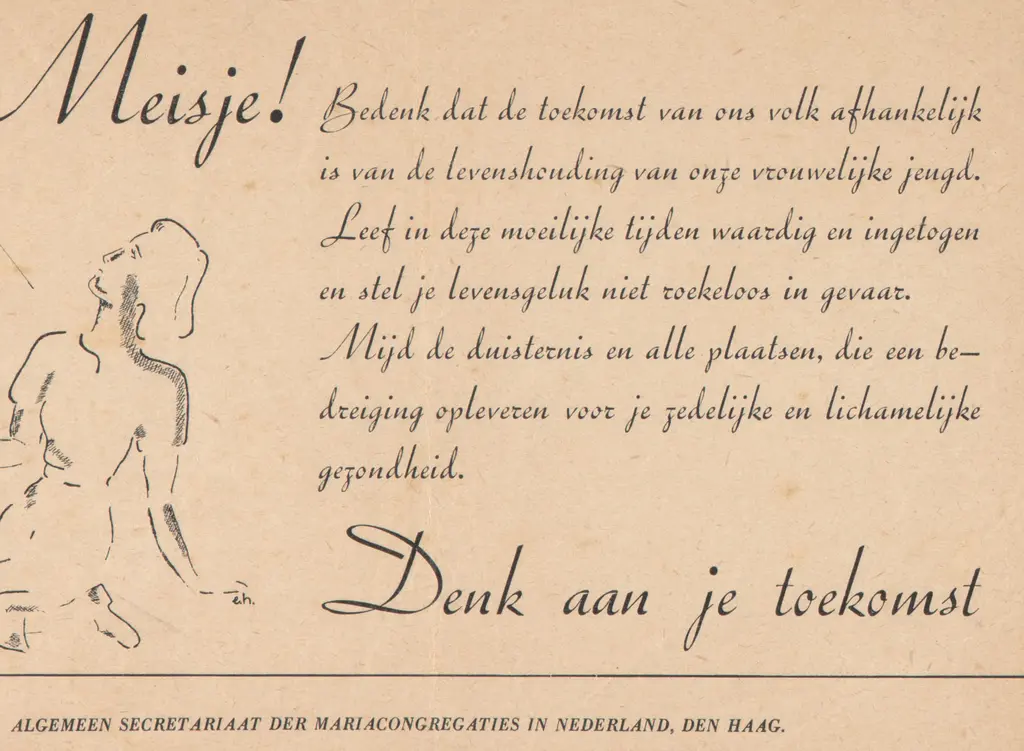
1911 - 1960: Atomisation of the debate
Although abortion was narrowly discussed in political debate after 1911, the debate flared up again around 1930, following the legalisation of abortion in the Soviet Union and debates about legalisation in Germany. After 1911, the debate was dominated by 'experts': criminal law scholars, criminologists, doctors, psychiatrists, theologians and ethicists. Every now and then they published a study on abortion (e.g. Van Heynsbergen and Van Balen Blanken, 1925 on allowing abortion after a sexual offence; or Valkhoff, 1934 on legalisation). Women and feminist groups did not participate in the discussion. According to emeritus professor of women's studies Joyce Outshoorn, this was because abortion was not then defined as a feminist interest.Within the women's movement at the beginning of the 20th century, ideals such as motherhood and sexual control were central.
In the 1950s, the taboo on abortion peaked. No articles appeared and no one publicly raised the issue.
1911 - 1960: Abortion behind closed doors
"An abortionist arrested. Treatment to death."(The People, 1929)
"A doctor prosecuted for abortion".(The Telegraph, 1920)
Headlines like these are illustrative of the increased number of convictions following the introduction of the stricter and more effective abortion laws of 1911. Yet abortion did not disappear, but henceforth took place in the deepest secrecy. Not only because it was punishable, but also because defining abortion as a morality problem meant that abortion became unmentionable.
Dangerous potions
When a woman wanted an abortion (and she had no medical reason to get one in hospital), she would often first go on her own with folk remedies, or newer remedies such as quinine and apiol. These chemical potions were available in certain drugstores under all sorts of made-up names (Dr Martin, Dr Ellison, Dr Richter, gouttes Marcella). They could only be very dangerous, sometimes even fatal for the woman.
Taking action herself
When these remedies did not work, the woman had three options. First, she could try inserting an instrument into the womb herself, possibly with the help of a family member, neighbour or friend. For example, Treub mentioned a ballet dancer who had induced an abortion nine times this way.
Professional abortionists
Second, the unwittingly pregnant woman could visit an illegal abortionist. These professional abortionists, usually with no medical background, often had thriving practices and were not hard to find. It was easy to get an address via via. They also placed veiled advertisements, especially in local and regional magazines. In Amsterdam, cards were also distributed door-to-door, on which 'professors', 'clairvoyants' or 'masseurs' offered advice on 'every possible life issue', 'marriage' or 'period breakdowns'. Illegal abortionists mostly operated in towns, to which women came from the surrounding region. Some cases are also known of abortionists visiting their clients. Historian Cornelis Johannes Brenkman wrote in 1912 about an abortionist who travelled from Rotterdam to the islands of South Holland with a knitting needle and stayed with her clients until the abortion was successful. Often abortionists could live off their income as abortionists. Not for everyone the income was the motive; sometimes they also acted out of pure conscience. Abortions were relatively often performed by women: 58% of convicted abortionists were women.
Abortion at the doctor's office
A third option was to go to a (home) doctor who performed abortions illegally. These were probably not many and usually charged a higher rate. One well-known GP who was convicted of performing abortions was W.F. Storm. In 1953, Storm, also until then the president of the Dutch Society for Sexual Reform (NVSH), was given a six-month suspended prison sentence for performing three abortions without medical reasons.
The ban made abortion far more dangerous than it needed to be. Hospital doctors were confronted with the injuries women suffered in the process, making them mostly reluctant to perform abortions. Yet the abortion debate would begin among doctors in the 1960s.
* From a brief conversation with Johanna, in response to a call to speak to individuals about the taboo surrounding abortion during this period.
** By 'abortion' in this timeline, we refer to 'abortion provocatus', or the deliberate termination of a pregnancy.