Abortion and the right to self-determination is an important topic in the (international) public debate. How did the abortion law originate in the Netherlands and which organisations fought for a good law?
Abortion and the right to self-determination is an important topic in the (international) public debate. How did the abortion law originate in the Netherlands and which organisations fought for a good law?
Towards the end of the 1960s, the public debate on abortion started. Several hospitals were given a committee to determine whether an abortion could possibly be performed. It was clear that there would be an abortion law, the only question was when. The first illegal abortion clinics opened their doors. Justice did not intervene. From several European countries, buses full of women came to the Netherlands to have abortions in one of the government-sanctioned clinics.
Knitting needle or soapy water
The morality laws of 1911 increased the punishment for abortion. Only practitioners (doctors or illegal abortionists) were punishable under it. Women undergoing abortions were not punishable. Illegal abortions were common. Abortions were performed with the proverbial knitting needle or soapy water, or women dropped down stairs. It often had horrific consequences. Internal puncturing could cause air bubbles in the bloodstream or perforation of the uterus. Unsanitary instruments or improper spraying of the suds often resulted in severe abdominal wall infections. Women regularly died from such 'treatments'.
First abortion clinic
The first abortion clinic was the Mildredhuis (later the Mildred Rutgershuis) in Arnhem. Here pregnancies were illegally terminated from 1971 onwards. The house was founded by some general practitioners who disagreed that women had to go to England to terminate an unwanted pregnancy. In the UK, abortion on foetuses under 28 weeks had been legalised since 1967 (up to 24 weeks since 1990).
Demonstrations
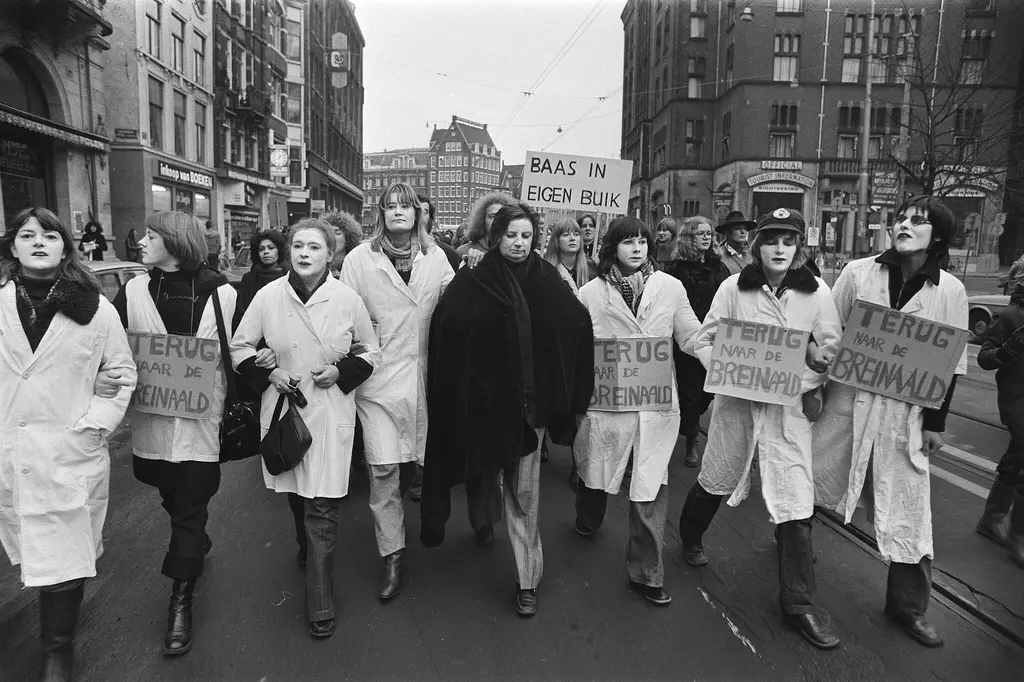
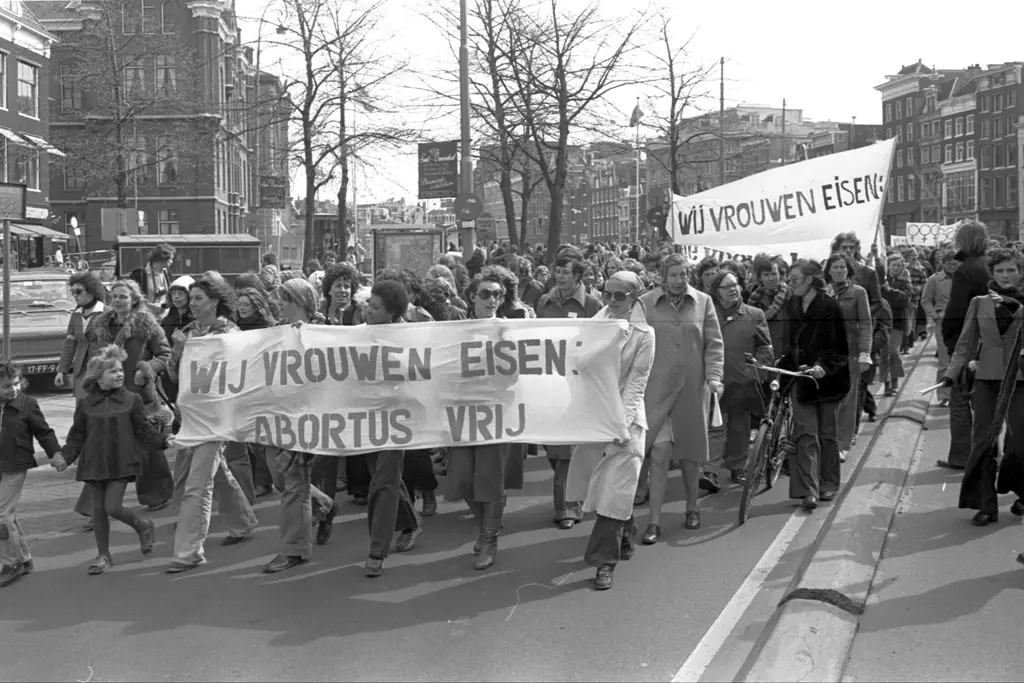
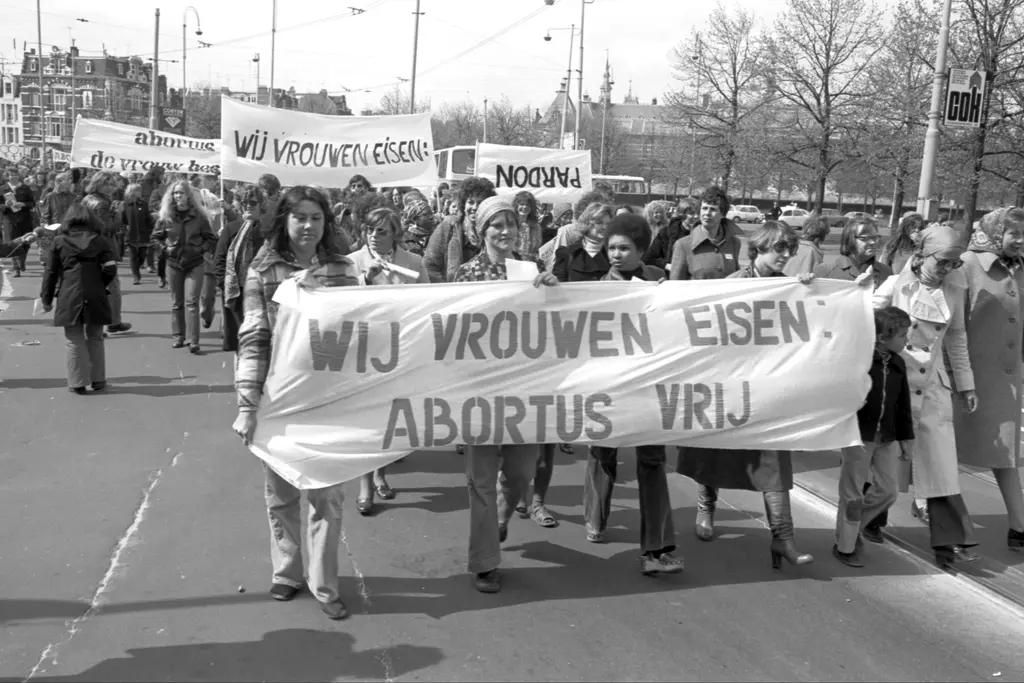
The 1970s saw regular demonstrations for proper abortion legislation by the likes of Dolle Mina and We Women Demand who summarised their demands as:
Abortion out of the penal code
Abortion in the health insurance fund
The woman decides
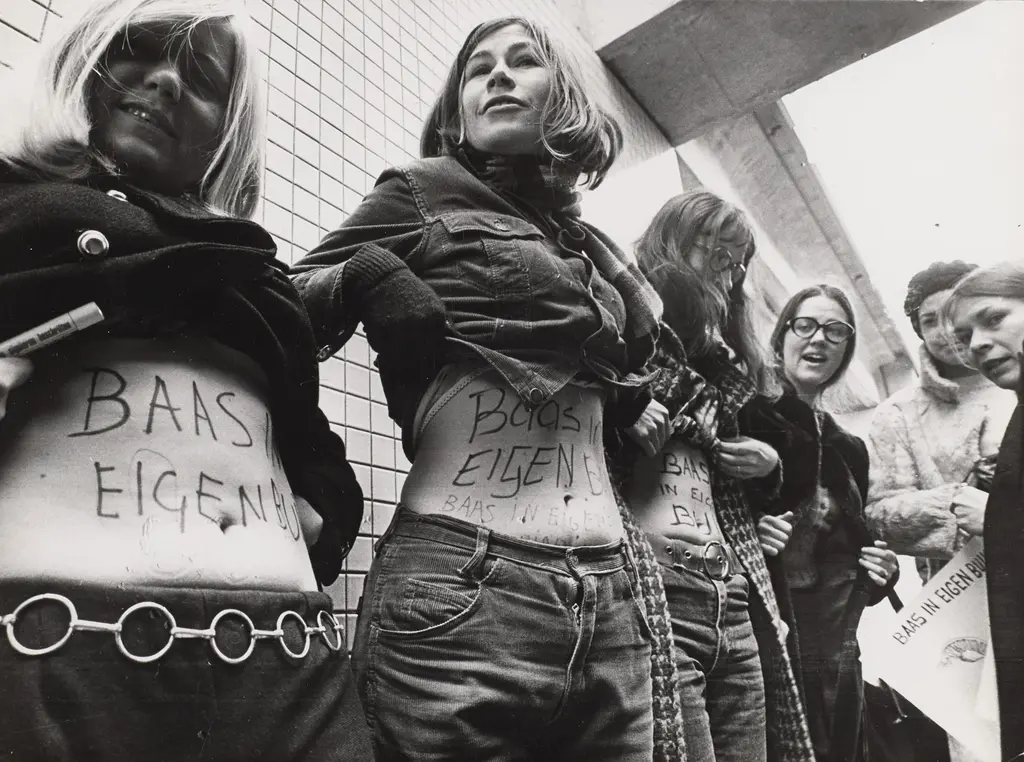
One of the key action points of both Dolle Mina and other women's organisations was 'abortion free'. Women demanded the disposition of their own bodies and campaigned for the removal of abortion from the Penal Code. Dolle Mina's slogan Boss in Own Belly is a winged expression still used today.
Dolle Mina
Dolle Mina was an action group, formed in late 1969 in Amsterdam. It took its name from Wilhelmina Drucker. A major theme was the constant fight for free abortion. Dolle Mina did not have a membership, but it did have 35 sections, working groups and political education groups. In 1974, for the legalisation of abortion, the separate action group We Women Demand was founded. Dolle Mina was characterised by striking actions and held many lectures.
Dolle Mina archive
Some of the circulars and pamphlets (1970 - 1976) have been digitised
AXI-bulletin, Dolle Mina Amsterdam newsletter (1970-1977)
We Women Demand
We Women Demand was founded in October 1974, by Selma Leydesdorff, Marjan Sax and Ria Sikkes. They were previously active in Dolle Mina's abortion group, which could no longer cope with all the required activity and sought broadening.
Archive We Women Demand
Bloemenhove
In 1976, a conflict arose in the cabinet (consisting of PvdA, PPR and D66) over the Bloemenhove abortion clinic in Heemstede. Justice minister Dries van Agt wanted the clinic closed. A complaint had come in from a German woman who had lost a second foetus naturally, after the first had been aborted at Bloemenhove. On 18 May 1976, the public prosecutor announced that the clinic had to close its doors that same day. Dozens of women subsequently occupied the Bloemenhove clinic and prevented the officers who wanted to confiscate the treatment rooms from entering.
Minister Van Agt was challenged by the Liberals during an emergency debate in the Lower House the next day. The House passed a motion putting the fate of Bloemenhove in the hands of the courts. However, Van Agt announced he would not abide by the motion and prepared a raid on the Bloemenhove clinic. The clinic was tipped off that a raid was planned the next morning. Some three hundred women accordingly rushed to the clinic and helped ensure that Van Agt called off the raid shortly before it started.
In the end, the clinic did not close. It was decided not to prosecute for abortions up to 13 weeks.
Women's strike 1981
On 30 March 1981, an estimated 400,000 to 500,000 women marched nationwide. The Women's Strike was mainly aimed at legalising abortion. Women campaigned in many ways. For example, they hung sheets out of windows with slogans like Ik staak tegen de Abortuswet (I am striking against the abortion law) or went on strike while sailing.
Abortion law
The current abortion law dates back to 1984. After much political wrangling and several draft laws, the new abortion law was finally passed in 1981 and amended in 1984. The Termination of Pregnancy Act allows abortion provocatus in the Netherlands under certain conditions:
the procedure may only be performed in designated clinics or hospitals
there is a waiting period of 5 days
Update: On 21 June 2022, the Senate agreed to the proposal to remove the compulsory legal reflection period for abortion. On 4 March 2025, a motion was passed in the House of Representatives to investigate abolishing the mandatory reflection period.no one can be obliged to cooperate in abortion
On 1 November 1984, the abortion law came into force in the Netherlands. The bill would not have been far off. On 18 December 1980, the bill was only just approved (76 against 74) in the Lower House. The Upper House also passed the abortion law a few months later with only a narrow majority (38 against 37).
PSP Lower House party collection, abortion collection
Abortion in other countries
The Netherlands was certainly not the first country where abortion could be performed under certain circumstances. In 1920, Russia was the first country where you could have an abortion without risk of persecution. However, Stalin reversed this in 1936. In Iceland, abortion has been legal under certain conditions since 1935 and in Sweden since 1938.
In America, abortion has been legal since 1973, following the Roe vs Wade ruling. According to progressive judge Ruth Bader Ginsburg, abortion may have been legalised but never accepted in the US. Update: On 24 June 2022, the US Court ended the nationwide right to abortion by rejecting the 1973 ruling.
In the Netherlands, abortion is still in the Penal Code. Update: On 21 June 2022, the bill to remove the mandatory 5-day reflection period was passed. That mandatory reflection period still exists in 8 European countries and goes against WHO advice.
Clinics
There are 14 clinics in the Netherlands where a woman can have an abortion. But it is not part of women's regular healthcare, which means the care is not equally accessible to everyone.
Abortion pill
While a country like Ireland now has 300 GPs dispensing abortion pills, in the Netherlands the abortion pill is still punishable under Article 296 of the Penal Code. In 2018, GroenLinks and the PvdA tabled an initiative bill to regulate that the abortion pill can now be dispensed by GPs. Now, women can only get this pill on prescription from the hospital or abortion clinic. Update: This initiative bill was passed by a large majority in the Senate on 6 December 2022, allowing GPs to start prescribing abortion pill to pregnant people.
Women on Waves
In 1999, doctor Rebecca Gomperts founded Women on Waves. The organisation offers help to women living in countries where abortion is not allowed. They take women who want an abortion into international waters so that Dutch law applies. In 2005, Gomperts founded Women on Web, which sends abortion-inducing drugs to women in countries where abortion is banned or severely restricted under online guidance. Gomperts stressed in the Volkskrant of 8 June 2019 that women's rights are again under great pressure:
"As soon as a country becomes less democratic, as soon as the rule of law is gnawed away and authoritarian forces win, women's rights come under pressure. And abortion first."
Counterforces
Father Koopman
"Heaven forbid; within two years that barbaric abortion law will be gone," Fr Jan Koopman predicted at his last demonstration at the Binnenhof in 1994. He was the first to demonstrate against abortion clinics in 1974. As a counterpart to the Foundation for Medical Termination of Pregnancy, Stimezo, he founded Stirezo. Right Without Discrimination: the right of unborn life. Koopman distributed leaflets and pamphlets explaining that killing children in the womb was terrible and an abomination to God. He rallied many people to the first abortion clinic (Bloemenhove) and, through advertisements, hundreds of thousands of signatures against legalising abortion.
VBOK
The Society for the Protection of the Unborn Child will cease to exist almost 49 years after its founding. From 1 January 2020, VBOK will merge into aid organisation Siriz.
Cry for Life
Scream for Life Foundation is a Christian pro-life organisation, which deals with the beginning and end of life. People from the foundation demonstrate in front of abortion clinics to persuade women not to have abortions.