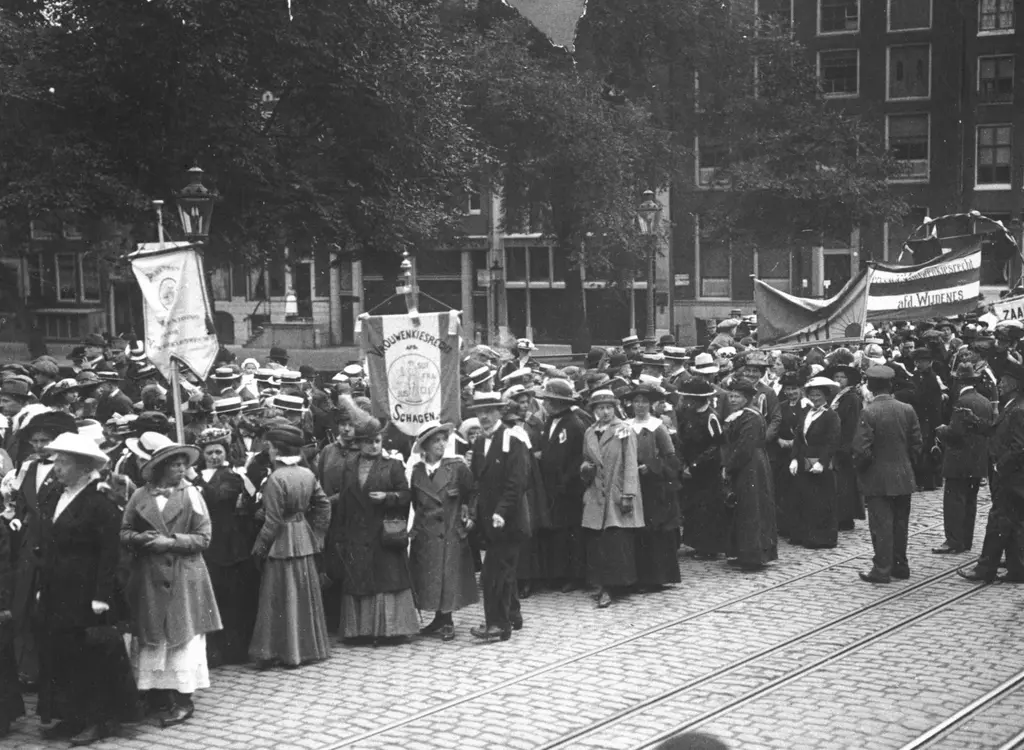
On 18 June 1916, a large demonstration in favour of women’s suffrage took place in Amsterdam. The march, involving 18,000 demonstrators – both women and men – paved the way for the inclusion of universal suffrage for women in the Constitution in 1922.
On 18 June 1916, a large demonstration in favour of women’s suffrage took place in Amsterdam. The march, involving 18,000 demonstrators – both women and men – paved the way for the inclusion of universal suffrage for women in the Constitution in 1922.
It was an impressive sight on 18 June 1916. According to the newspapers, an estimated 18,000 men and women had gathered at the IJsclub on Museumplein in Amsterdam to make their views known.
"First came the mounted police, followed by a marching band. This was followed by the actual procession, featuring three women and a gentleman on horseback, one of whom was dressed as the Dutch Maiden, a figure symbolising the Dutch state. They held aloft a shield bearing the words ‘Women’s suffrage’.”
Behind them marched women dressed in the colours of the Association for Women’s Suffrage: yellow and white. They represented the countries that had introduced women’s suffrage in full or in part. Behind them followed women dressed in green. According to the newspapers, that colour represented the hope for universal women’s suffrage. The women represented the Dutch provinces and the then colony of the Dutch East Indies. Women from branches of the association across the country took part, dressed in local traditional costume. Behind them came the other parties, and the procession was brought up the rear by carriages carrying people who were unable to walk themselves.
At the IJsclub, where the crowd had gathered, eight women and four men spoke out in favour of women’s suffrage, concluding with a motion stating that the constitutional amendment must ensure that women, too, would be granted universal suffrage.
An extensive photo report appeared in Het Leven, and the magazine De Proletarische Vrouw wrote:
"[…] in the end, they marched on together: the bourgeois women, who do want the right to vote but wish to preserve the existing social order, and the socialist women, who want the right to vote so that they can use it in the class struggle to bring about a socialist society."
Following the successful demonstration, membership of the Association for Women’s Suffrage rose to 22,000.
"The demonstration in Amsterdam in support of women’s suffrage, organised by the Association for Women’s Suffrage, was a resounding success."
Born out of a split within the suffrage associations: the Association for Women’s Suffrage
In March 1883, Aletta Jacobs submitted a request to the Amsterdam City Council to be included on the electoral roll, as she met all the requirements laid down by law. The response was that women could not be expected to possess all civil rights.
Jacobs took her case to the District Court and the Supreme Court. Among the responses was that it could not possibly have been the intention of the Dutch legislature to grant women the right to vote. Partly as a result of Jacobs’ petition, a constitutional amendment to the electoral law was made in 1887; from then on, voters were required to demonstrate ‘signs of social prosperity and suitability’. It was also stipulated that they had to be male.
In order to secure an extension of the right to vote, women were invited to join existing suffrage associations. However, following a bill tabled by MP Tak van Poortvliet in 1893, which would have significantly expanded the right to vote, it became apparent that the suffrage associations had been motivated solely by a desire for support; they had no interest in women’s suffrage.
This led Wilhelmina Drucker of the Free Women’s Association to decide in 1893, together with Theodore Haver and D.G. Stokvis, amongst others, to take the initiative to form an association for women’s suffrage. As early as July 1893, a lecture was held on universal suffrage, featuring Theodore (Schook)-Haver and Pieter Jelles Troelstra as speakers; the latter would go on to found the Social Democratic Workers’ Party (SDAP) in 1894, together with others. On 5 February 1894, the Association for Women’s Suffrage (VVK) was founded.
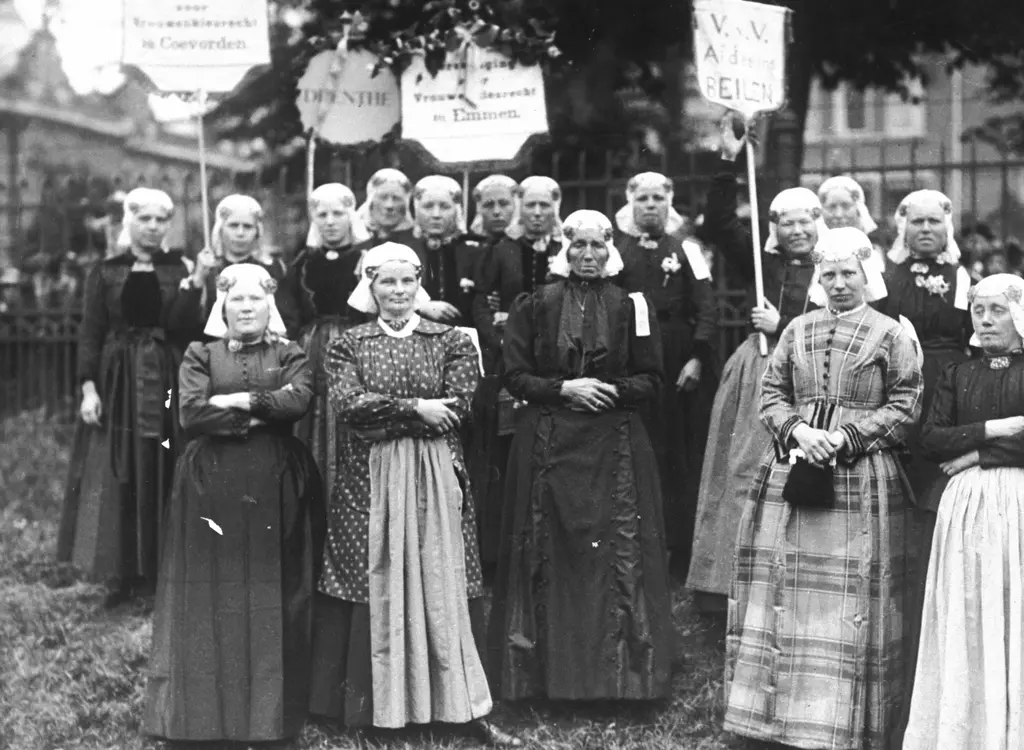
Demonstration for women’s suffrage
The demonstration for women’s suffrage took place on 18 June 1916. The VVK had long been planning to hold a demonstration to coincide with the constitutional proposals, which was to be larger than ever before. However, the demonstration did give rise to differences of opinion within the VVK and would lead to the resignation of a group of members who went on to found their own association under the name the Neutral Association for Women’s Suffrage.
A great deal of preparation went into the demonstration. A call to action was published in the monthly magazine of the Association for Women’s Suffrage. The executive committee invited several organisations to take part in the event. In this way, the women sought to demonstrate that universal suffrage for women was supported across all sections of society. The Men’s League for Women’s Suffrage sided with the Association, and various political parties expressed their support. Newspaper advertisements called on women and men to join the demonstration. During the demonstration, placards were also held aloft urging people to join the procession, in order to gather as large a crowd as possible. The SDAP called on its members in the daily newspaper Het Volk to attend in as large numbers as possible. The party wanted to demonstrate that female workers and the wives of workers were also entitled to the right to vote.
"The more women who take to the streets for this demonstration, the stronger the message will be."
Not all socialists agreed with this expression of support.
"The bourgeois association for women’s suffrage reimburses travel expenses. So here, these working-class women are being exploited to bolster the bourgeois movement, using the money that these ladies’ husbands squeeze out of the workers’ bodies."
However, the VVK shared the same aim as the socialists: universal suffrage for all. Ultimately, the VVK was able to secure the support of the socialists. The demonstration followed this route: Museumterrein, round the IJsclub grounds, Honthorststraat, Jan Luikenstraat, the bridge over the Rijksmuseum, Spiegelgracht, Spiegelstraat, Heerengracht, Koningsplein, Singel, Sophiaplein, Rokin, Dam, Mozes en Aäronstraat, Raadhuisstraat, Westermarkt, Rozengracht, Marnixstraat, Leidscheplein, Stadhouderskade to the IJsclub.
The Algemeen Handelsblad reports that at one point public order was threatened. This occurred on the Spiegelgracht, shortly after the demonstrators had left, when ‘a small group of men and women attempted to push their way to the front of the procession’. They were carrying a placard bearing the words: ‘The people are hungry’. The police managed to remove the troublemakers, but at the Geelvincksteeg they tried to rejoin the procession, shouting: ‘Away with the right to speak’.
When the procession returned to the Museumterrein at three o’clock, an open-air rally took place. A number of speakers addressed the demonstrators, including Aletta H. Jacobs, Sophie W.A. Wichers, Martina G. Kramers, Clara Mulder van de Graaf-De Bruin, Cornelia V. v.d. Meer van Kufferler, Jo van Diesen-Oberink, M. Wibaut-Berdenis van Berlekom and Heleen Ankersmit.
Restoration of a 1907 banner campaigning for women’s suffrage, from the IAV-Atria collection
Universal suffrage for women in 1919
The march was impressive, but did not immediately yield the desired result. “No constitutional amendment without women’s suffrage” – as forceful as it sounds – had not yet been adopted in political circles. It was not until 1922 that women were allowed to vote for the first time in the elections to the House of Representatives.