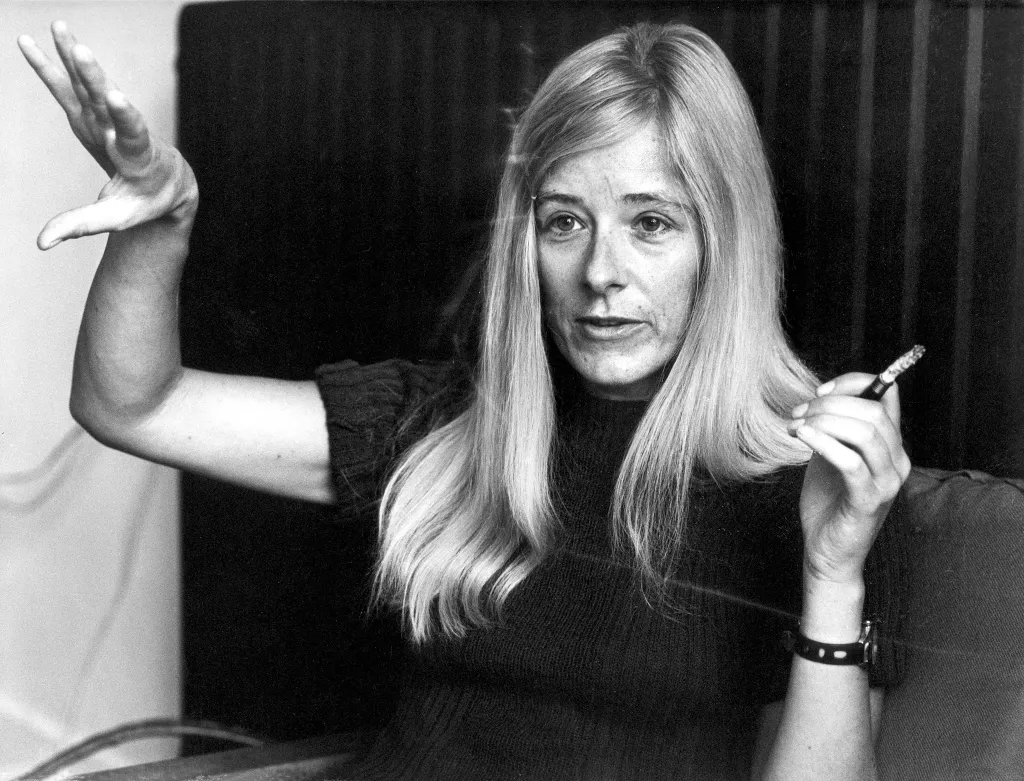
Joke Smit has also been called the icon of the 'second feminist wave'. The journalist, educator and feminist gained great fame with Het onbehagen bij de vrouw. This article is often considered the starting point of the 'second wave' in the Netherlands. Its impact would lead Joke Smit to work tirelessly for the 'women's cause' for the rest of her life.
Joke Smit has also been called the icon of the 'second feminist wave'. The journalist, educator and feminist gained great fame with Het onbehagen bij de vrouw. This article is often considered the starting point of the 'second wave' in the Netherlands. Its impact would lead Joke Smit to work tirelessly for the 'women's cause' for the rest of her life.
The uneasiness of women
In 1967, the Netherlands had a wake-up call when Het onbehagen bij de vrouw was published in the literary magazine De Gids. In the 1960s, there were few working mothers, let alone that society was set up for two working parents. Drawing on her own experiences, Joke Smit describes how women bore the brunt of the organisation of the labour market and marriage at the time. Or, as she herself puts it: "In short, as soon as there are small children, the house door falls into lockstep behind most women. As long as that remains the case, there will be a waste of human potential and my private unhappiness will not go away."
The article hits like a bomb. Countless Dutch women recognised themselves in the discomfort described by Joke Smit and wrote her letters to express this displeasure. These expressions of support would later inspire Joke Smit and Hedy d'Ancona to found the feminist action group Man Vrouw Maatschappij. Today, Het onbehagen bij de vrouw is considered the beginning of the 'second feminist wave'.
The uneasiness of then and now
In her time, Joke Smit was one of the few mothers with paid work. In her article, she focuses mainly on the labour market. Here, there would be a lot to do. Among other things, she argues for a 30-hour working week for men and women, which would allow for a better division of domestic and parenting tasks. Above all, she argues that women should also be able to assert their potential outside the home, without being trapped in the straitjacket of marriage or parenting. According to her, the feminist ideal lay primarily in three things:
That women would become free human beings
That she would realise her potential as much as possible
That she would become a full member of society
None of these things, according to Joke Smit, had been achieved, and in none of these areas had women got as far as they should theoretically be able to get. The problems she faced as a working mother and the unease she felt in doing so did not appear to be a private matter. Many women in the Netherlands shared these concerns and feelings, with which Het onbehagen bij de vrouw can be crowned a turning point in the gender equality struggle.
The topicality of the three issues Joke Smit draws attention to is apt. For instance, it now appears that women are still more likely to be financially vulnerable than men. Even in politics, women still do not seem to be able to realise their potential enough.
Founding Man Vrouw Maatschappij (MVM)
On 26 October 1968, Joke Smit and Hedy d'Ancona decided to found Man Vrouw Maatschappij (MVM) to put their ideals into practice. MVM became a unique feminist organisation in Europe by not excluding cooperation with men. The organisation's main aim was to address social discontent in a practical way. Both women and men could participate in it. With this pragmatic attitude, MVM regularly managed to penetrate Dutch politics when forming gender equality policies. Yet the organisation was sometimes criticised by other feminist groups. Not everyone agreed with the pragmatic, politically-oriented approach in which men also played a role.
"ladies beautiful, gentlemen gorgeous"
That Joke Smit also held her feminist ideals in high regard outside the political agenda is shown by an incident from 1970. On an invitation card for guests of the then mayor of Amsterdam (Ivo Samkalden), the dress tip read "ladies beautiful, gentlemen plain". Smit filed a complaint. She felt that the municipality was thwarting men's ability to be also beautiful. Her alternatives 'ladies beautiful, gentlemen also' and 'ladies beautiful, gentlemen gorgeous' were rejected.
"Sometimes I think it might be another 100 years before the individual will decide what to do based on abilities, and not on the fact that they happened to come into the world as a boy or a girl."
'Sisters, be courageous, astute, united'
Even in the last years of her life, Joke Smit remained committed. In 1977, she advocated the creation of a women's party. One of her main concerns was that women needed to find a way to exert political influence to gain power. For her, a women's party was the solution. Just as the workers, Catholics and Reformed had organised themselves into a political party. Joke Smit did not believe in "the myth of organic growth". An increase of women in boards, committees and politics would not happen automatically, it had to be enforced.
In 1980, Joke Smit got breast cancer, and a year later she died. Joke Smit lives on in the many awards, initiatives, streets and schools named after her and in the many articles and books she wrote in her short life. Her gravestone leaves her message: "Sisters, be courageous, astute, united".
Short film by Karlijn Broekhuizen (Bureau Op Zolder) about Joke Smit (2015)
Brief biography Johanna Elisabeth (Joke) Smit
27 August 1933: born in Utrecht
1951: diploma Gymnasium A
1955 - 1966: French teacher
1956 to 1974: married to Constant Kool, two children
1958: doctorate in French language and literature
1962: freelance journalist in Paris and editor of the magazine Tirade
from 1967: chief scientific officer at the Institute of Translation (University of Amsterdam)
1967: publication Het onbehagen bij de vrouw in De Gids
1967: member of the Dutch Labour Party
1968: co-founder action group MVM
1970-1971: city councillor in Amsterdam for the PvdA
From 1971: on (core) editorial board of PvdA magazine Socialisme en Democratie
1974 to 1981: member of the gender equality Committee
19 September 1981: death anniversary of Joke Smit