Dolle Mina is still known to the general public as a symbol of post-war feminism. Dolle Mina was a feminist action group, formed in December 1969. It is etched in the collective memory as a group of young girls with guts, who demanded change with playful actions. However, Dolle Mina's action points are still relevant today. Achievements such as equal wages and opportunities for women, better childcare, sexual freedom and gender roles are still topics of social debate. How did Dolle Mina come about and what actions did they take?
Dolle Mina is still known to the general public as a symbol of post-war feminism. Dolle Mina was a feminist action group, formed in December 1969. It is etched in the collective memory as a group of young girls with guts, who demanded change with playful actions. However, Dolle Mina's action points are still relevant today. Achievements such as equal wages and opportunities for women, better childcare, sexual freedom and gender roles are still topics of social debate. How did Dolle Mina come about and what actions did they take?
How did Dolle Mina come into being?
Dolle Mina began in September 1969 as a handful of women as well as men, who shared from their own experience dissatisfaction with women's position and opportunities, both in their private lives and in society. Despite the formal rights women had, there was still much injustice and disadvantage. The initiators were members of the Socialist Youth who wanted a new women's movement. Their sources of inspiration were campaigning women in the US and the Maagdenhuis occupation in Amsterdam (1968).
The name Dolle Mina
The action group took its name from the nickname of the Wilhelmina Drucker (1847-1925). This militant feminist of the first hour was nicknamed 'Iron Mina'. Drucker fought against unjust laws and outdated morals. Among the first-time Dele Mina members were Nora Rozenbroek, Claudette van Trikt, Selma Leydesdorff, Marjan Sax, Miklos Racz and Loes Mallée, and Henriëtte Schatz.
What was the purpose of Dolle Mina?
At its first congress (April 1970), Dolle Mina painstakingly drafted a statement:
"Assuming that a division of roles between men and women cannot be defended on the basis of biological distinctions, Dolle Mina sets itself the goal of a change in society, which enables equal opportunities for development for all and independent of gender. This can be achieved through social struggle, awareness and change of mentality and thereby ending the socio-economic subordination of both men and women."
How did Dolle Mina proceed?
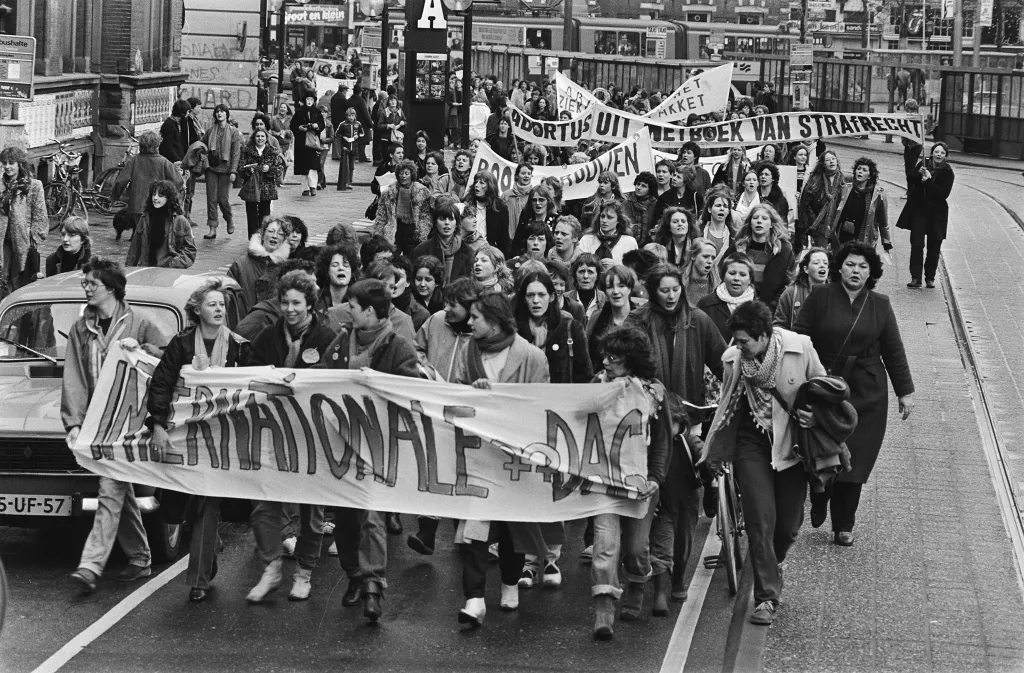
The action group managed to draw media and political attention to women's gender equality with large public actions. The first action was on 23 January 1970: the storming of Nijenrode castle. The Institute of Business Administration that sat here had until then only been open to male students. The action was followed by the burning of a women's corset at the statue of Wilhelmina Drucker. A few days later, public urinals were tied up with pink ribbons in protest against the lack of public toilets for women.
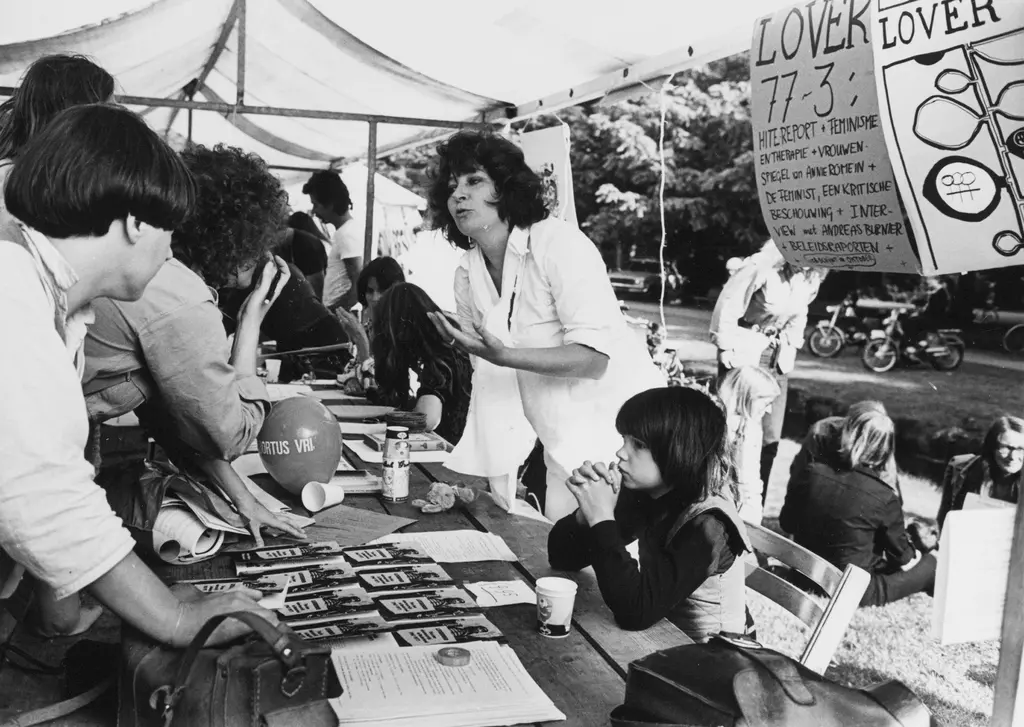
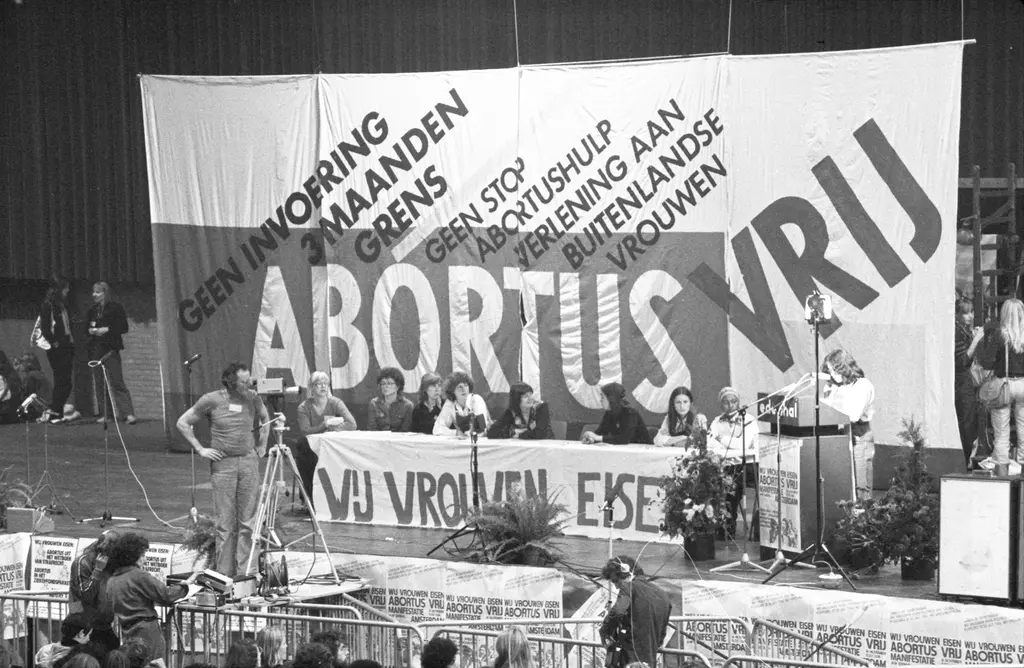
Within a few weeks, Dolle Mina had thousands of supporters. Like a hurricane, the new action group swept through Amsterdam and very soon throughout the Netherlands and later Belgium. Soon after the start, working groups were formed. Most working groups focused on practical issues such as abortion, crèches, equal pay for equal work and unmarried mothers. A theory working group was also set up to deal with education.
Documentary Dolle Mina: guts to change loudly (2010). The full documentary can be viewed on Vimeo.
What did Dolle Mina want to achieve?
Equal pay for equal work
More and better sex education and information
Fight against double sexual morality
Good contraception
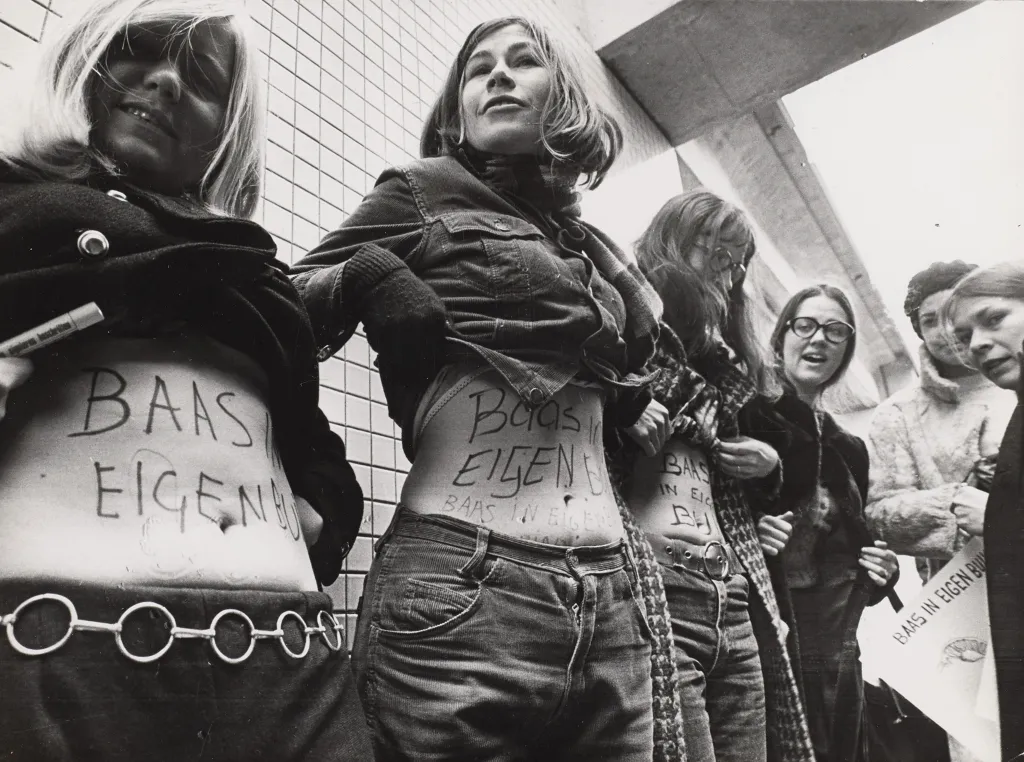
Self-decision on abortion ('Boss in your own Belly')
Equal education for boys and girls
Expansion of the number of child centres: crèches, playgroups, lunchtime facilities
Safe children's playgrounds
No 'slave-girl role' for the housewife
No discrimination against the married mother
Work for the married woman, if that is her wish
Public toilets also for women
All education also accessible to women
Improvement and democratisation of education
Men should be allowed to refuse service
Against the 'Miss election'
What did the action group achieve?
Around 1975, Dolle Mina's actually only took to the streets en masse for abortion demonstrations. Meanwhile, Dolle Mina had continued in numerous action groups and organisations: discussion groups, VOS courses, women's houses. The (struggle for) gender equality expanded. Women started participating in political parties and trade unions. Women's studies emerged at universities. Stichting de Ombudsvrouw was founded, as well as women's telephones and women's shelters. There were now also lunchtime facilities for schoolchildren, more extensive information on contraception and abortion clinics.
Retrospective By Dolle Mina
Travel back to the 1970s and the playful actions of Dolle Mina. What changed? Using unique pieces from Dolle Mina's archive, feminists Milou Deelen and Ayisha Siddiqi take you back to this turbulent time in ten short films.
Criticism
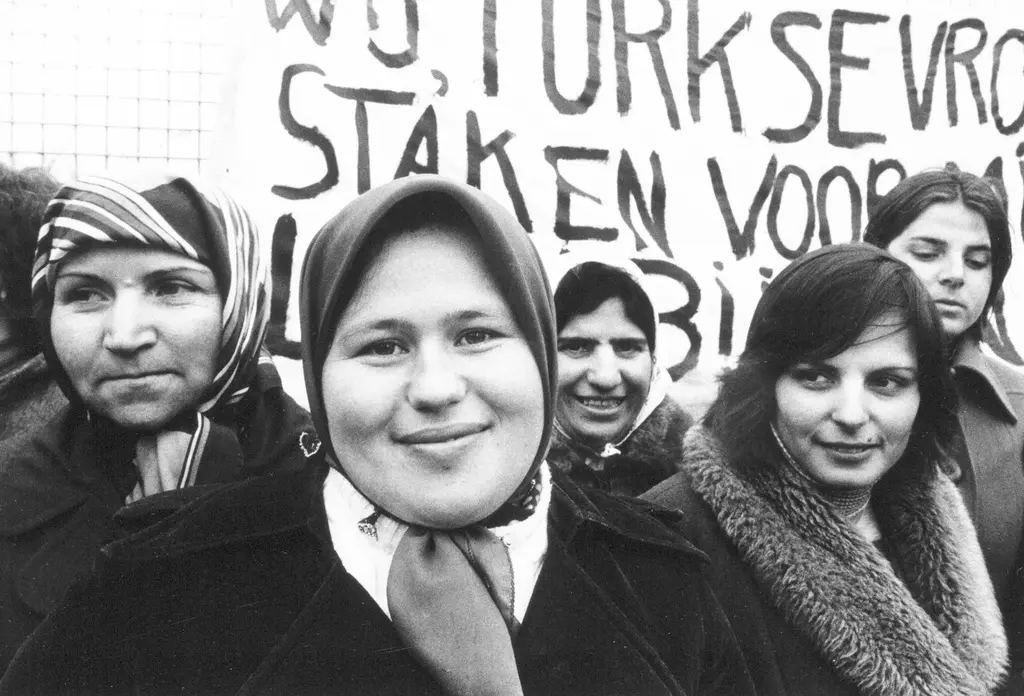
Dolle Mina was bold, playful and media-savvy, but also very white and straight. That made not everyone feel at home. How do the representatives of two other feminist action groups of the time view Dolle Mina?
Read the blog Dolle Mina had the same blindness as everyone else back then here.
Doing research
At Atria, you can do research in the extensive collection of archives, journals, theses and other publications by and about Dolle Mina and other feminist organisations.