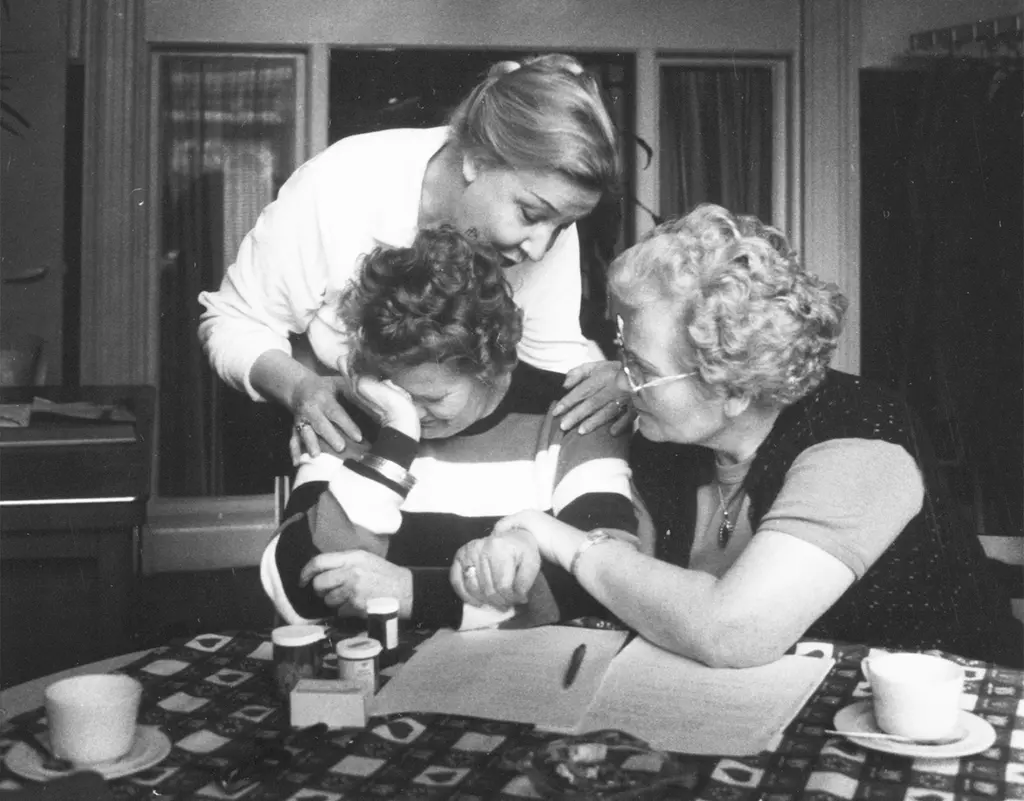
From scripts for doctors’ appointments about the menopause to playground days where transgender children could meet up: these are just a few examples of everyday health activism. Unfortunately, this form of activism often goes unnoticed.
From scripts for doctors’ appointments about the menopause to playground days where transgender children could meet up: these are just a few examples of everyday health activism. Unfortunately, this form of activism often goes unnoticed.
That is why researchers Prof. Marjolein de Boer (Open University) and Dr Britt Myren (Atria), together with interns Dominique van Dongen, Hanna Blom and Iris Olde Hampsink, delved into the archive collections of Atria and IHLIA. They investigated how people used personal stories and informal networks to fight for access to healthcare and for control over their own bodies.
What is everyday health activism?
De Boer: ‘We’re usually most familiar with iconic or mainstream activism. By that, we often mean the kinds of activism you see on the news, featuring major activist heroes such as Greta Thunberg or Martin Luther King. Everyday activism, as the name suggests, often takes place in everyday life. Examples include discussion groups, social media posts or simply striking up a conversation at a birthday party.’
Myren: ‘What often stands out is that people act out of a sort of personal necessity, a sense that something isn’t quite right. Often, the message is also that even by doing something small, you can make a difference.’
De Boer: ‘Moreover, it’s important that everyday activism is understood as a distinct form of activism. It isn’t necessarily a precursor to a major activist movement, nor is it any less common or effective than iconic activism.’
Myren: ‘It is indeed a distinct form of activism; everyone can contribute in their own way. Everyday activism is therefore also an incredibly broad form of activism. That is why we have focused specifically on one theme, in this case health.’
Why do you think it is so important to carry out research into this kind of activism?
De Boer: ‘Everyday activism is often overlooked because it isn’t particularly glamorous. It doesn’t involve grand gestures, and this form of activism is often carried out by groups who have little or no access to other forms of activism. Protesting or campaigning is, in fact, a privilege. When you take part in a demonstration, you are vulnerable and may, for example, face racism, sexism or police violence. So, by consciously focusing on everyday activism, you can raise the profile of the stories of people who have fewer or no equal opportunities in society.’
"Everyday activism is often overlooked because it isn’t particularly glamorous."
Myren: ‘During this research, we looked through an enormous amount of material and found far more than we’d expected beforehand. I remember one of the interns being amazed by the sheer volume of material we came across. It makes you think: wow, they really did all those things. How brave, how brilliant. They may not always have been large-scale operations, but they were certainly of great importance. And the wonderful thing is: it’s all here in the archive. We just didn’t know it was there yet.’
Your focus was on transgender care and the menopause. Your research showed that support groups played an important role in day-to-day health activism. Why were these support groups so important?
Read the rest of the interview on the National History Month website [in Dutch]