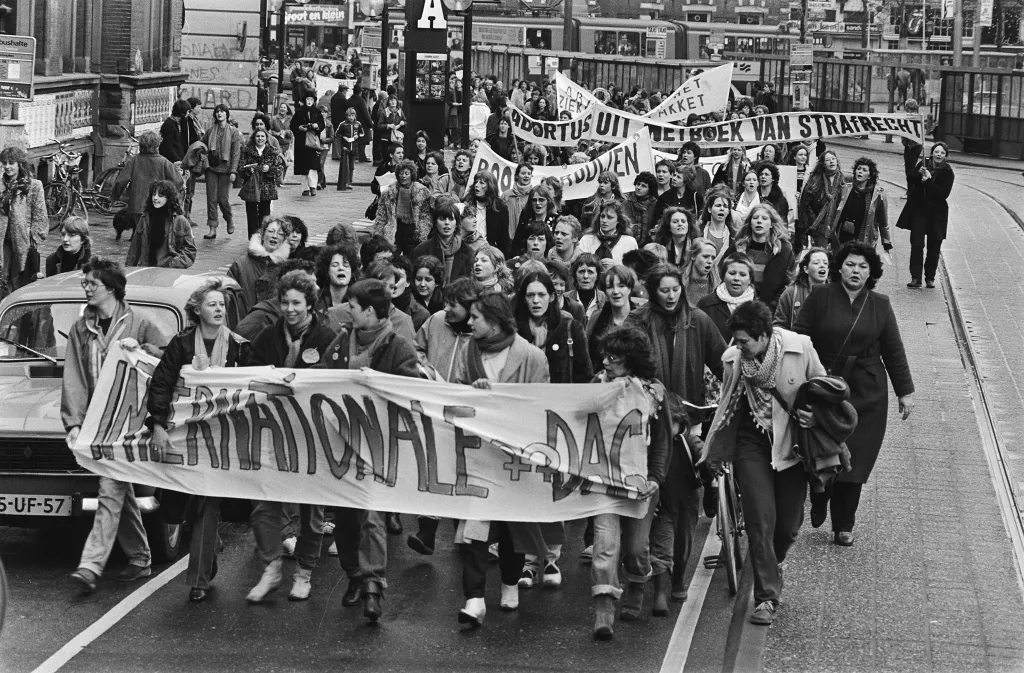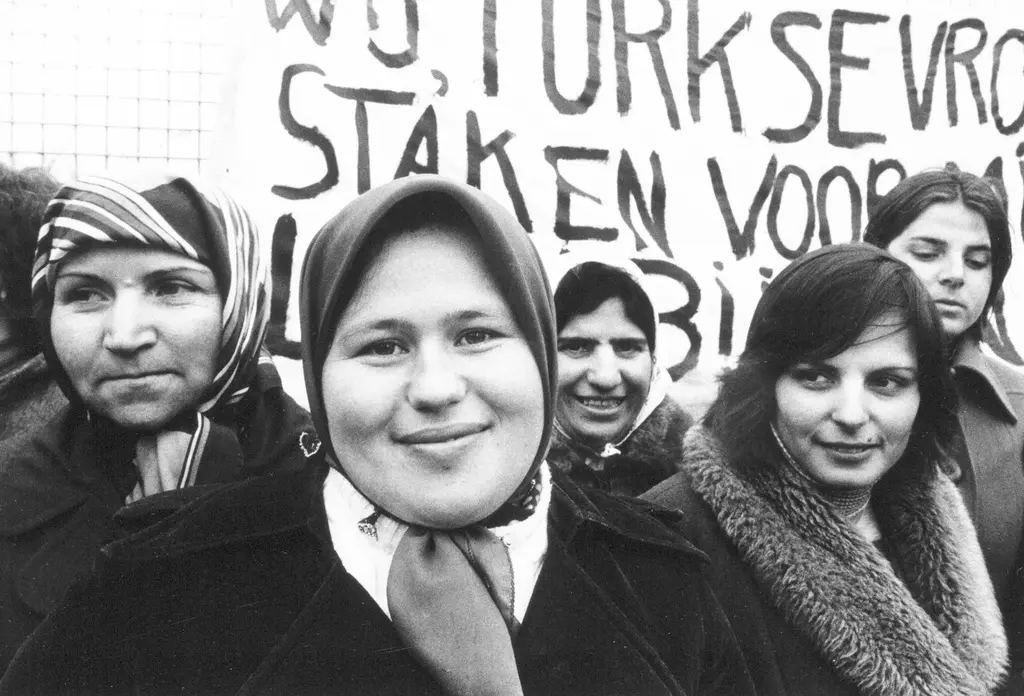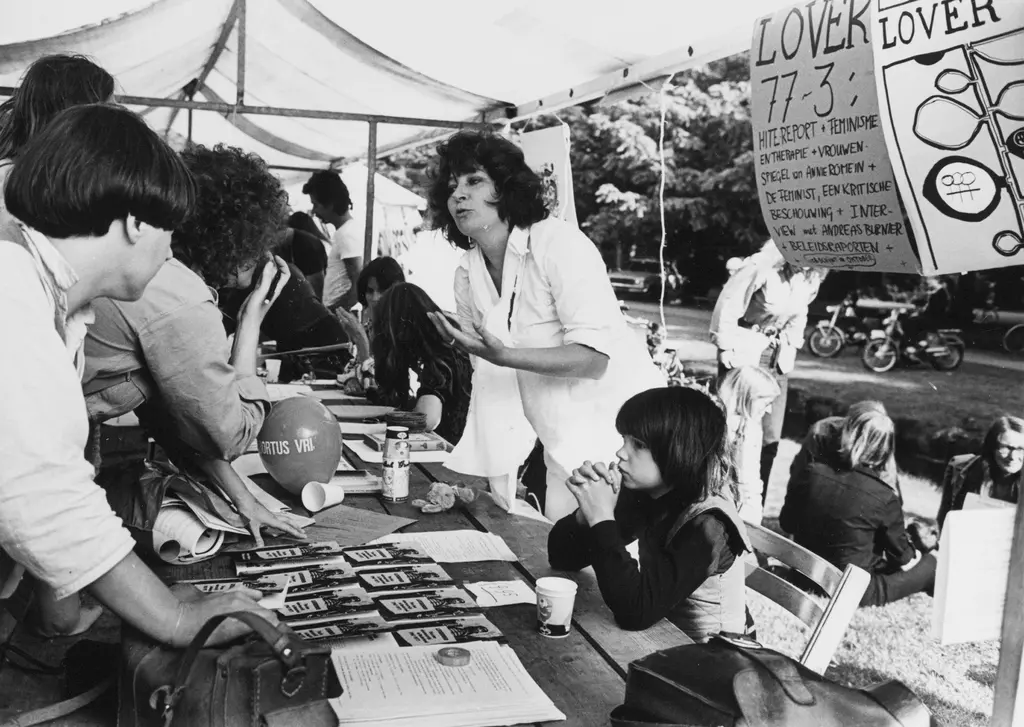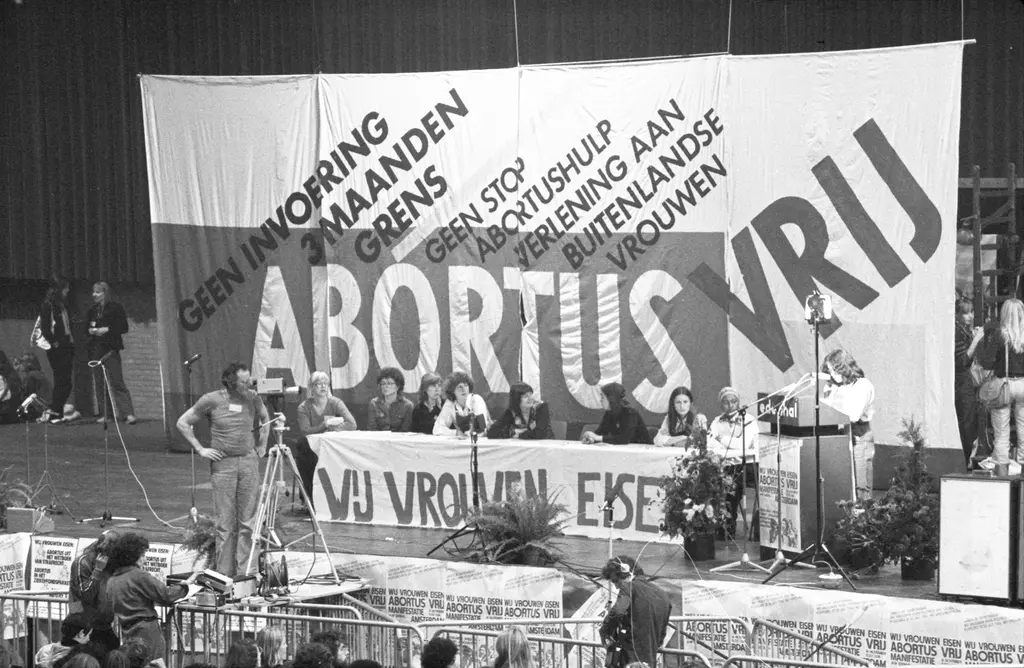
In the late 1960s, women's gender equality made its proverbial 'go-ahead' in the form of a 'second feminist wave'. Within feminism, a movement of women emerges in the early 1970s to fight patriarchy. The need for women to come together makes one women's café after another open its doors. 'Banana, banana, I can't take it anymore, I just came from Saarein'.
In the late 1960s, women's gender equality made its proverbial 'go-ahead' in the form of a 'second feminist wave'. Within feminism, a movement of women emerges in the early 1970s to fight patriarchy. The need for women to come together makes one women's café after another open its doors. 'Banana, banana, I can't take it anymore, I just came from Saarein'.
Men not welcome in women's café
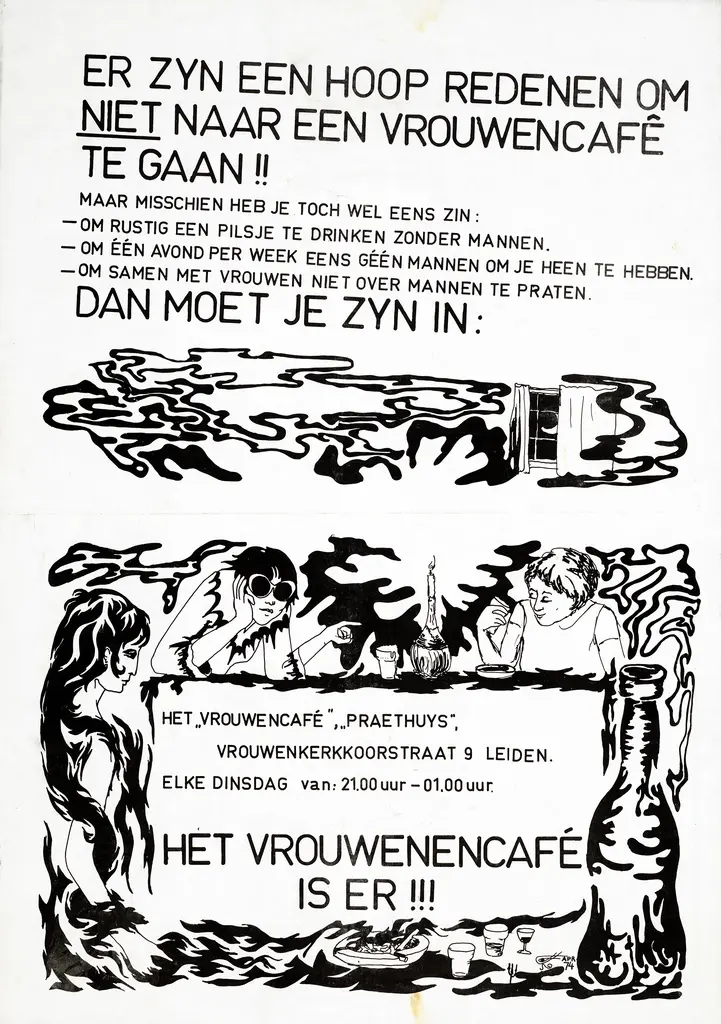
The women's café is a meeting place where women can feel safe. Initially, the first women's cafés open their doors to both women and men. But it soon becomes clear that women find the presence of men unpleasant and even threatening, so they are henceforth actively denied entry.
Conversely, the women's café itself is also often seen as intimidating. In parallel with how gender equality is thought of at the time, it is dismissed as unnecessary. There is even suspicion about possible 'plots' being forged behind the closed doors of the pubs. So in those early years, men did regularly enter, usually with the aim of hitting on the women present. But there are also incidents of men shouting at, calling or scaring guests or staff, ironically proving their own relevance for a safe place.
Resistance from the outside world does not stop the women; humour and irony are the motto. This is reflected in the names of the various women's cafés, sometimes with little subtle ambiguity about the function of the café. In Utrecht, the first women's café in the Netherlands opened in 1975: de Heksenketel. Soon you can also have a drink in de Feeks, Madame Mik-Mak or het Joffertje. And otherwise you will find a cold drink or good conversation at Dikke Trui in Groningen, Paraplu in Amstelveen or Kantje Boord in Haarlem.
How-to-paste-myself-my-bicycle-tire
Besides being a place to meet safely, the women's cafés also aim to be a place where people can come together and talk to each other about feminist issues. In the early years, the evenings mainly involved formative work, the educational sharing of knowledge and skills and finding recognition in the various aspects of being a woman. For example, in discussion groups.
But the evenings soon became more substantive, more specific. In the late 1970s, early 1980s, the cafés invited speakers who talked about earning money and economic independence, who gave assertiveness training or they organised very practical how-to-paste-myself-my-bicycle-tire workshops.
Now that there is a physical place where women can meet undisturbed, they can explore their individual needs with each other. As opposed to taking to the streets and campaigning for larger general interests, women can strengthen their own knowledge and network here. The women's cafés become the beating heart of empowerment, discussion and social change. And it works: several important social initiatives stem from insights born in women's cafés. For example, shelters for abused women (the Stay off my Lives homes) and various support services such as those for victims of sexual violence. Education aimed at women, for example the Women's Orientation to Society courses and mother-mavo courses, also date from that time. The fight for abortion rights was also in full swing. Many a petition was signed during the meetings.
Oh bar oh bar oh bar...
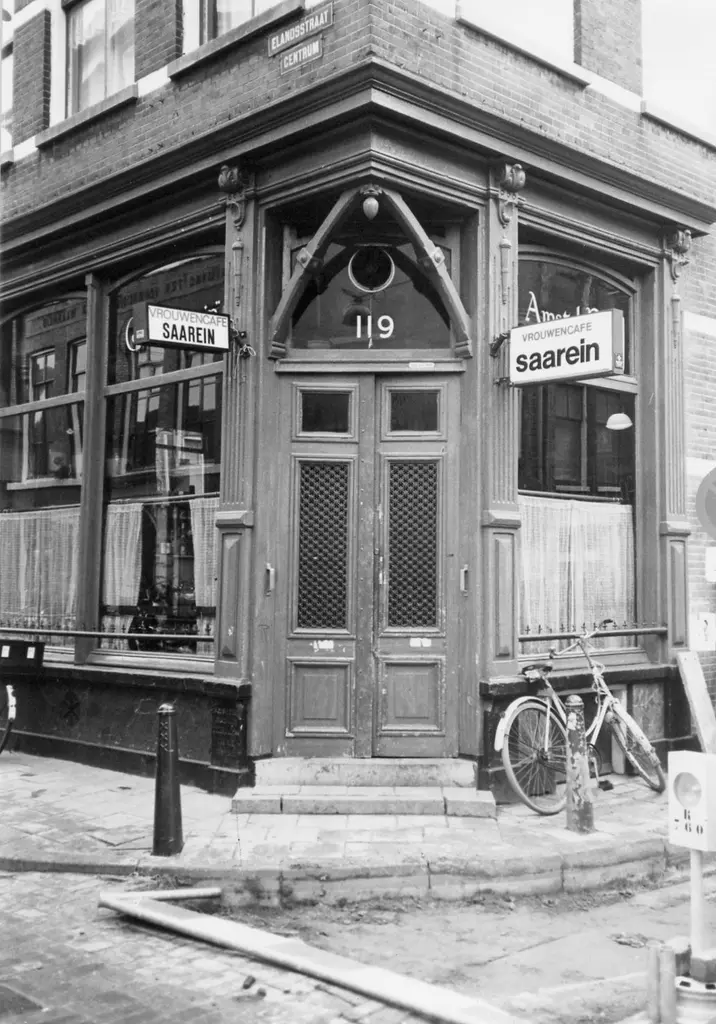
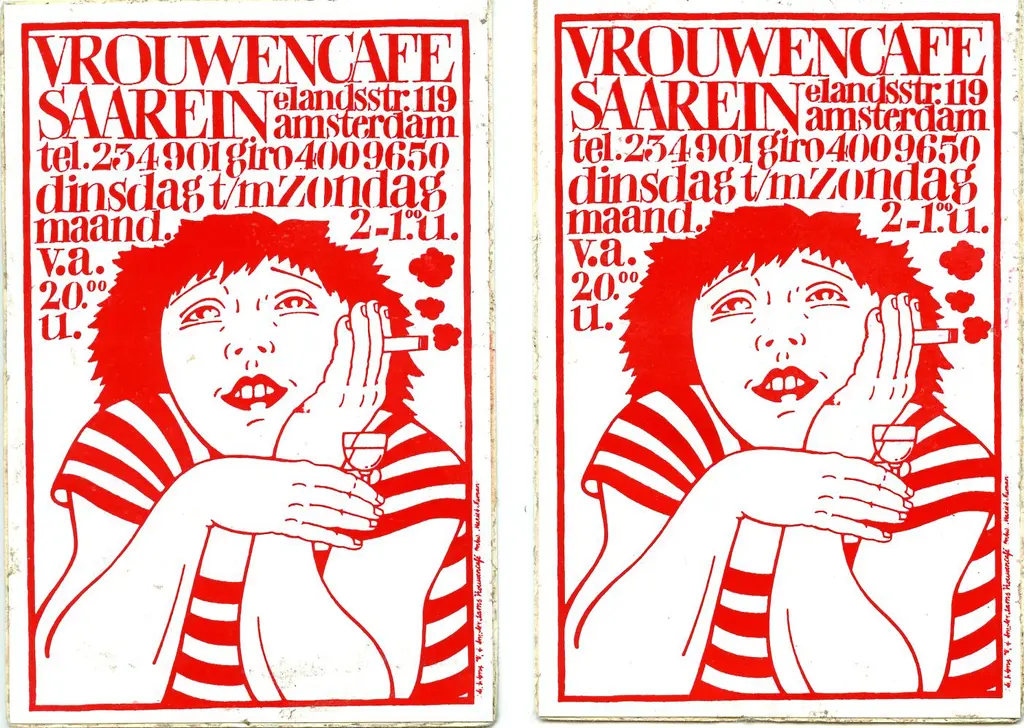
The oldest existing women's bar is Saarein in Jordaan, Amsterdam. Unlike the aforementioned cafés that had to close their doors long ago, we can still pop in to Saarein for a cold glass of something or other. There is a nice story behind this.
Before Saarein opened, there was already a lesbian café in Amsterdam: het Schaartje. When Schaartje closed, the women who frequented it decided to do everything they could to keep a café. They founded the Stichting Het Amsterdams Vrouwencafé and wrote a crowdfunding avant la lettre for:
"...A true & unadulterated open women's café, offering space to all our mothers, aunts, sisters, grandmothers, girlfriends, neighbours and daughters."
Women were asked to lend a "firm initial capital" to successfully open Saarein. In exchange for a "comfortable place in women's heaven". The crowdfunding attracted 11 women investors, whose money ensured that Saarein's contents were paid for and the café opened its doors as planned in 1978.
Marjan Sax
One of the eight initiators of Women's Café Saarein is Marjan Sax. Before co-founding the café, she has already won her spurs within feminist activism. In 1969, she is at the occupation of the Maagdenhuis. At the same time, she became active at Dolle Mina, where she left in 1974 to set up Wij Vrouwen Eisen together with Ria Sikkes and Selma Leydesdorff. Both Dolle Mina and Wij Vrouwen Eisen spoke out for years on the right to self-determination and abortion. In 1983, Sax and four other women founded Mama Cash, a foundation that funds women's initiatives around the world. Mama Cash has grown into an international organisation that helps women become more self-reliant and independent.
Marjan Sax has been awarded several times for her successful work in the women's movement. Her inspiring archive is preserved by Atria. Atria also made a video portrait about this remarkable woman:
Inclusive safe space
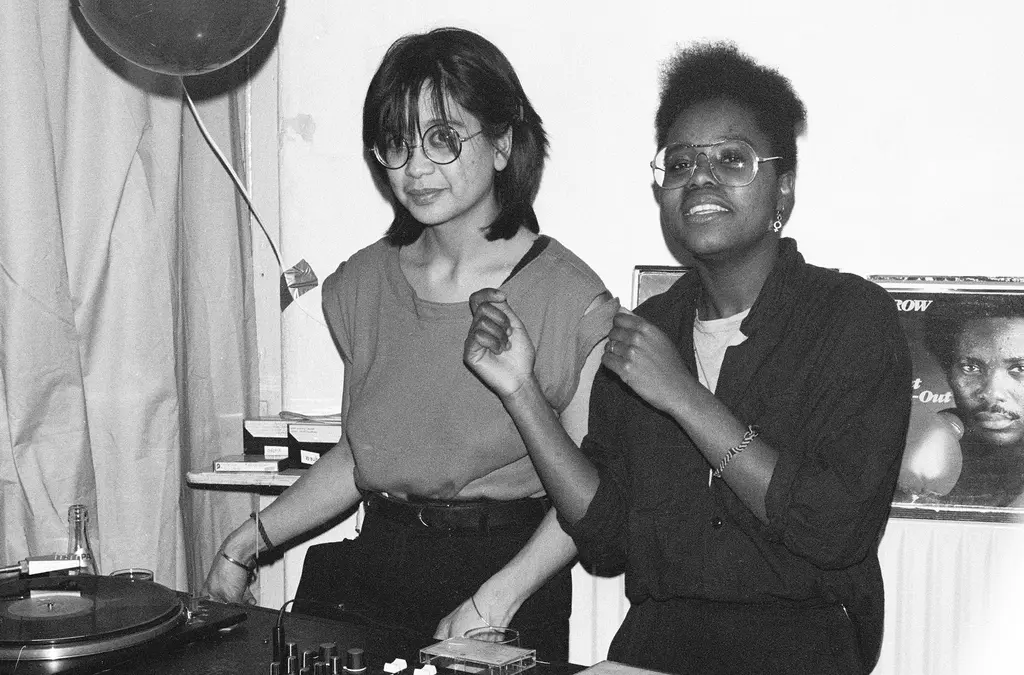
Within feminism, lesbian and queer women are widely represented. For a lesbian woman, the women's café is a safe space, where she can be herself and meet other lesbian women safely. In the 1970s and 1980s, this was almost nowhere else.
The women behind Saarein are aware that more groups can benefit from a safe space, recognition and representation. They recognise from the early years that they have a white image. They would like to see that change, which is why they are trying to book more performances that appeal to a wider audience. They enlist help from the black community, which helps them strategise and connect women where possible.
Still going to the pub
Saarein is a success. Many women's parties and anniversaries follow, for instance at the Melkweg in Amsterdam. The large groups of women attending these regularly cause nuisance in the neighbourhood. Through active communication with local residents, the café still maintained good relations with its neighbours. In 1999, Dia Rozemond became the new owner. She expanded the door policy; besides women, Saarein was now also open to 'all queer minded people'.
That the café is also still a hotspot for the queer community is once again confirmed when, in 2021, the successful queer series Anne+ records a scene from the film in Saarein. Thus, Saarein is once again a fine and unique place for a new generation of queer(minded) people.