Vegetarian food a trendy Havermelkelite trend? Well no, the women's movement in the nineteenth century was an early preacher of a just existence for man and nature. Over the centuries, the kitchen has been "women's domain": whether they like it or not. Household school was a reality for many and many a cupboard held a Wannée cookbook. Until the rise of electrical appliances offered breathing space. Marketing strategies targeted the housewife and a Dutch Women's Electricity Association was even formed. How did the advent of the butter warmer contribute to women's gender equality?
Vegetarian food a trendy Havermelkelite trend? Well no, the women's movement in the nineteenth century was an early preacher of a just existence for man and nature. Over the centuries, the kitchen has been "women's domain": whether they like it or not. Household school was a reality for many and many a cupboard held a Wannée cookbook. Until the rise of electrical appliances offered breathing space. Marketing strategies targeted the housewife and a Dutch Women's Electricity Association was even formed. How did the advent of the butter warmer contribute to women's gender equality?
A good housewife
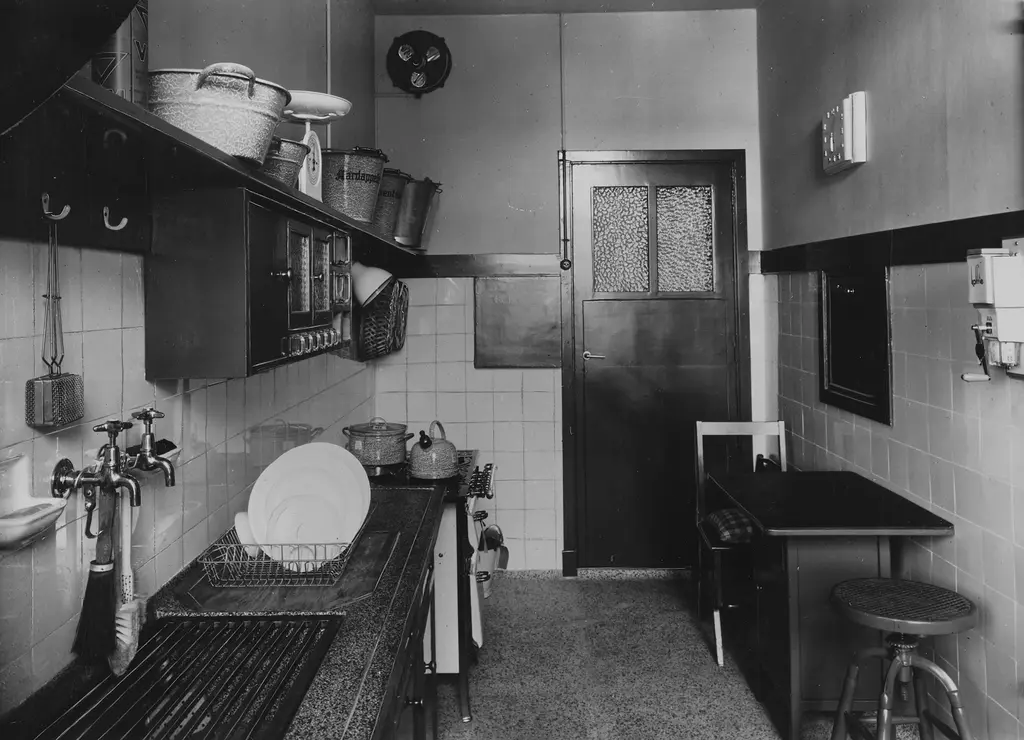
The 1950s are marked by reconstruction after World War II. The family is central, and in it the (house) wife is an indispensable pivot. The kitchen is her domain, whether she wants it or not. After primary school, girls often go to domestic science school to become housewives and mothers. When a woman marries, she is expected to stop working. Work at home does come on her plate, unpaid. In the population register, a housewife is declared as someone 'without occupation'. And without working hours, because housework takes more time than a full-time job. In 1955, a housewife spends an average of 62 hours a week on housework. In this study, they did not even count housewives with children under the age of two, says Suzanna Jansen, author of the book De omwenteling or de eeuw van de vrouw: "because then the average would be out of kilter. And any work that took longer than half an hour - whether it was baking or cooking or engaging with the children - was not counted. Because then it was a 'hobby'."
From butter warmer to immersion heater
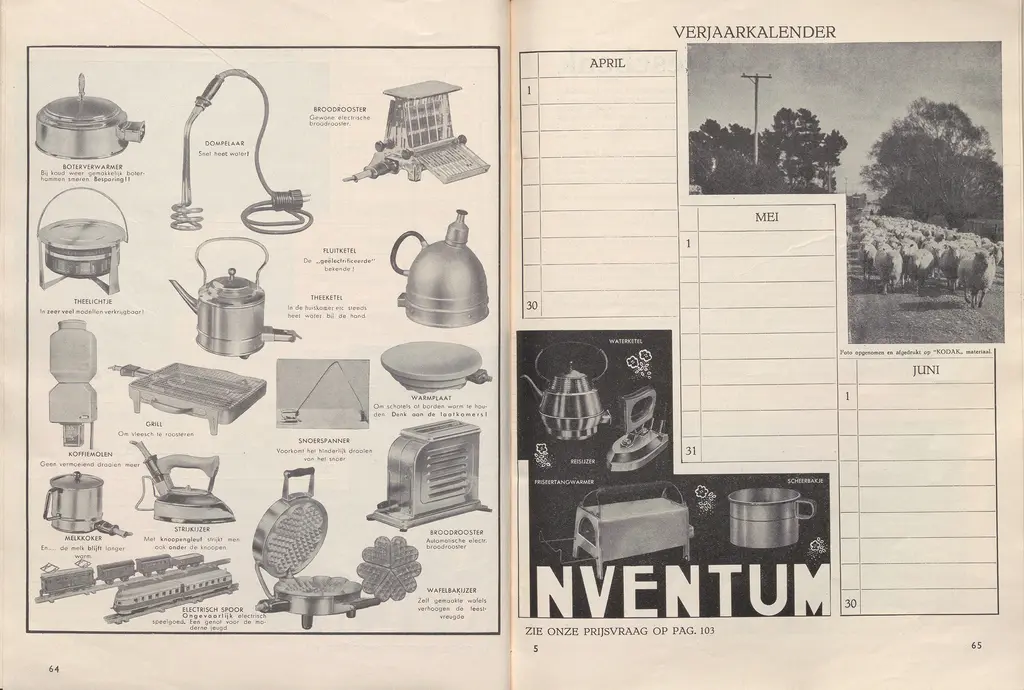
At the beginning of the twentieth century, gas companies and emerging electricity companies engage in a real competition. Their marketing revolves around the housewife. Will she cook on gas or electricity? With the promise of electric appliances' ease of use, electricity companies are slowly gaining ground. In 1932, the Dutch Women's Electricity Association is founded. They aim to get women excited about using electrical appliances, with demonstrations and tours of manufacturers. They publish Elektro household books and the magazine Bulletin. Everything to encourage and teach women how to (safely) use appliances and even repair them. Housework, she can't escape it, but with the help of these appliances, she can get it done faster.
Yet most households, especially during the scarcity after World War II, do not have the convenience of electrical appliances. Although they are being developed and marketed, the appliances are still expensive to buy. Unattainable for many families where every dime has to be turned over. Sometimes appliances are rented, such as a fridge or washing machine. You can probably imagine what a time and convenience that provided. A small victory for women's gender equality.
Not for the faint-hearted
Much attention is also paid to electrical appliances at the Huishoudbeurs, whose first edition was in 1950. The latest household gadgets are demonstrated here. All kinds of appliances pass by, such as an infrared meat grill, a closet kitchenette and a potato peeler (running on water power). Ingenious and innovative, but often quite expensive, or as the Polygoon newsreader put it in 1956: 'the price is not for the faint of heart'.
Wednesday mince pie day
Cookbooks from that era focus entirely on the housewife. A classic for Dutch cooking is Cornelia Wannée's Kookboek van de Amsterdamsche Huishoudschool. The first edition appeared in 1910 and has been used by generations of women ever since. Girls receive it as a textbook at the household school or as a gift when they get married. Although the book is primarily intended as a manual for teaching cooking, Wannée, who was a teacher, writes in her preface:
"This cookbook also aims to meet the difficulties so many housewives face in putting together the daily menu, which all too often suffers from chronic monotony in many families, and also to give advice on how, in the spirit of old-Dutch thoroughness, to process good ingredients into a good whole: "How many a woman, by unwise cooking, has wasted a good bite, and broken all lust!" says father Cats."
At the time, Dutch cuisine was little surprise. Most families served simple Dutch food: lots of bread, boiled potatoes, seasonal vegetables and meat. But the latter not more often than once or twice a week, because meat is expensive. Have you ever heard of Wednesday mince day? Because on Tuesday the good cuts of meat were taken off the animal - such as steak and chops - on Wednesday the leftovers were ground into minced meat. This was best eaten on the same day because most households did not yet have a fridge.
Diplomat pudding
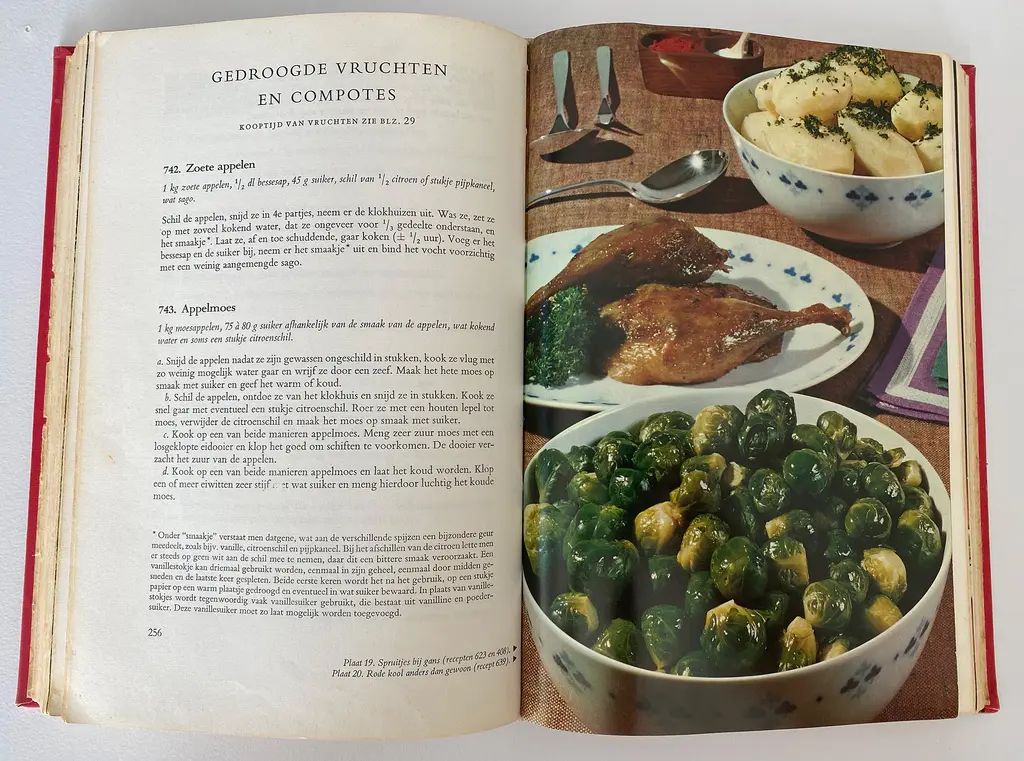
The Wannée cookbook gives a nice glimpse into history, as each reprint was adapted to the tastes of the times and the latest findings in nutrition. In the 8th edition (1940), we still find separate chapters for the use of gas, the use of electricity and the use of petroleum, in which the pros and cons are described in detail. The main focus of the almost 900 recipes is palatability, nutrition and economy. In the index you will find recipes such as 'rice in newspapers', 'diplomat's pudding' and 'milk soup'.
In 2010, the cookbook celebrated its centenary with a 32nd edition. Culinary journalist Anne Scheepmaker looks back on a century of cooking in the introduction. On the division of roles between men and women, she writes:
"Today's ideal is to divide all tasks fairly within a family. But it has not reached that point yet. Research shows that 84 per cent of women regularly prepare meals against 41% of men. In 1975, it was 95% against 20%."
Convenience serves the woman
In the 1960s, prosperity increases, wages rise and households have more to spend. Convenience enters the kitchen, it becomes less and less of a taboo to put a quick meal on the table. Albert Heijn introduces the supermarket and increasing prosperity changes consumer behaviour. Eating habits changed too. The weekly recipes in women's magazines like Libelle and Margriet encourage cooking something different from the eternal meatball, beans and potatoes. But the fact that something different is on the table for once does not mean that someone else is stirring the pans.
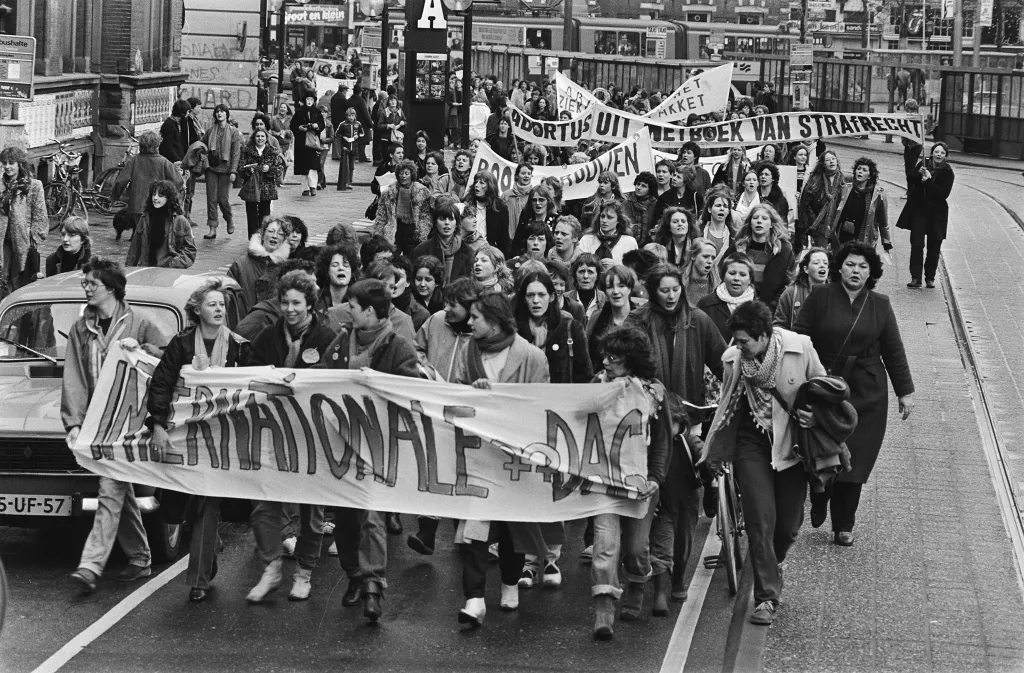
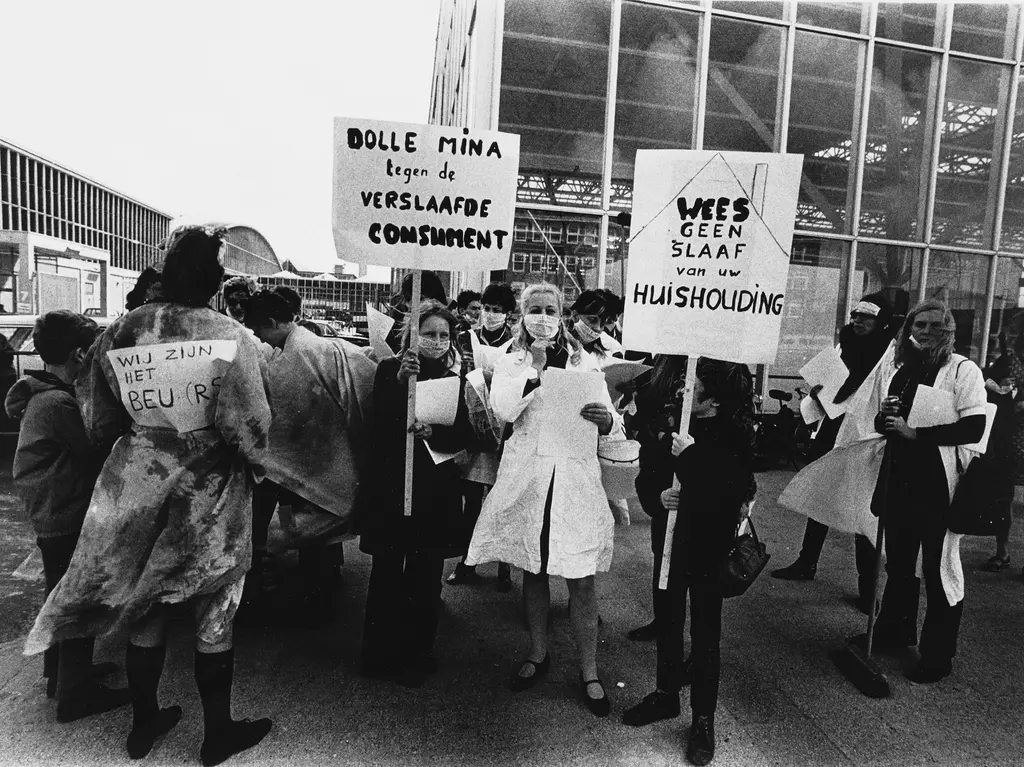
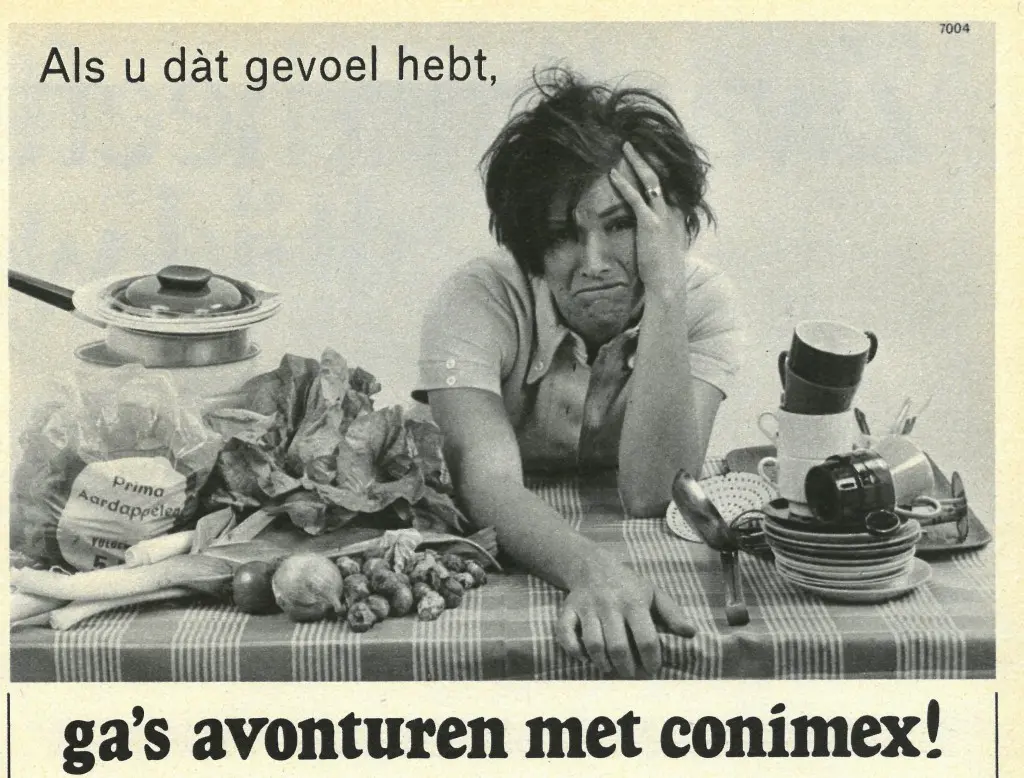
Although the 'second feminist wave' has tilted the image of women, it has not yet thrown off the domestic yoke. Gender equality brings women more freedom, but in the kitchen it is still mostly literal. Thus, there is more understanding that eternal worrying can be tedious and exhausting. Convenience serves the woman and advertisers are cleverly capitalising on this. Iglo, for instance, can think of a few good reasons for a ready-made dinner: no desire or time to cook or a husband who does not eat at home. A 1970 Conimex ad shows that women are fed up with the daily drudgery and monotony of potatoes, vegetables and meat: 'If you are over-bubbling with rebellion because in these days of soggy old potatoes and expensive scarce vegetables, you still face the bitter task of putting something decent on the table... then only composure and Conimex can save you'.
Women's restaurants
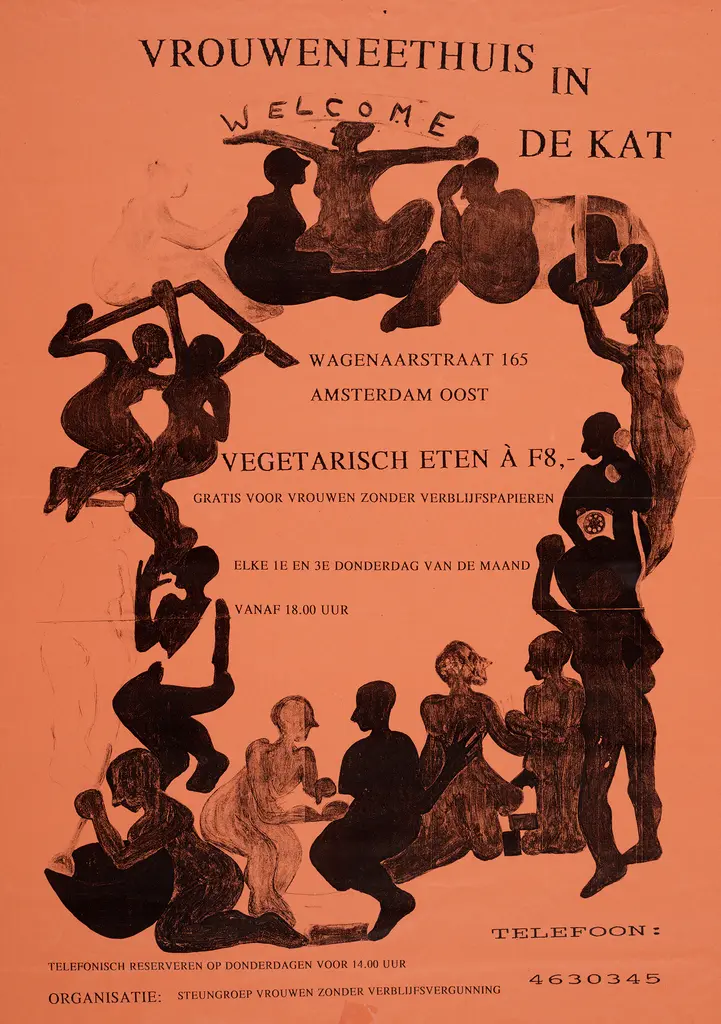
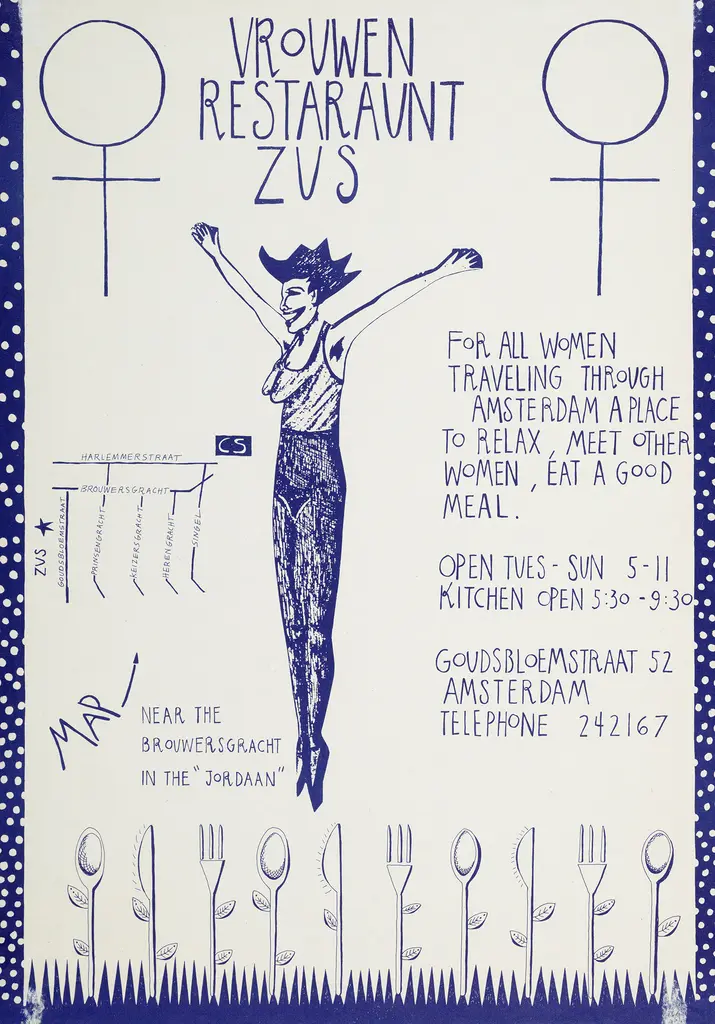
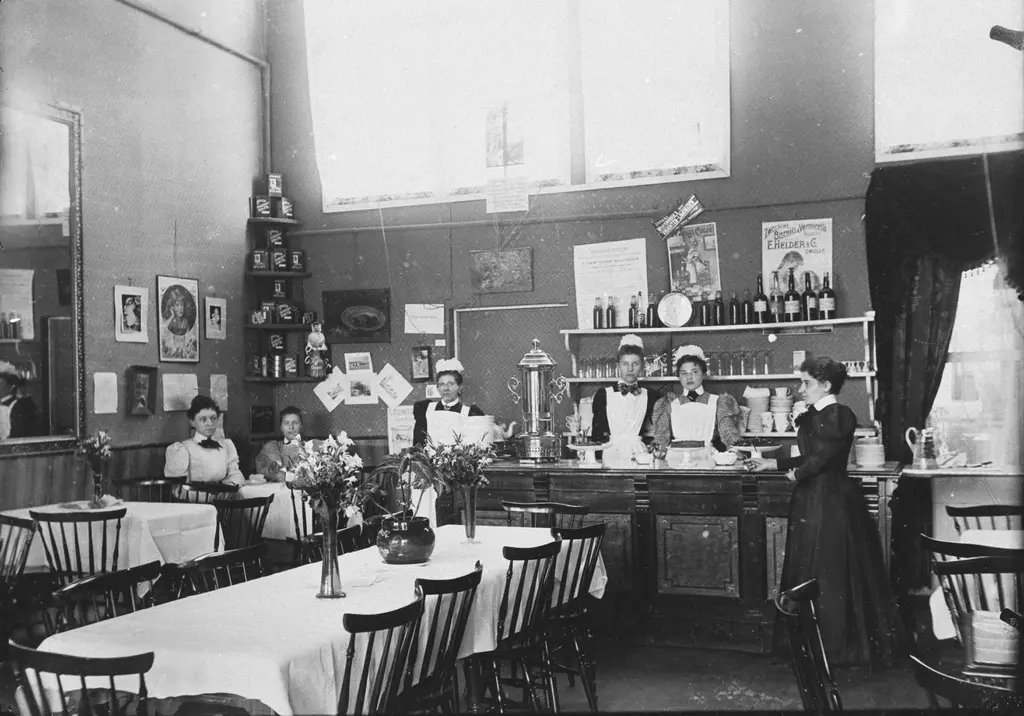
Influenced by the 'second feminist wave', we see another interesting thing happening in the 1980s. A number of cities opened so-called women's restaurants: run by and only accessible to women. In Amsterdam, for instance, you had Zus, Orka la Rose and De Kat, and in Utrecht, women's eatery Eucalypta. In history, we see the 'women's restaurant' appearing earlier. For instance, a hotel-restaurant for women sat on Keizersgracht in Amsterdam between 1924 and 1969. Founded by the Nederlandsche Vrouwenclub (NVC), following the example of the numerous men's clubs. Although things were very different in the establishment on Keizersgracht from the women's restaurants of the 1980s, they do have a similarity. They were places where women 'claimed' space for themselves in a world set up for men. And where activities could be organised for women's development and self-development. More 'neat' on Keizersgracht (including concerts and a craft club) and more activist in the 1980s. Orka la Rose, for instance, had its own women's football team.
Women and vegetarianism
A vegetarian meal was no exception in women's restaurants. So reads a De Kat poster: 'vegetarian food for eight guilders and free for women without residence permits'. Not very surprising if you look at the history of vegetarianism in the Netherlands: women played a major role in this.
The Nederlandsche Vegetariërs Bond was founded as early as 1894. Caroline van der Hucht-Kerkhoven - a champion of animal protection - and Suze Groshans, a feminist from the very beginning, were actively involved. Although the union initially promoted not eating meat as a healthy diet, it soon turned to animal welfare and respect for nature. Marie Jungius, feminist, socialist and active member of the union also fights for a fairer existence for humans and animals. According to her, this includes a vegetarian lifestyle. During the National Women's Labour Exhibition in 1986, the restaurant at the exhibition was vegetarian and run entirely by women. A year later, Marie Jungius ensured that the Netherlands opened its first vegetarian restaurant: Pomona on Stadhouderslaan in The Hague. In Pomona's kitchen, Elisabeth van der Molen-Heijnsdijk cooks simple vegetarian meals. She also wrote cookery books for the Nederlandsche Vegetariërs Bond: De vegetarische Keuken (from 1896 and still available), Stuivers kookboek (1898) and Drie-stuivers kookboek (1919). These were the very first vegetarian cookbooks from Dutch soil.
You are what you eat
Women cook and men eat meat. Faint or true? Research by Wageningen University (2020) shows that we associate meat with masculinity and vegetables with femininity. So professor of sensory and eating behaviour Kees de Graaf tells Trouw:
"You are what you eat. With it, we show which group we belong to. That applies to some products more than others. Whether you like strawberries, people around you won't care. But meat? That is something else. In the West, we associate that with strength and masculinity. Vegetables we associate with femininity."
The culture surrounding barbecue seems to confirm this. Although meat consumption in the Netherlands is high and the number of vegans and vegetarians in the minority, significantly more women than men do not eat meat. And the women who eat meat consume smaller quantities than men who eat meat.
Food and gender
Whereas a vegetarian stand at the Exhibition of Women's Labour was an exception to the rule in the nineteenth century, menus of many corporate canteens, restaurants and trade fairs are now often vegetarian by default. And if you stand in front of the cookbook shelf these days, you will find a world of cultures, tastes and cooking ways. The preface is no longer aimed at the housewife. And electrical appliances still offer convenience, even if the prices of the latest gadgets are still 'not for the faint of heart'. The history of food culture tells us more about how food and gender are inextricably linked. And if we look at the conclusions from CBS' gender equality Monitor (2022), one thing becomes clear: even today, women still spend more time on caring tasks than men.