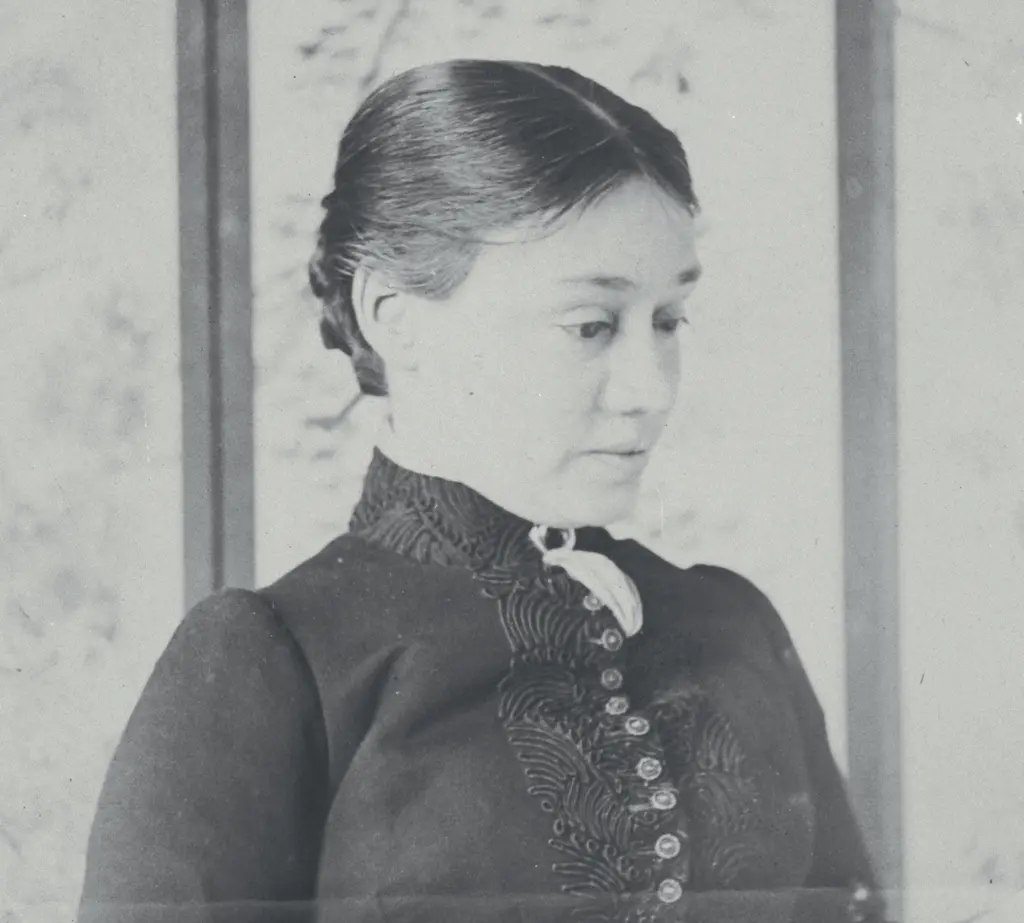
Maite Karssenberg has won the 2016 ‘ Johanna Naberprijs ’ for her research Master’s thesis An Irresistible Double Life: The Development of Geertruida Kapteyn-Muysken as an Intellectual in London, 1880–1900. She is a writer, historian, interviewer and programme maker for the academic and cultural platform SPUI25, and writes for various magazines.
Maite Karssenberg has won the 2016 ‘ Johanna Naberprijs ’ for her research Master’s thesis An Irresistible Double Life: The Development of Geertruida Kapteyn-Muysken as an Intellectual in London, 1880–1900. She is a writer, historian, interviewer and programme maker for the academic and cultural platform SPUI25, and writes for various magazines.
Why did you choose Geertruida Kapteyn-Muysken as the subject of your dissertation?
I came across Geertruida Kapteyn-Muysken quite by chance. In 2012, I was working at the Huygens Institute for Dutch History on a project to map out Albert Verwey’s network of correspondents. As part of this, I read a lot of letters and gathered basic information about the people with whom he corresponded. One letter was signed ‘Truus Kapteyn’. I was immediately fascinated. Little was known about her and I could find only one brief biographical sketch. I decided to write my research Master’s thesis about her.
"Geertruida Kapteyn-Muysken has become very dear to me. She deserves a place in history; she is an incredibly strong, internationally-minded woman."
Your thesis is about her years in London – why did you choose this focus?
I found Geertruida Kapteyn-Muysken’s archive at Atria. It was quite a lot – a one-metre-long archive, containing all sorts of information. I leafed through it meticulously and then came across inventory number 53, a number of thick notebooks. These turned out to be her diaries. I became fascinated by Kapteyn-Muysken’s personal confessions. My dissertation focuses on her years in London (1880–1900), the period covered by the diaries. It was also a time marked by a major turning point in her life: in the space of a single year, she not only moved from the Netherlands to London, but also got married and had her first child.
Can you tell us a bit about her time in London?
At that time, London was the largest city in the world, a truly vibrant place. Kapteyn-Muysken arrived there as the daughter of the mayor of Hillegom. Despite having to look after her children as well, she managed to fulfil her potential to the full. She frequented all sorts of clubs in London and attended many lectures, debates and discussions. Among other places, she visited the Pioneer Club, London’s most radical women’s club, which – quite remarkably – had a smoking room for women.
The motto of my thesis,‘The greatest freedom and strength lie not in campaigning against the “no”, but in creating a “yes”’, fits Kapteyn-Muysken very well. More well-known feminists often emphasised how things should not be done. Kapteyn-Muysken, on the other hand, was busy creating an alternative herself.
What did Geertruida Kapteyn-Muysken write about?
She was exceptionally well-read, devouring the works of all manner of philosophers and writing on a wide range of philosophical topics. She gradually formulated her own ethical theory. Her feminism formed an integral part of a broader progressive endeavour to improve the world.
Are there any differences in the use of diaries compared with other sources?
Diaries are a difficult source. They are, in fact, highly subjective and must be read critically. People often write in their diaries when something is troubling them. Sometimes Kapteyn-Muysken writes nothing for a whole year. You then have to compensate for this by searching other sources. Moreover, her handwriting was sometimes illegible.
The jury for the Johanna Naber Prize is looking forward to seeing what comes next. Do you have any plans in that regard?
Geertruida Kapteyn-Muysken has become very dear to me. She deserves a place in history; she is an incredibly strong, internationally minded woman. I’m still thinking about the sequel; it will probably be a biography, but I’m not yet sure what form it will take.
Update
In May 2026 , the biography *Dubbelleven: Geertruida Kapteyn-Muysken and her rebellious philosophy of life* was published. A review on the biography portal.