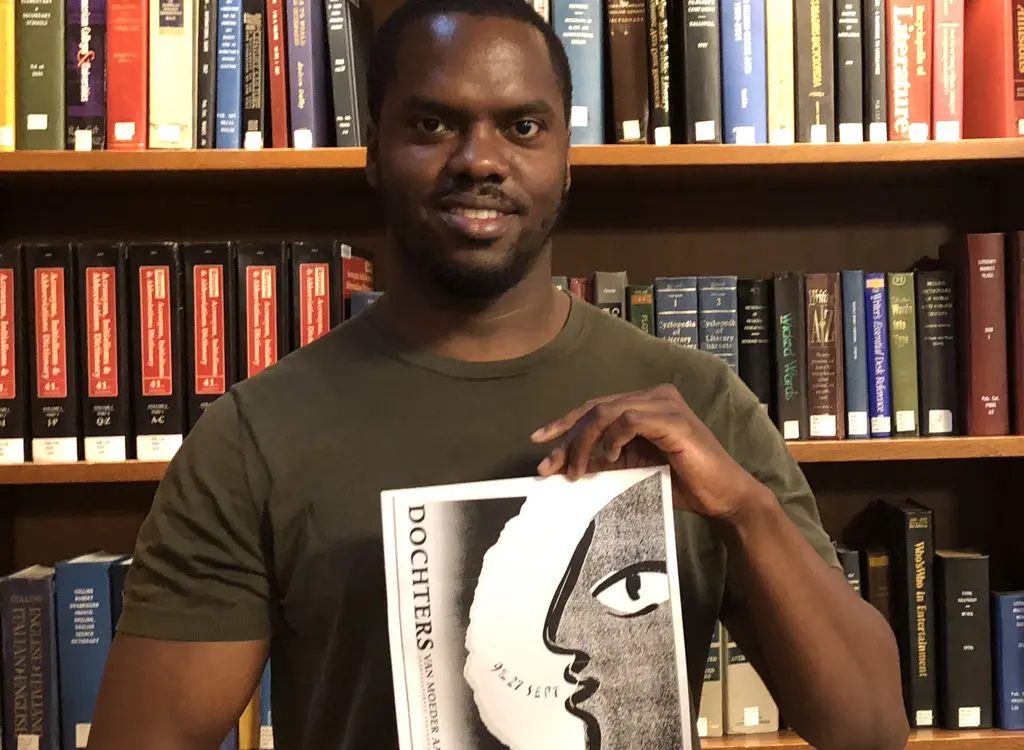
Atria asked four people to highlight a special collection piece from the archives of black women (movements) who have done important work against the establishment. In this blog, researcher and co-founder of Black Queer & Trans Resistance NL Wigbertson Julian Isenia highlights a poster from Villa Baranka, an art salon for and by artists from bicultural backgrounds in the Netherlands (1986 to 1989).
Atria asked four people to highlight a special collection piece from the archives of black women (movements) who have done important work against the establishment. In this blog, researcher and co-founder of Black Queer & Trans Resistance NL Wigbertson Julian Isenia highlights a poster from Villa Baranka, an art salon for and by artists from bicultural backgrounds in the Netherlands (1986 to 1989).
Villa Baranka
Artists Margareth Adama (1950, Jakarta) and Fridi Martina (1950-2014, Curaçao) opened Villa Baranka on 15 November 1986 at Prins Hendrikkade 140 in Amsterdam. Villa Baranka (Papiamento for rock), was an art salon for theatre, visual art, music, poetry and readings for and by artists from bicultural backgrounds in the Netherlands.
Atelier and meeting place
In an interview with Trouw in 1986, Martina explains the name of the art salon. Villa Baranka acts as a mother rock:
"Life is like the water lapping against the rock and receding again."
Setbacks may occur but the rock stands firm."[1] Villa Baranka was described as an "art salon" because it was not only a gallery and theatre, but also a studio and a meeting place for artists and art lovers in the centre of Amsterdam.
Financing the restoration of the six-storey building and the activities of Villa Baranka was difficult. At the Amsterdam municipality's art department, Adama and Martina were referred to the 'minorities department'.
"It didn't occur to them that people from different cultural backgrounds could make professional art"
Contemporary works of art
Nevertheless, Villa Baranka has made important contributions to theatre and art history in the Netherlands through occasional funds and its own resources. Often, only traditional artworks or folklore by non-Western makers are highlighted by museums and galleries, Martina and Adama believe. Or these makers are forced to discuss purely socio-economic themes, such as the oppression of minorities and racism to justify their existence as artists.[4] The aim of the art salon Villa Baranka was to create a venue for contemporary artworks by artists with a migration background.
However, the 'minority fund' was mainly aimed at material gain and welfare of minorities in Amsterdam. Providing housing, employment and organising sewing and cooking courses appeared to be its main purpose.[3] Art salon Villa Baranka fell between the cracks in structural subsidies.
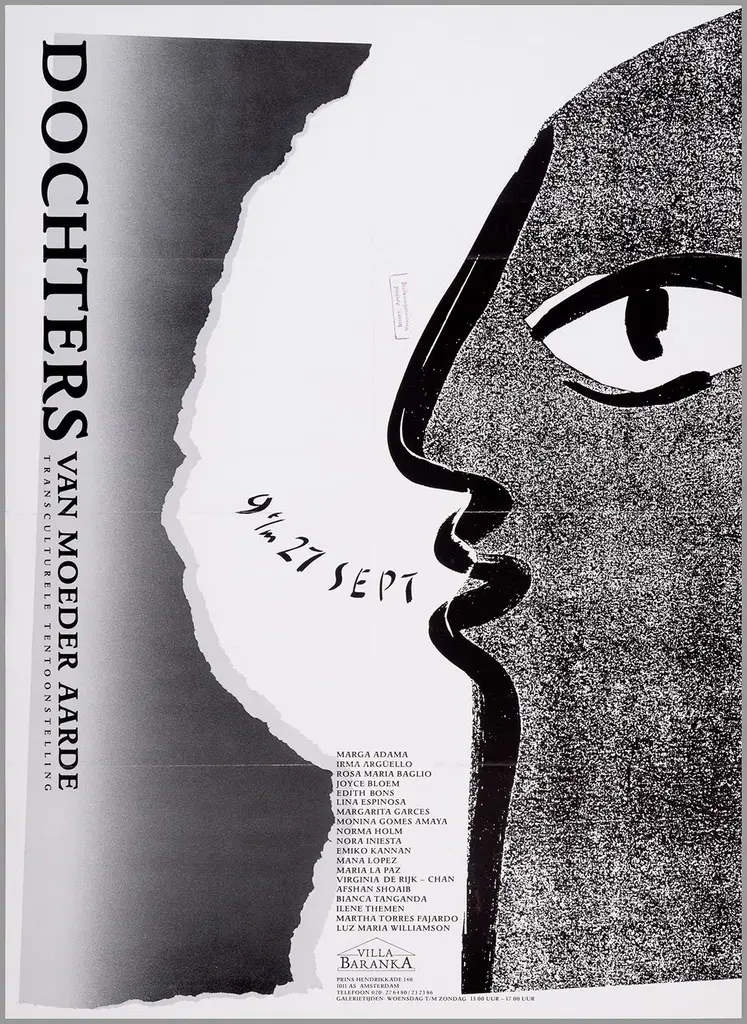
The poster Daughters of Mother Earth: transcultural exhibition, referring to Greek mythology, shows one of the many manifestations at Villa Baranka. Nineteen women artists from Argentinian, Chilean, Chinese, Colombian, Indian, Japanese, Dutch, Pakistani and Surinamese backgrounds exhibited at the art salon from 19 to 27 September 1987. The artists exhibited paintings, sketches and drawings, as well as lectures and plays.
Earlier, I interviewed Adama about her oeuvre and her work with Martina. In it, she endorsed the importance of the art salon in general and this exhibition in particular:
"I came from a time when, for example, Surinamese artworks were not exhibited in the museum. I once got a letter from [Eduard] de Wilde [of the Stedelijk Museum]. He said: 'no we don't do Surinamese.' [...] It wasn't art to them. So we did that! I think Fridi and I have done that. We set up [an art salon] that didn't exist yet."[5]
Round table discussions on gender, race and sexuality
Over the years, Villa Baranka organised lectures on the gender equality of non-Western women, the future of Antilleans in the Antilles and in the Netherlands and held round-table discussions on gender, race and sexuality in Dutch theatre. It also offered drama and dance classes. These combined Western techniques with non-Western philosophies. The curtain finally fell in 1989. Without structural subsidies, the financial situation was no longer sustainable.
Villa Baranka's legacy is rich. Villa Baranka was ahead of its time. It was a place that championed interdisciplinary and multicultural art before these terms became fashionable and incorporated into art policy. Its history needs to be passed on to a new generation. I want to take a first step through this blog.[6]