Dutch-Moluccan feminist Julia da Lima's statement, which she read at the opening of the Winter University Women's Studies (WUV) in Nijmegen on 17 December 1983, began as follows:
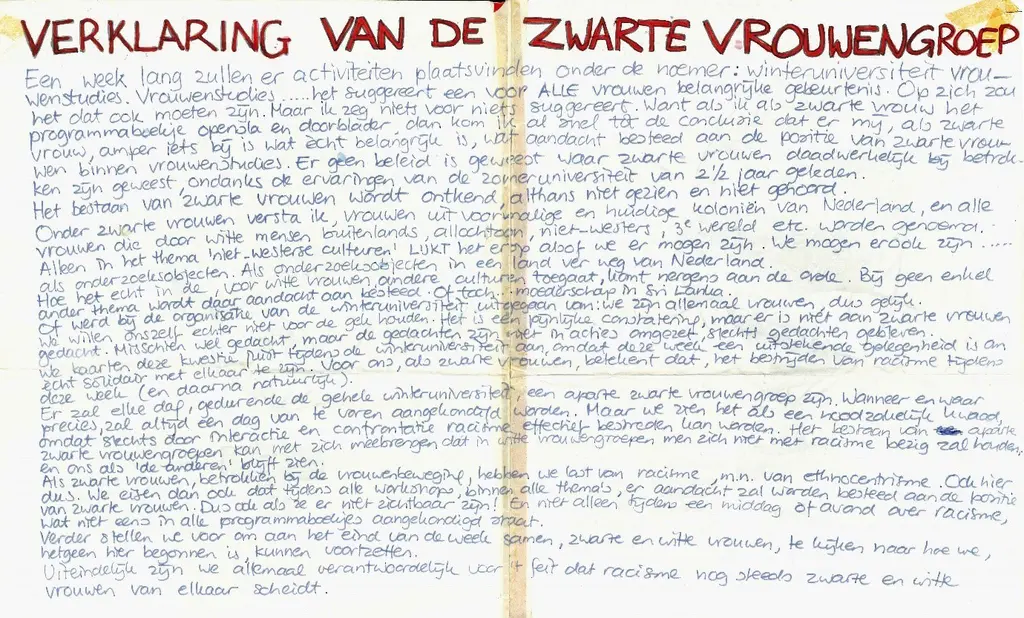
Dutch-Moluccan feminist Julia da Lima's statement, which she read at the opening of the Winter University Women's Studies (WUV) in Nijmegen on 17 December 1983, began as follows:
"A week of activities will take place under the banner: winter university of women's studies. Women's Studies ... it suggests an important event for ALL women. In itself, it should be. But I say suggests for a reason. Because as a black woman, if I open the programme booklet and leaf through it, I quickly come to the conclusion that for me, as a black woman, there is hardly anything among them that is really important, that pays attention to the position of black women within women's studies."
Julia da Lima
Da Lima studied psychology at the University of Groningen. She was previously active in the white and Moluccan women's movements. And during her travels through America and England, she became inspired by the black women's movement.
"The years of dissatisfaction with the white nature of Women's Studies and feminism, all these white anthropologists talking about us, while we were left out. I had had enough."
We black women
Da Lima walked onto the stage on an impulse after the official opening of the WUV and read out the statement. She talks about "we" for strategic reasons, but wrote the text on her own on her way back from London. Da Lima chose to use "we black women" as a response to the white character of the Dutch women's movement. In doing so, she was inspired by American and English feminism, in which 'black' was a common term for black women and women of colour.
The image above this article is not the original A4 statement Julia da Lima read out. She later wrote down her statement again along with the programme that was made. For this, she used the back of two posters stuck together. On one, we see a poster of the Black Women's Telephone - for and by Black women - one of the pioneering projects of the Black Women & Racism Arnhem Foundation. The poster was designed by the founder of this foundation: Ans Sarianamual, a friend of Julia da Lima.
"...There has been no policy where black women have actually been involved, despite the experience of the summer university 2½ years ago. The existence of black women is denied, at least not seen and not heard."
1981: Women's Studies Summer University
From 29 June to 4 July 1981, the first Summer University of Women's Studies was held in Amsterdam. The aim was to examine the different views on women's studies. One of the themes was 'Foreign Women', prepared by Philomena Essed, Marianne Beelaerts and Annemiek Hoogenboom. For the Summer University conference volume, Essed wrote a contribution on the relationship between feminism and racism and the role of white and black women among themselves.
In the contribution, she wonders why little attention is paid to racism within the feminist movement. She argues for an anti-racist feminism. "Are they aware that learning from-each other is not a one-way street towards us: seeing us only as women with problems, women who are oppressed, who need to be helped. It also and above all means being open to our learning experiences and insights." It was the discussion paper of the Racism, Ethnocentrism, Allies, Solidarity working group at the 1981 Summer University and was published in elaborated form in Socialist-Feminist Texts 7.
"As black women, involved in the women's movement, we suffer from racism, specifically ethnocentrism. So here too. We therefore demand that during all workshops, within all themes, attention will be paid to the position of black women. So even when they are not visibly there! And not just during an afternoon or evening on racism, which is not even announced in all the programme booklets."
Racism and women's studies
On Wednesday evening, 21 December 1983, racism was on the programme of the Winter University Women's Studies. The evening began with a lecture by Troetje Loewenthal on racism and women's studies. This appeared in the Journal of Women's Studies under the title: The white tower of women's studies. In it, Loewenthal wonders where black women are in the programme. "Trained by years of experience, I think 'oh yes, probably with the non-western cultures again'." And indeed under the heading non-Western cultures, she sees "foreign women in the Netherlands" in addition to Kenya, Colombia, Peru, among others.
The Winter University has chosen themes that stem from a social field. Loewenthal wonders where then is the 'White women' social field. "You guessed it, that can't help but be all these themes together, or am I thinking too dualistically?". You can read more about the rest of this evening and its follow-up in the 1983 Winter University Report.
"I belong there too"
Although Da Lima's statement caused a commotion, to her surprise, she received overwhelming responses from women who said "I belong to that too". Following the statement, an ad hoc working group was formed, which held activities and discussion meetings alongside the Winter University programme.
Black, migrant and refugee women's movement
Julia da Lima's statement was a pivotal moment in the history of the black, migrant and refugee women's movement. After Winter University in 1983, a group was formed and a collective fist was raised. Initiatives and networks such as the National Black Women's Days, Black Women's Radio, the Black Women's Newspaper, Sister Outsider, Black Orchid and Strange Fruit emerged, and the first black and migrant women's knowledge centre Flamboyant was established in 1985. In the late 1980s, the black women's movement evolved into a black, migrant and refugee women's movement.
In March 2021, Tabea Nixdorff came across this Declaration of Julia da Lima' s Black Women's Group in the archive of Troetje Loewenthal while doing research for an exhibition at The New Institute in Rotterdam. It will be on display as a reproduction for four years in the exhibition 'The Design of the Social', for which Tabea Nixdorff has been researching with Setareh Noorani and others at Atria. Earlier, in 1996, the statement was shown at the IIAV's (predecessor Atria's) exhibition Onderbelicht (Underexposed) as part of the project Information Care in the Field of Black and Migrant Women.