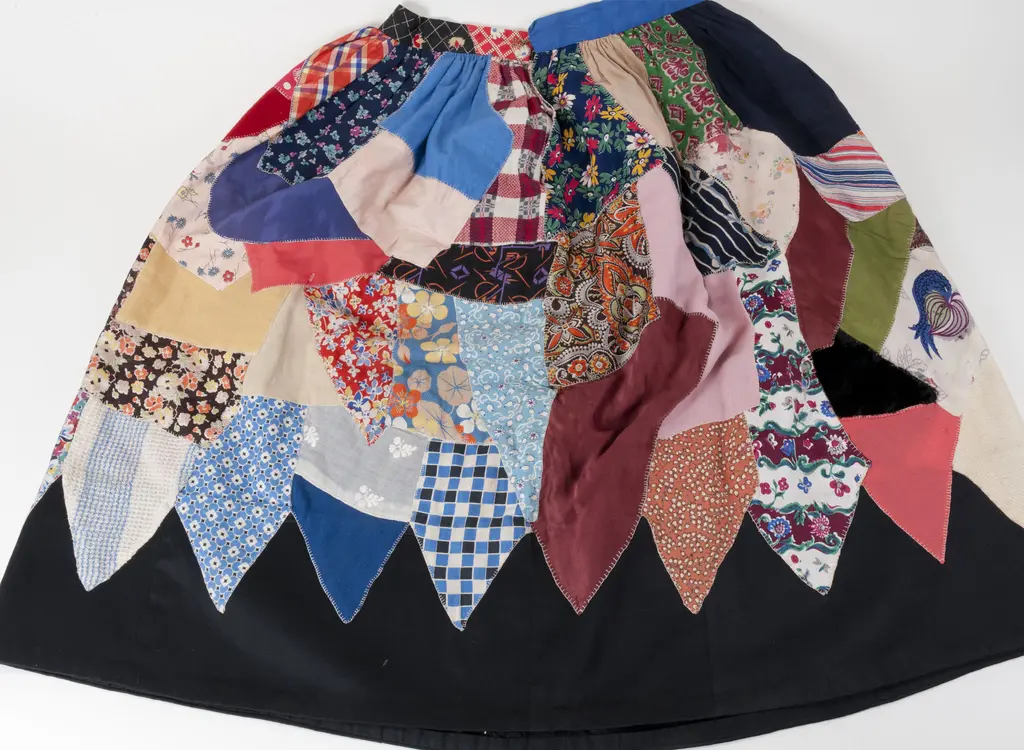
Atria owns five party skirts, also called liberation skirt, life skirt or orange skirt. The idea of the national party skirt came from feminist and resistance fighter Mies Boissevain-van Lennep. She called on women in the Netherlands after World War II to wear a 'National feestrok' on special days as a commemorative and festive symbol of togetherness between women. Women made the party skirts from old cloth with personal memories.
Atria owns five party skirts, also called liberation skirt, life skirt or orange skirt. The idea of the national party skirt came from feminist and resistance fighter Mies Boissevain-van Lennep. She called on women in the Netherlands after World War II to wear a 'National feestrok' on special days as a commemorative and festive symbol of togetherness between women. Women made the party skirts from old cloth with personal memories.
Party skirt transfer
On 3 March 2009, the IIAV (now Atria) received a very special archive piece: a national party skirt. Esther Elkerbout handed over the skirt that her mother made to then director Saskia Wieringa. She explains that her mother incorporated pieces of fabric from her engagement dress and wedding gown into the party skirt. The date of Liberation Day was embroidered on the hem. Elkerbout also found fabric from summer dresses she wore as a young girl.
How did the national party skirt come about?
Mies Boissevain-van Lennep was arrested in August 1943 and transferred to Vught concentration camp in October. Here, at some point, she was sent a tie made of all sorts of small pieces of cloth. She recognised bits of fabric in it from coats, trousers and other garments of friends and acquaintances. To her fellow prisoners, Mies told the story that went with each piece of fabric. This prompted the other women to start reminiscing too. This strengthened solidarity among the women. This event probably prompted the introduction of the idea of the national party skirt.
After the end of World War II, Boissevain-van Lennep took the initiative on behalf of the Committee of Feast and Memorial Days to make skirts out of various pieces of cloth. Women could wear these on special days. It was not just about the wearer's personal memories. The skirt also symbolised the reconstruction and renewal of the Netherlands by merging old patches of fabric into one new whole. Something women are naturally good at, according to Boissevain-van Lennep: creating harmony.
Guidelines for making a party skirt
Boissevain-van Lennep wrote specific rules for making and using the party skirt. The hem had to consist of plain triangles and '5 May 1945' embroidered prominently on the front. The skirts were to be worn on national holidays as well as on important private celebrations. Subsequent events in the wearer's private life, both highs and lows, women could also incorporate into the skirt.
Patchwork skirts
Despite the textile scarcity in the post-war era, there was no shortage of old garments. Women sewed the patches onto old skirts. The idea was for women to give meaning to each patch themselves. Embroidery depicted memories. And the patches were often decorated with dates of important events. As a result, the patchwork skirts ultimately form a unique life story.
Register of party skirts
Boissevain-van Lennep had called on all women to register their skirts in the 'skirt register'. The skirts were then stamped with a number. The stamp was round and on the outside was the text the 'National Party Skirt', inside it was 'Assembled on one ground' and in the middle NI, the abbreviation of National Institute. At the bottom was the year 1946, 1947 or 1948. After registration, the owner received a postcard with the registration number. She was advised to embroider the assigned number on the skirt. Eventually, some 4,000 party skirts were registered.
The skirt register is not present at Atria; the Mies Boissevain-Van Lennep archive contains only a list of names and addresses under inventory number 41, but this is therefore not the skirt register itself. Egge Knol, curator of the Groninger Museum, reports in his book The Liberation Skirt in Groningen (2020): 'Unfortunately, the skirt register cannot be found.' Jolande Withuis, in her article De doorbraak en de feestrok (1991), also makes no mention of where the skirt register might be. It cannot be said with certainty whether the skirt register still exists, but so far it has not turned up anywhere.
Defile of party skirts at the Binnenhof
Just after the Second World War, Dutch feminists seized upon important events in the royal family to highlight their 'cause' through exhibitions, commemorative books and historical studies. Such was the case in 1948, the year of Queen Wilhelmina's abdication, her golden jubilee of reign and Juliana's inauguration as queen. On 2 September 1948, there was a joint celebration of Dutch women at the Binnenhof. A 'skirt parade' formed a festive highlight with the meaningful cloth skirts. And there was even a real 'Song for the National Party Skirt'.