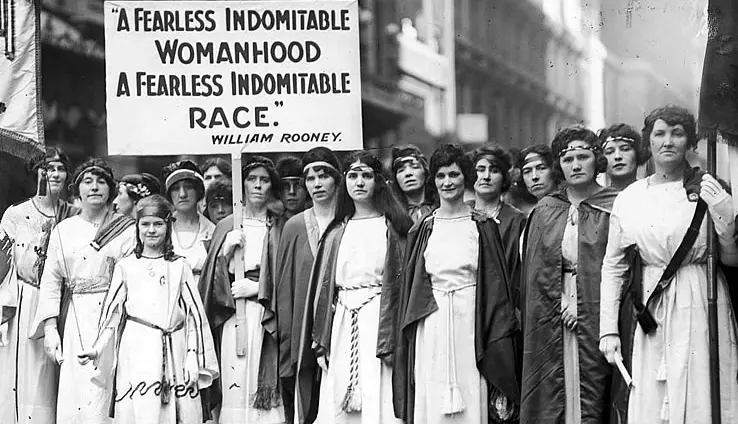
During the early years of the birth control movement and fight for women’s rights there were many feminists who used eugenic rhetoric to argue for more rights. Most current literature on early feminists treats this simply as a sign of the times they were in, but this article argues that Eugenic Feminism was a unique and prominent ideology in its own right and that we should adopt this term in future research.
During the early years of the birth control movement and fight for women’s rights there were many feminists who used eugenic rhetoric to argue for more rights. Most current literature on early feminists treats this simply as a sign of the times they were in, but this article argues that Eugenic Feminism was a unique and prominent ideology in its own right and that we should adopt this term in future research.
This article will provide an introductory explanation of what Eugenic Feminism was and how its legacy has continued on into the present day in an attempt to argue for the adoption of the term Eugenic Feminism into wider feminist discourse as a unified ideology rather than a coincidental symptom of the times.
The Birth of Eugenics
In 1859 Charles Darwin wrote On the Origin of Species which proposed the theory of evolution and natural selection. These ideas were very quickly applied to humans by Herbert Spencer in the 1860s where he posited that human civilizations and ‘races’ were also in their own struggle for the survival of the fittest with white Western-Europeans being the most fit (Weßel, 2018). Darwin’s cousin, Francis Galton went on to centralize these ideas into the pseudo science of eugenics which advocated for the “conscious improvement of our stock.” (Gilman, 1927). The goal of Eugenics was to “subject evolution to human will” through government-run selective breeding initiatives (Röling, 1987). Eugenic arguments that claimed certain traits or races were inherently more fit were used all over the world to propagate racist laws that prevented interracial marriage, force sterilizations on those they saw as ‘unfit’ (predominantly women of color and the disabled), restrict immigration, and much more.
The history of eugenics has primarily focused on its use as a justification for the Holocaust, however, its prominent role in social movements in the early 1900s beyond Nazism has begun to grow (Weßel, 2018).
What is Eugenic Feminism?
By the turn of the 20th century eugenic ideas had become widely popular across (predominantly the Western) world. Quite a few feminists who were active at the same time as the rise of eugenics adopted these eugenic ideas in their arguments for women’s rights, particularly within this birth control movement. (Timm, 2022) The term Eugenic Feminism was patronizingly coined in 1911 by Caleb Saleeby (1878-1940) in his book Woman and Womanhood: a search for principle (Devereux, 2006). He coined the term in a bid to convince white suffragists to continue having children, with a slightly higher social standing as ‘mothers of the race.’ His term was never widely adopted in his own time but it does give us a fitting term for a trend that we can now clearly see in retrospect.
Mainstream eugenics treated women as passive actors in reproduction but eugenic feminists added themselves into the conversation as active participants as the ‘Mothers of the Race’ (Lettow, 2014 and Devereux, 2006). Rather than confronting the racist categorizations of eugenics and its over-emphasis on reproduction being the singular value of women, they seized those ideas to position (white) women as the keys to the success of the Nation. They argued that by granting women increased rights and bettering their lot in life, they would be able to be better, more ‘fit’, mothers. They argued that the patriarchy actually hindered natural selection because women were not free to choose their own partners and were instead forced into unhygienic (a eugenic term for unfit) marriages (Jacobs, 1899).
Eugenic Feminists were also prominent in the birth control movement where they argued that wider access to birth control (and in some cases even abortion and sterilization) would help to limit the amount of ‘unfit’ babies being born (Röling, 1987).
Prominent Feminists who Promoted Eugenics
In recent years there has been a growing awareness of the connection between early feminists and eugenics. Margaret Sanger (1879-1966), the founder of Planned Parenthood and one of the most influential feminists in the American birth control movement was one of the first early feminists whose eugenic beliefs were uncovered (Ziegler, 2008). She founded Planned Parenthood in 1942 as an American NGO that promoted family planning through sexual education, contraceptives, and even abortion. Sanger undeniably played an instrumental role in the American fight for contraception and women’s liberation, however, her outspoken admiration of eugenics has gone largely overlooked up till now. In 2020 Planned Parenthood themselves even released a statement admonishing and distancing themselves from Sanger’s prominent eugenic ideas. In her books such as The Pivot of Civilization and Woman and the New Race she advocated for birth control as essential in the eugenic mission of breeding a ‘better’ race (Ziegler, 2008). She said that birth control was “crucial and primary” for the betterment of the (white race) stating that:
"In the creation of a race of strong, well-born children, fitted by proper heredity and breeding to transmit undimmed the life force to the succeeding generation, the instrument of Birth Control cannot be ignored: its importance is crucial and primary."
Other prominent early feminists such as Charlotte Perkins Gilman (1860-1935), the American author and feminist activist, has also started to fall under scrutiny for racist themes in her novels and political writing, however, the specifically eugenic nature of her beliefs is still under researched. Gilman did indeed have racist rhetoric built into her writing but it went deeper than that (Nadkarni, 2012). She professed specifically eugenic beliefs that focused on the supposed power of selective breeding to shape society into her vision of an ideal world. Her eugenic feminist rhetoric can be seen in her utopic novel Herland that celebrates the all female (and entirely white) eugenic society. (Weinbaum, 2001). Gilman believed that:
"When the mother of the race is free, we shall have a better world, by the easy right of birth and by the calm, slow, friendly forces of social evolution."
Here in the Netherlands as well, the celebrated feminist and doctor, Aletta Jacobs (1854-1929), has also been found to have connections with the eugenics movement. As of yet her connection to eugenics has not been sufficiently explored, however, there are indicators that she also held such beliefs, though she was less explicit and outspoken than her American sisters. (1) Jacobs’ husband was a co-founder of the Dutch Neo-Malthusian Bond (the original name of the Nederlandse Vereninging voor Sexuele Hervorming) which advocated for birth control and family planning which they justified in their early years with eugenic rhetoric (Röling,1987). They promoted Neo-Malthusianism which was an offshoot of eugenics that pushed for the unfit (the poor) to have less children to prevent overpopulation and the perceived decline of the birthrate of the ‘fit’ (Timm, 2022 en Pols, 2010).
Jacobs was a participating member until 1899 when she had a falling out with Jan Rutgers over the training of laypeople in birth control methods (Nabrink,1978). Ironically it was through this program of “expert collaborators” that Rutgers himself trained Margaret Sanger in the administration of birth control in 1915 (Röling,1987). In what is currently known as the only time Jacobs publicly wrote about eugenics, she stated that:
"Everyone has the right to live, but this does not imply that everyone also has the right to procreate new lives."
The Double Edged Sword of Eugenic Feminism
Eugenic Feminists such as the women listed above, argued for women’s rights by emphasizing the important role they played in the future of the Nation. They framed motherhood as a service and sacrifice for the Nation, except the problem is that if they are the key to the success of the Nation, they are also the key to its downfall (Jones, 2010). When reproduction is framed as a duty to the Nation that means that the Nation also has the right to interfere in a woman’s choice in how or when to have children because it stops being a private decision, but a service to the greater good. This becomes increasingly important to address today as governments across the world are tightening restrictions on a woman’s right to choose, it is important that we reassess our relationship with reproduction and our value as humans, not just as mothers in service to society.
The legacy of Eugenic Feminism likewise propagates racism today. Eugenics relies on the idea that people are not equal and divides the ‘fit’ and ‘unfit’ along arbitrary and racist lines. The influence of eugenics on early feminists is not the only reason for the racism seen in many early feminist movements, however it does allow us in the present to deconstruct the justifications they themselves used and pinpoint where the same logic has persisted today. To properly confront racism within the feminist movement we need to understand not just if they were racist, but how so that we know how to properly address it in the future.
An example of the legacy of Eugenic Feminism logic today can be seen in the TERF movement (Trans exclusionary radical feminism) which, much like early Eugenic Feminists, denies the trans-experience of femininity based on their narrow and set definition of womanhood that often centers on a fixation with reproduction and motherhood. (Burns, 2019). Both movements use biological determinism to define womanhood as a fixed experience with traits and abilities such as women being naturally nurturing or passive automatically determined based solely on their sex at birth. We must move beyond the continuing belief that the value of women and femininity is motherhood but is instead an everchanging and highly personal experience that does not need to have value or definitions.
Conclusion
Our understanding of the eugenic legacy within feminism is still very limited and requires a great deal more research. It is clear that even well-known feminists such as Sanger and Jacobs have connections with eugenic ideas but the extent of their beliefs is not yet clear. Current research is scattered due to the fact that there is not yet an overarching term for feminists who used eugenic ideas. Many researchers have individually discovered this connection (because it is not exactly hidden) but they write about each instance in isolation rather than a piece in the wider ideology of Eugenic Feminism. The adoption of the term Eugenic Feminism will allow us to research these women in connection with each other as well as building a base for future collective research rather than our current isolated discoveries. It will also allow us to nuance our discussion of racism within the feminist movement by breaking down the exact ideologies that went into justifying it. Breaking down the Eugenic Feminist fixation on reproduction will also allow more room for women to find value in their experience as people with unique and special experiences rather than as mothers chained to the fate of society.
The connection between the birth control movement and eugenics does not negate the monumental achievements made by early feminist but it does help us to uncover and process the neglect and abuse that these successes were won on. We can appreciate the results of the success while still critically examining how we got her in the first place. If we do not address our darker past then we allow it to continue into the present. If we take early feminist ideas at face value and do not critically assess their ideas then we will carry their flaws into the future with us and will never be able to work to build up a more inclusive intersectional movement.
(1) Aletta Jacobs only wrote about eugenics once in her 1899 book Vrouwenbelangen, however in this book she mirrors eugenic feminist rhetoric seen elsewhere in the US and UK which, in connection with her extensive international eugenic network, brings her own eugenic leanings into question.