‘So put all your clothes in a bin bag and come to Blijf!’ rang out the catchy song on 25 June 2024 at the Rode Hoed in Amsterdam. That evening, Mayor Femke Halsema presented a royal medal of honour to the Blijf group, which is celebrating its fiftieth anniversary in 2024. Today, Blijf is recognised as an established organisation that provides shelter for victims of domestic violence.
‘So put all your clothes in a bin bag and come to Blijf!’ rang out the catchy song on 25 June 2024 at the Rode Hoed in Amsterdam. That evening, Mayor Femke Halsema presented a royal medal of honour to the Blijf group, which is celebrating its fiftieth anniversary in 2024. Today, Blijf is recognised as an established organisation that provides shelter for victims of domestic violence.
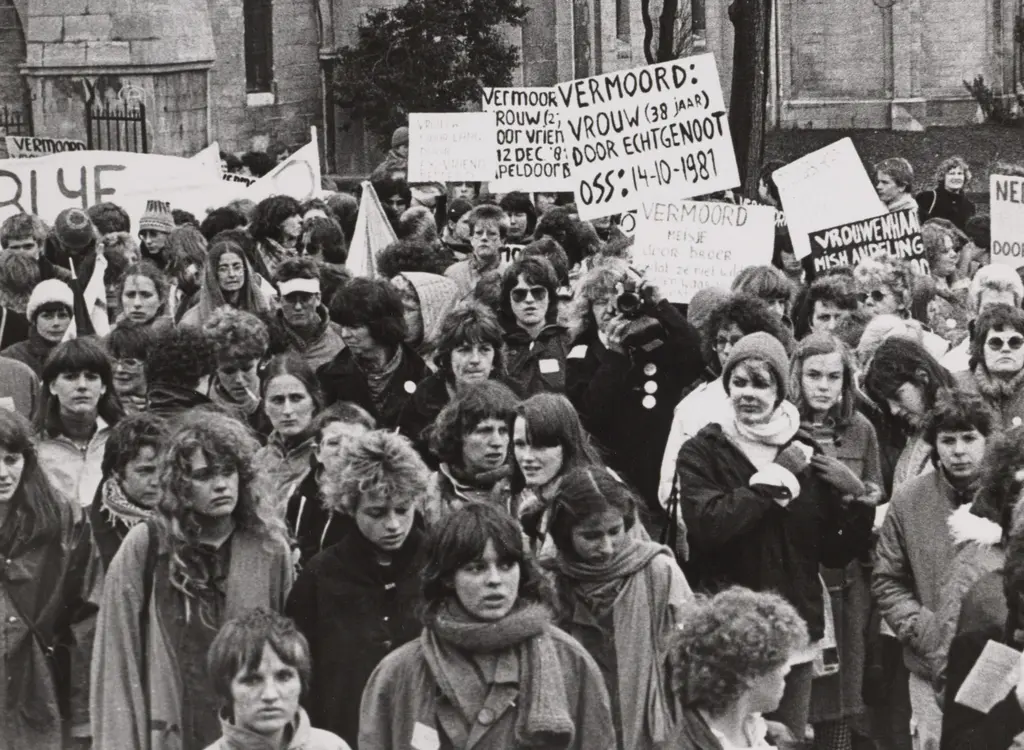
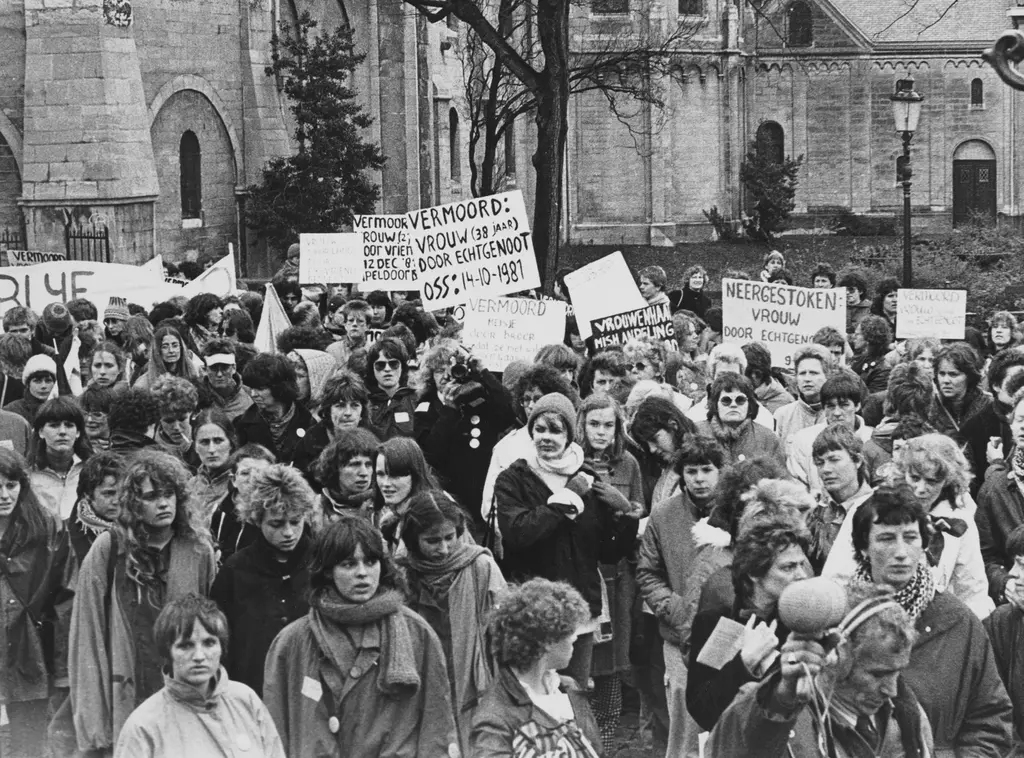
Unfortunately, (sexual) violence against women in the home remains a growing social problem. Anita Aerts, one of the founders of Blijf Amsterdam, said in an interview with AT5 on 27 July 2024 that a second Blijf shelter had been opened in Amsterdam for the first time since the opening of the first one in 1974. The history of the past fifty years shows just how crucial those radical early days were in putting this issue on the agenda, but also how important it was for the organisation to evolve alongside a constantly changing society.
We want to ‘really do something for women’
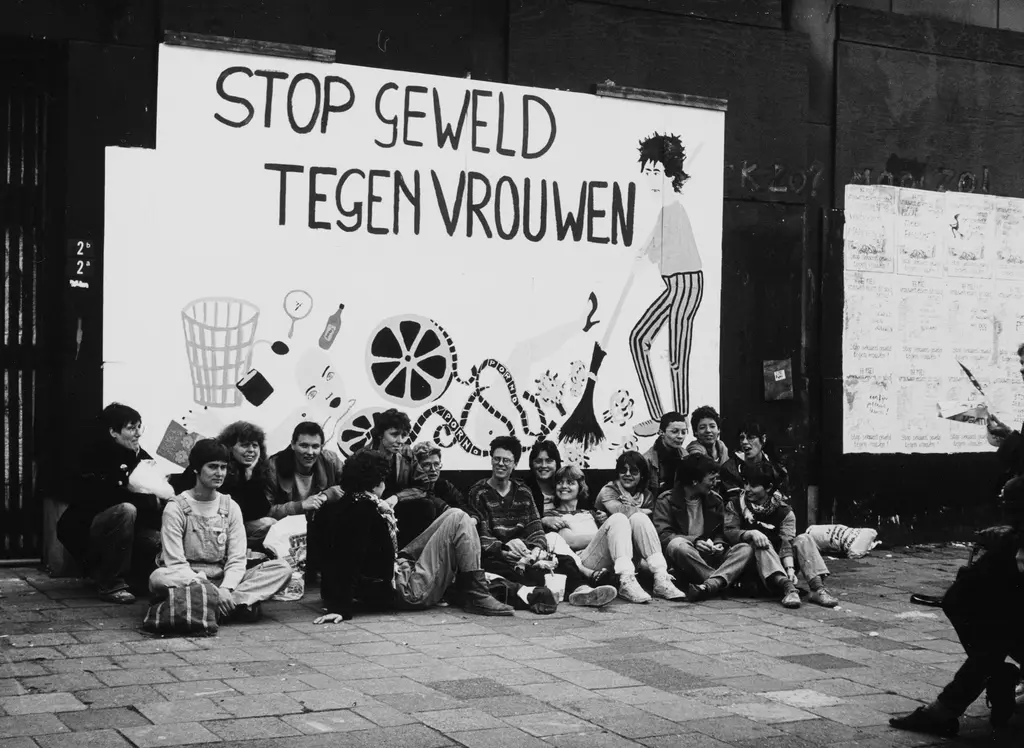
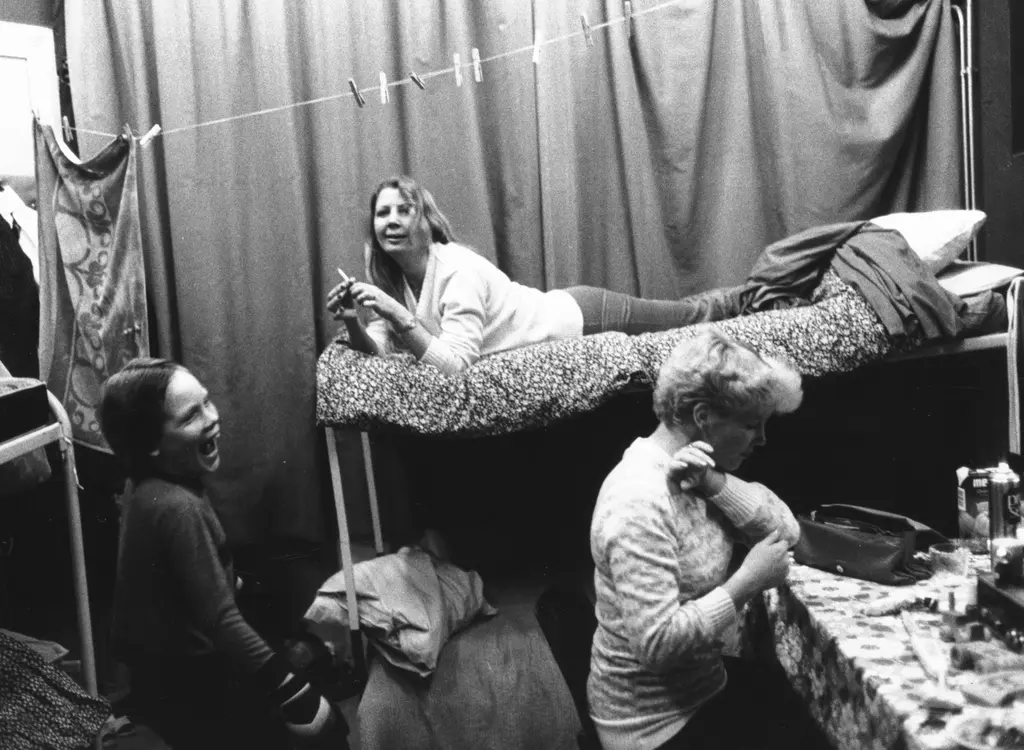
When the first ‘Blijf-van-mijn-lijf’ shelter (BVML shelter) was established in Amsterdam in 1974, politicians at the time still regarded (sexual) violence against women in the home as a private matter. These were thought to be isolated incidents that, on legal grounds, did not require protection for the victims. The aim behind setting up the first BVML shelter was ‘to really do something for women’. This principle was originally discussed at the meeting on the ‘JAC women’s project’ (JAC: the Youth Advice Centre) on 17 December 1973. During this meeting, the group of women was formed that eventually split from the JAC and opened the first BVML centre.
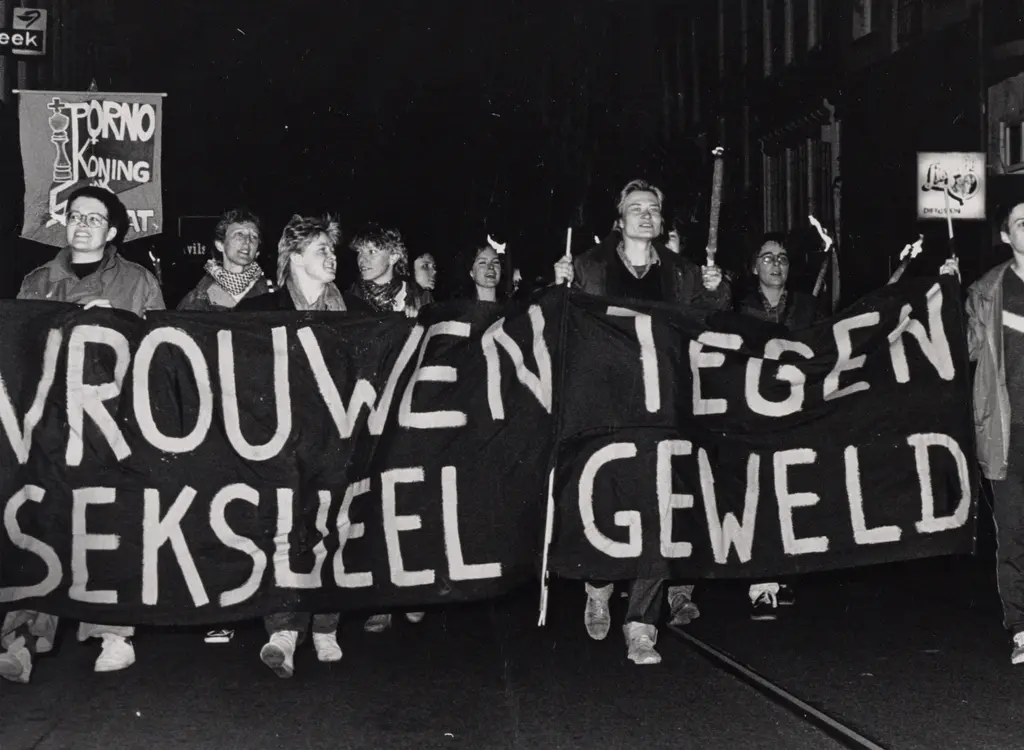
The founders of the early BVML houses were headstrong and ideologically driven. By pursuing their radical feminist ideals – which initially led to squatting, the development of a new form of care provision and the empowerment of women who had been abused – they ensured that (sexual) violence against women in the domestic sphere came to be recognised as a social problem. This laid the foundations for a long-standing tradition of support for victims.
In the early days, the organisation of the BVML houses was steeped in the ideological background of its founders. They wanted to demonstrate that (sexual) violence against women in the domestic sphere was a product of patriarchal society, and therefore actively distanced themselves from it. They developed the concept of ‘deprofessionalised working’, which meant that they eliminated all forms of hierarchy and dependency from their organisation. No subsidies from central or local government, and in the early years every staff member worked purely on a voluntary basis.
‘Just get started!’
The minutes of the meeting on 19 June 1974 clearly show the dilemma faced by the founders of the first BVML centre in Amsterdam when it came to finding premises for the centre:
“Through council channels or squatting? It’s difficult through the council. Endless meetings, constantly having to explain a problem ‘that doesn’t exist’.” “We can’t substantiate anything, nor prove it with figures, and that’s what they’ll focus on at first. (...) Squatting gets round that problem. Just get started – once we’ve got a few women in the house, nobody can ignore it any longer.”
And they were proved right. Shortly after the first house opened, it was a huge success: ‘supply created demand’. In no time at all, thirty to forty women and children had been housed in the first BVML house in Amsterdam. ‘We were constantly doing things we’d never done before (...) You really have no idea what’s in store for you,’ reflects Anita Aerts in 2024 on the OVT podcast ‘50 Years of Blijf van mn Lijf’.
But although terms such as ‘squatting’, ‘activism’ and ‘deprofessional’ may sound chaotic, the founders of the first BVML house set about their work in a professional and meticulous manner. The archives of BVML Amsterdam, Delft and Rotterdam all clearly demonstrate this: the boxes are filled with neatly typewritten minutes of the large number of meetings that took place. When you delve into these minutes, you see that every step was thought through in detail: lengthy reports on the reasons why only volunteers were involved, why the locations of the houses were kept secret, why they decided to squat a building; lists of organisations offering support to victims; a typed manual on how to squat professionally, complete with illustrated diagrams; correspondence with other BVML houses; the horizontal structure; the promotion of self-determination among the victims; and so on.
Working in an unprofessional manner
‘The aim of our project is to provide those forms of practical assistance which also serve the overarching goal: the liberation of women as women.’ So state the minutes of the BVML centre in Amsterdam dated 25 March 1974.
The criticism levelled by the founders of the first BVML shelter at mainstream support services was that this approach would trap victims in an endless cycle of dependency. In this cycle, they were first dependent on their abusive partner – in 1974, the number of women who were financially independent of their partner was still considerably lower than it is today – only to subsequently find themselves in a position of dependency within the care system. Instead of the victims being empowered, decisions were made for them, and the ultimate aim was, in the end, to return them to their home situation.
The founders of the BVML House wanted to take a different approach. A horizontal structure was therefore adopted throughout the organisation. Staff and trainees worked on a voluntary basis so that no hierarchy would arise, such as that found in the social care sector. In addition, the intention was that the victims who came to the BVML House would take responsibility themselves for running the households and preparing meals. They were given pocket money (if they were not already receiving benefits), took the initiative to seek out other support services themselves, and took in new victims at the house.
This approach was taken so far within the organisation that no grant was applied for until 1978, and the house relied on donations. The thinking was that dependence on grants would lead to the creation of a power structure and the repetition of patriarchal patterns. When Blijf did receive its first grant in 1980 – to pay the staff responsible for looking after the victims’ children – some staff members who were ideologically opposed to this resigned. BVML-Groningen closed its doors for the same reason.
‘Deprofessional’ therefore by no means meant ‘unprofessional’. The founding manifesto of Blijf Amsterdam states the following: “By this we mean that we wish to make it clear, right from the outset, that BLIJF VAN M'N LIJF does not offer ‘shelter’, nor non-committal assistance, but rather to offer support and concrete, practical help to women who are prepared to fight back and take matters into their own hands. We are attempting to develop a systematic, methodical approach to this, through literature reviews, discussions of our own experiences and insights in providing support, and role-plays. In doing so, it is becoming increasingly clear that developing our own theoretical framework is indispensable.”
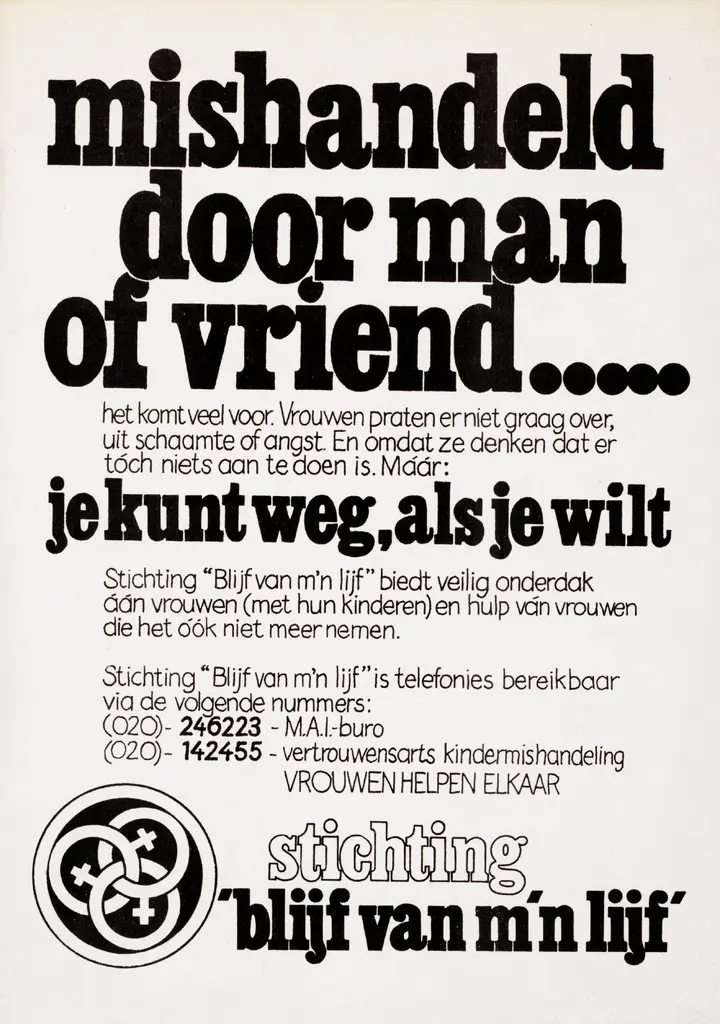
But not everyone felt as strongly about radical feminism as the founders did: the volunteers, founders and victims engaged in many political discussions amongst themselves. That is why the minutes of the BVML Amsterdam branch meeting of 22 May 1974 stated:“Good feminist activities do not have to get in each other’s way”. At the end of the day, providing support to victims was always the most important thing.
‘Children’s work’
The term ‘children’s work’ appears frequently in the minutes of the BVML homes. ‘Childcare’ did not mean that children had to work in the BVML homes, but referred to staff – formerly volunteers – who were responsible for looking after the children who had come with the victims. This gave the victims the space to sort out their own affairs.
The ‘childcare’ led the founders and staff to start questioning the non-professional approach to working in the centres. The first grant for the BVML centres in 1980 was therefore intended to pay the ‘childcare workers’. The idea of a horizontal structure simply did not hold up when it came to the care of the children. It also raised the question of whether men might also need to be involved in the organisation. Wouldn’t a positive father figure be more than welcome for the children?
The ‘professionalisation’ of radical feminism
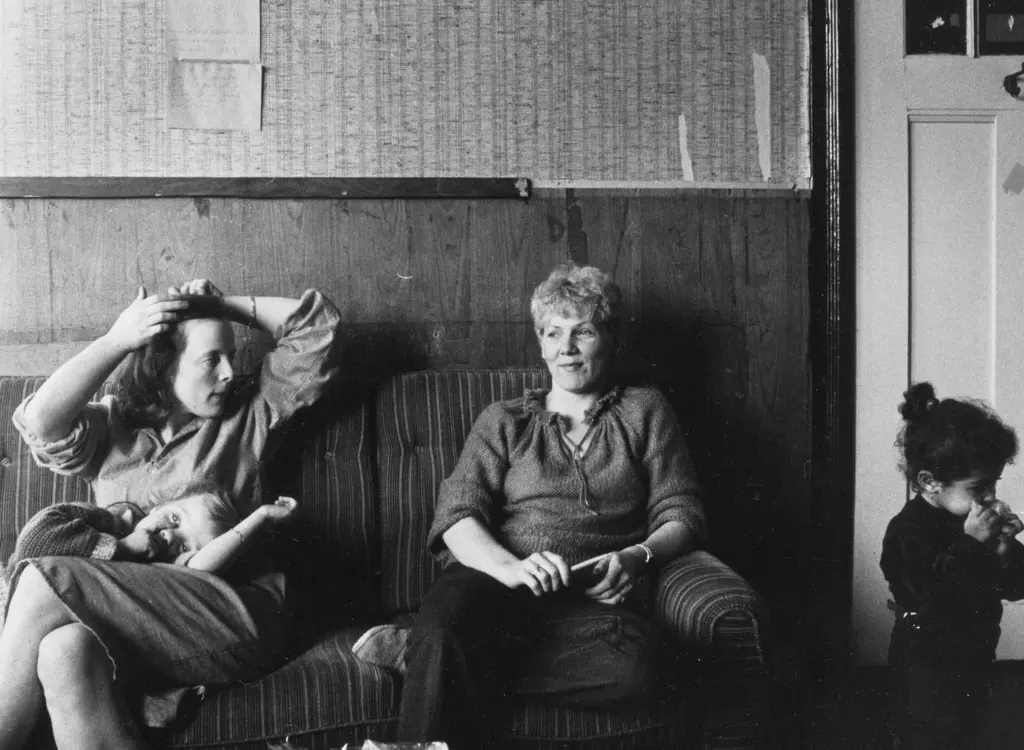
From the 1980s onwards, the strongly radical feminist ideology of the BVML centres increasingly faded into the background. Whilst in the early days the aim had been not only to provide support to victims but also to campaign and bring (sexual) violence against women in the domestic sphere onto the political agenda, as time went on, providing shelter for victims became an ever-greater priority. It became clear that the shelters were indispensable to society; the original, unique way of working could simply no longer support the scale of the organisation.
A problem ‘that doesn’t exist’?
In the late 1980s, a substantial amount of funding had become available, which was used to launch a large-scale study into the extent of (sexual) violence against women in the domestic sphere. In 1992, Professor Rénee Römkens, a specialist in gender-based violence, published the findings: 20 per cent of Dutch women had unequivocally experienced (sexual) violence within the home. Five per cent had experienced repeated violence, and 8 per cent of women had been raped within their marriage. The study also showed that anyone could be a victim: rich, poor, black, white, religious or non-religious.
These figures were shocking. They contributed to a wave of political decisions taken in the 1990s: rape within marriage was made a criminal offence; (sexual) violence within the domestic sphere was recognised as a social problem; and women were able to apply for restraining orders themselves. Most of these developments were initiated by the then State Secretary for Social Affairs and Employment, Hedy d’Ancona, who herself had been particularly active in the radical feminist movement of the ‘second wave of feminism’ in the 1970s.
Who is the victim?
Renée Römkens, the researcher behind the above figures, explained in a 2020 interview with OVT that, alongside these political decisions, the terminology was also made gender-neutral. What had previously been referred to as (sexual) violence against women in the domestic sphere was suddenly described as ‘partner violence’ and ‘domestic violence’. This is a regrettable development, as making these terms gender-neutral obscures the fact that this type of violence is generally directed primarily against women.
Originally, the BVML shelters were specifically focused on this very issue. They provided shelter exclusively for women, and the minutes of a meeting in 1974 state the following:‘There are no institutions in the Netherlands that deal with – or are aware of – the political nature of women’s issues.’ The BVML shelters were therefore established specifically because, at that time, (sexual) violence against women in the domestic sphere was seen as a symptom of patriarchal society.
In 2004, the first shelter for men who are victims of domestic violence opened under the auspices of the Blijf group. Over the years, the organisation’s perspective has broadened; Blijf is an organisation that keeps pace with contemporary developments in feminism: gender issues affect society as a whole. Nevertheless, it is important to remain mindful of the fact that domestic violence primarily affects women and members of the LGBTI+ community.
The scientific research highlighted the need for BVML homes in society. It had become clear much earlier that the founders of the BVML homes were engaged in something of such great social importance. For example, as early as 1978, the homes applied for a grant that would enable them to employ on a salaried basis the staff responsible for the children’s care. In 1980, this grant was awarded on the condition that a central governing body be established for all BVML homes. This led to the founding of the Blijf Group.
Around the late 1980s and early 1990s, questions began to be raised from within the organisation about the unprofessional way of working. When, in 1997, the BVML home in Amsterdam was occupied by its residents because an unsafe atmosphere had developed within the home, the situation reached a boiling point. They deliberately distanced themselves from the horizontal structure and appointed a director. This gradual change within BVML was in step with the political changes and academic research of the time: all of this was driven by women active in the feminist movement who succeeded in exerting a tangible influence on politics and society.
The houses are being painted
The 1980s and 1990s were also characterised by the Netherlands becoming increasingly multicultural. Suriname’s independence in the 1980s, the influx of migrants from Indonesia and the recruitment of ‘migrant workers’ from countries such as Turkey and Morocco had an impact on society. This was also reflected in the BVML homes. Cecilia Pérez Yáñes, one of the first black, migrant and refugee women to work at Blijf, described in a 2014 interview published by Atria that, initially, 60 per cent to 70 per cent of the women housed at Blijf were white. During this period, this began to change gradually.
Black, migrant and refugee women
In the 1970s and 1980s, a movement emerged in the Netherlands comprising women from diverse backgrounds who identified with the term ‘Black, migrant and refugee women’ (ZMV women). The term ZMV is a period-specific term. It refers to the feminist struggle of women who have a colonial connection with the Netherlands or of women who migrated to or fled to the Netherlands in the post-colonial era.
The increase in diversity within the BVML homes also makes it clear that the deprofessionalised way of working was, in fact, primarily suited to white, middle-class women. A different approach was needed to provide appropriate care for a diverse group of women. From that point onwards, the BVML homes began recruiting black, migrant and refugee women as staff members to develop a new way of working together. The most appropriate approach is best derived from the community itself. One of the first stumbling blocks was the fact that everyone worked on a voluntary basis: many black, migrant and refugee women came from a more unstable social background, making it impossible for them to work without pay. Together with the political changes, this development within the BVML homes led the organisation to seek a different, more inclusive, form of management.
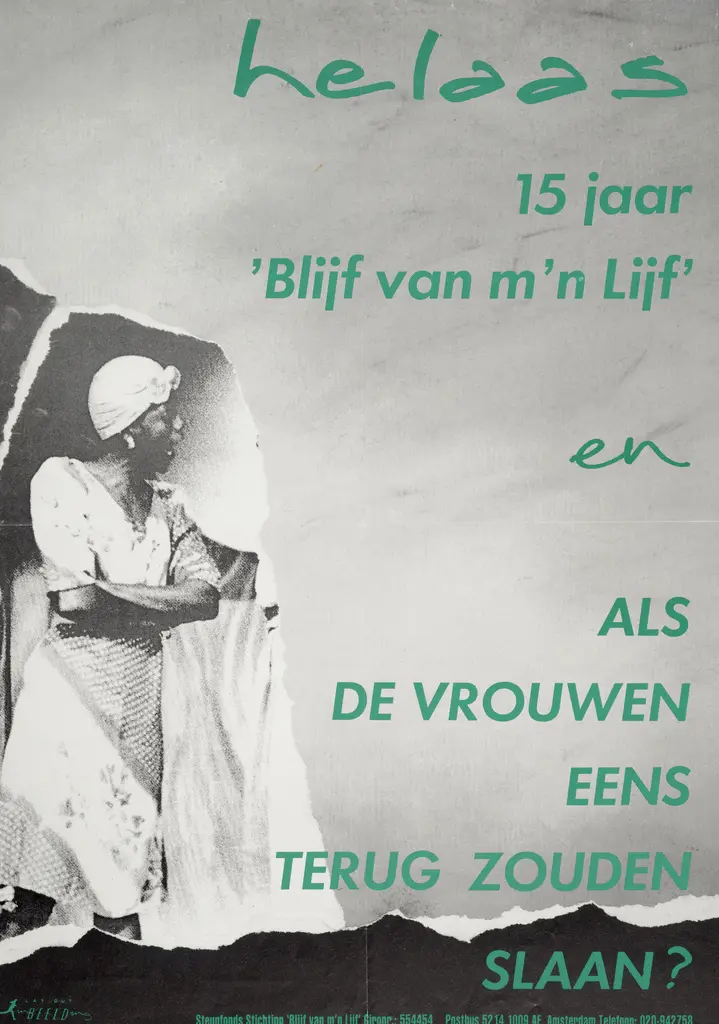
Hands Off Me: (unfortunately) now an integral part of our lives
Nowadays, the locations of most BVML houses are public knowledge, whereas in the past they were kept strictly secret. These houses are called Orange Houses: ‘(...) and why don’t we make a Blijfhuis (...) orange, because that’s obviously a lovely, eye-catching colour, with a white flagpole topped with purple balls. Why don’t we build a house like that and make a statement to society: we’ll all keep our hands off this. We’ll protect our women.’ said Cokky Roel, former director of the Alkmaar Blijfhuis, when, in 2014, she looked back on the transition from the secret ‘Blijf-van-mijn-lijf’ shelters to the public ‘Oranje Huizen’ from 2010 onwards, a change she had initiated.
Much has changed since the 1990s. The BVML shelters are professional institutions operating under the umbrella organisation Blijf Groep. They form part of a wider network of care institutions, the justice system and security services. Victims of domestic violence should receive all the help they need in as streamlined a manner as possible. On a practical level, little remains of the non-professional approach, but the feminist context from which the work is carried out is still very much alive. For violence against women within the home is, unfortunately, still a structural social problem.