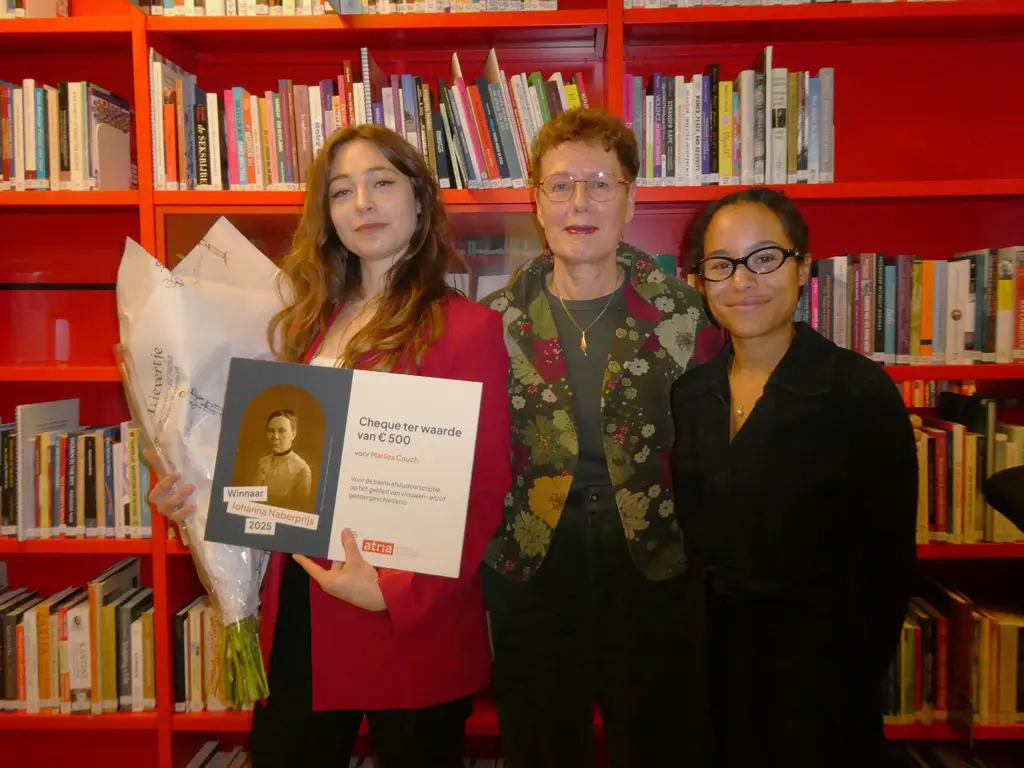
Marlies Couch wins the Johanna Naber Prize 2025, an award for the best thesis in the field of women's and/or gender history at Dutch and Flemish universities. Her thesis deals with the social and medical care of girls and women who had survived rape or other forms of sexual violence. Marlies Couch wins a sum of 500 euros and the opportunity to write an article for the journal Historica.
Marlies Couch wins the Johanna Naber Prize 2025, an award for the best thesis in the field of women's and/or gender history at Dutch and Flemish universities. Her thesis deals with the social and medical care of girls and women who had survived rape or other forms of sexual violence. Marlies Couch wins a sum of 500 euros and the opportunity to write an article for the journal Historica.
The Johanna Naber Prize is awarded annually on Gender History Day by VVG platform for women's and gender history and Atria, Institute on Gender Equality and Women's History.
Marlies Couch wrote her thesis entitled 'She procured a couple of Surgeries': unearthing social and medical care for survivors of sexual violence from the Old Bailey Proceedings, 1674-1800 as part of a one-year Master's degree in History at the University of Amsterdam. She used an online database of trial records from the Old Bailey criminal court in London, where suspects of crimes such as murder, arson and rape were tried, that had been in existence since 2003. The trial records provide detailed information about those involved and their daily lives.
What makes this study special is that Couch, drawing on 265 accounts, zooms in on the social and medical care of the girls and women who had survived rape or other forms of sexual violence in early modern London. This care for survivors is an almost unexplored topic. How did they communicate about their experience, or how was it discovered? What counted as evidence?
"In a subtle way, the author puts the agency of both survivors and the women and girls around them-mothers, sisters, neighbours, but also added midwives-who took care of them or arranged social and medical care and assistance."
The jury was very impressed by this work, using terms like mature, phenomenal, innovative, convincing and wrought.
"All in all, this thesis is an inspiring example of how gender history in cross-pollination with other historical subfields (history of crime, medical history) can lead to important new insights, insights that also touch on major questions in other fields of research."
Jury
This year, the jury for the Johanna Naber Prize (JNP) consisted of: jury president Francisca de Haan, Professor Emerita in Gender Studies and History at Central European University, fellow at the International Institute of Social History, and affiliate researcher at Atria; Nel de Mûelenaere, historian and professor at the Free University of Brussels; Lieke Speerstra, honourable mention JNP in 2024 and Noor de Smit, also an honourable mention JNP in 2024.